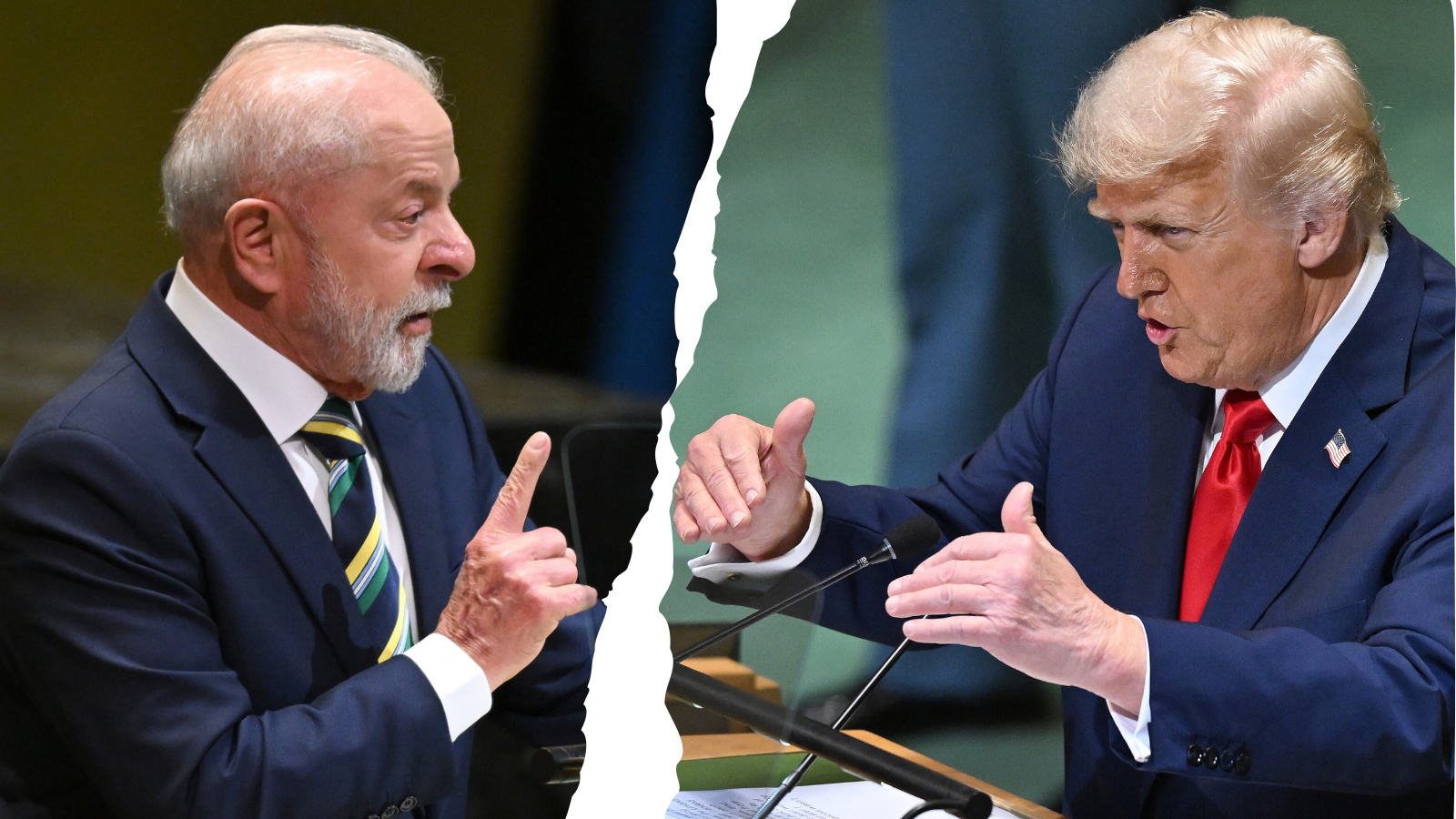

One president went before the UN on Tuesday and ranted against climate action, calling climate change “the greatest con job ever perpetrated on the world.”
Another president told world leaders his country is already facing historic climate-related floods, fires and drought.
The world “is weary of neglected carbon emission reduction targets and of financial aid to poor countries that never arrives,” Brazil’s Luiz Inácio Lula da Silva told the UN’s General Assembly. “Brazil is going to host COP30 in 2025, and is convinced that multilateralism is the only way to overcome the climate emergency.”
COP30, of course, is the next “conference of the parties” to the Paris climate accord, and will gather in November in the northern Brazilian city of Belém, a gateway to the Amazon basin. Brazil is using the arrival of more than 50,000 delegates, advocates, experts and investors to show off its climate achievements – and attract billions in climate investment.
Lula’s 25-minute speech offered a stark counterpoint to President Donald Trump’s nearly hour-long ramble, which pointedly sought to reverse the accelerating adoption of renewable energy in many countries around the world. Lula proudly told world leaders that his country generates 90% of its electricity from renewable sources, has reduced Amazon deforestation by 50% in the past year and is increasing the ambition of its climate goals to try to limit global warming to 1.5 degrees Celsius above historical levels.
“Brazil is emerging as a source of opportunities in a world that is being revolutionized by the energy transition,” Lula declared. “Our vision of sustainable development is based on the potential of the bioeconomy.”
To underscore the point, Lula on Tuesday announced a $1 billion investment in the Tropical Forests Forever Facility, envisioned as a permanent endowment to compensate governments for maintaining or restoring forested areas. If it mobilizes the targeted $125 billion from public and private investors, the Tropical Forests Forever Facility could generate $4 billion annually in such conservation payments, while providing investors with steady returns. Private investors including PIMCO, Bank of America and Barclays have signaled they would support the fund.
Lula’s commitment “primes the pump of this innovative new financial mechanism, which could ultimately represent Belém’s crowning achievement,” said The Nature Conservancy’s John Verdieck. “If anyone can achieve a breakthrough on COP, it is Brazil.”
Lula and Trump met and even embraced briefly after the speeches, and plan to meet next week. “At least for about 39 seconds, we had excellent chemistry,” Trump told reporters.
From negotiation to implementation
For asset managers looking to invest in Latin America’s largest economy, the Brazil Climate Summit during Climate Week NYC provided a one-day crash course on investing in Brazil and a rich pipeline of the country’s projects and investment opportunities. More than 700 investors, ecosystem builders and entrepreneurs surveyed Brazil’s vast climate landscape – and the hurdles that must be cleared to get public and private capital flowing.
“Two-thirds of the capital to finance Brazil’s transition will need to come from the private sector – and we can’t raise that only with Brazilian capital. Our interest rates are high, our culture is conservative. That’s why it’s critical to attract international investors.” said Marina Cançado of Converge, a São Paulo–based advisory firm, an organizer of the Brazil Climate Summit, now in its fourth year.
Attendees included representatives of CREO, a network of ultra high net worth families and foundations investing in climate solutions and of TPG Rise Climate, the $7.3 billion climate investing platform of global private equity giant TPG. Local investors included Patria Investments’ Beatriz Lutz, and Franciele Trentini of OCP Brasil, a producer of phosphate fertilizer.
Conversations ranged from standardizing and accelerating Brazil’s nature based solutions opportunities, to investing in overlooked sectors like green steel to attracting more global institutional capital to the region.
The Brazilian diplomat André Aranha Corrêa do Lago, who will preside over COP30, will have to manage delegations that increasingly prioritize economic growth, job creation and lowered energy costs over emissions reductions per se.
“We have to stop thinking that climate finance is only for projects that reduce emissions. Developing countries have to continue to grow, so you need investments that incorporate climate, not just those that are labeled climate projects,” Corrêa do Lago told ImpactAlpha at the Brazil Climate Summit.
“The scenario I would love to see would be the mainstreaming of climate in all investments,” he said. As part of COP30’s Action Agenda, Corrêa do Lago has launched a “Granary of solutions,” sourced from more than 300 initiatives implemented in the decade since the Paris climate accord was ratified in 2015.
Corrêa do Lago said the upcoming COP would mark a shift from negotiating climate pledges to a “COP of implementation.” At COP28 in Dubai and COP29 in Baku, Azerbaijan, international negotiators reached agreements to triple global renewable energy capacity and double energy efficiency by 2030, “transition away” from fossil fuels, and operationalize the long-awaited Loss and Damage Fund to support vulnerable nations.
“Now let’s implement, because we already have the mandate,” he said.
Project pipelines
There are early signs of progress. International Finance Corp. this spring issued the first biodiversity bond with Itaú Unibanco Holding, a R$1.4 billion ($266 million) deal to support reforestation and regenerative agriculture in Brazil’s forest-rich regions. IFC anchored the bond with a $200 million subscription; IDB Invest provided an additional $50 million.
“The instrument itself isn’t new — what’s innovative is how you use it,” the IFC’s Aurelien Boyers said. The bond “can push decarbonization, adaptation, and biodiversity while addressing social goals,” he said. “But they have to remain credible to avoid greenwashing.”
Marcelo Marangon of Citi’s Brazil division, flagged a “robust pipeline of transactions” across sustainable agriculture, reforestation and remediation, citing innovative tools like ESG derivatives tied to offtake contracts to finance new renewable plants. Citi Brasil has raised $5 billion in sustainable finance in 2024, including transactions across water and sanitation, sugar and ethanol, and renewable energy.
Just Climate, the climate-solutions arm of Generation Investment Management, has zeroed in on natural capital solutions in Latin America after acquiring São Paulo-based Good Karma Partners. Good Karma focuses on early-growth companies in climate, health and education.
The Chile and US-based venture platform Reciprocal, this week released its map of innovative climate and nature investment opportunities in Latin America and the Caribbean. In Brazil’s Cerrado, for example, entrepreneurs are pioneering biological inputs that replace synthetic fertilizers while sequestering carbon.
At the Brazil Climate Summit, Capital for Climate, a climate investment platform serving large institutional investors, presented several companies it considers ideal candidates for this curated pipeline.
The lineup featured Biomas, which is aiming to restore two million hectares of native vegetation. Luxor Agro is scaling regenerative production systems on degraded pastureland. And InPlanet is deploying enhanced rock weathering to permanently capture carbon in tropical soils.
Capital for Climate has convened more than a dozen investors and mapped Brazil’s nature-based solutions pipeline. Its Union for Nature network of project developers now represents more than 80% of Brazil’s market capacity. The result: “the deepest data on the nature based solutions investment pipeline in the country,” according to Capital for Climate’s Tony Lent. He said the platform has catalyzed over $500 million for nature-based solutions globally.
“When investors ask, ‘What’s the pipeline I’m going to invest in?’ we can now show them exactly what it looks like — by sector, by geography, and by capital need,” Lent said.
On the industrial side, agribusiness and steel executives described how Brazil can marry decarbonization with market competitiveness. Mosaic is working with Embrapa to expand soil-carbon projects and integrated crop-livestock-forestry systems, while Gerdau and Aço Verde do Brasil are piloting hydrogen-based and biomass-powered steel production to slash emissions.
“Brazil has the chance to lead not only on forests but on hard-to-abate sectors,” said Converge’s Cançado. “The conditions are here — renewable power, feedstock, technology. What we need now is the financing stack that allows these projects to scale before COP30.”