Brazil’s state-owned oil and gas company is leading a new initiative to mobilize capital for nature-based and bioeconomy projects in the country. The Petrobras Bioeconomy Fund, launched in February in cooperation with sustainable investment management firm Régia Capital, is directing 100 million reais ($18.5 million) in impact-linked financing to companies and projects protecting and regenerating natural ecosystems.
It is one of a number of impact partnerships gathering steam in Brazil ahead of this year’s COP30 climate summit in Belém.
COP29 in Azerbaijan largely failed on the climate capital mobilization front. Just $300 billion was pledged for low-income and highly climate-vulnerable countries, which had sought $1.3 trillion. COP30 in Belém aims to achieve the $1.3 trillion target, said Ana Toni, COP30’s CEO at the recent Converge Capital Conference in São Paulo. The organizers plan to submit a “concrete proposal” in Belém to finance tropical forest protection specifically, she said.
With all eyes now on Brazil for climate action, impact and climate finance players in the country are scrambling to match investors with nature-based project developers and entrepreneurs.
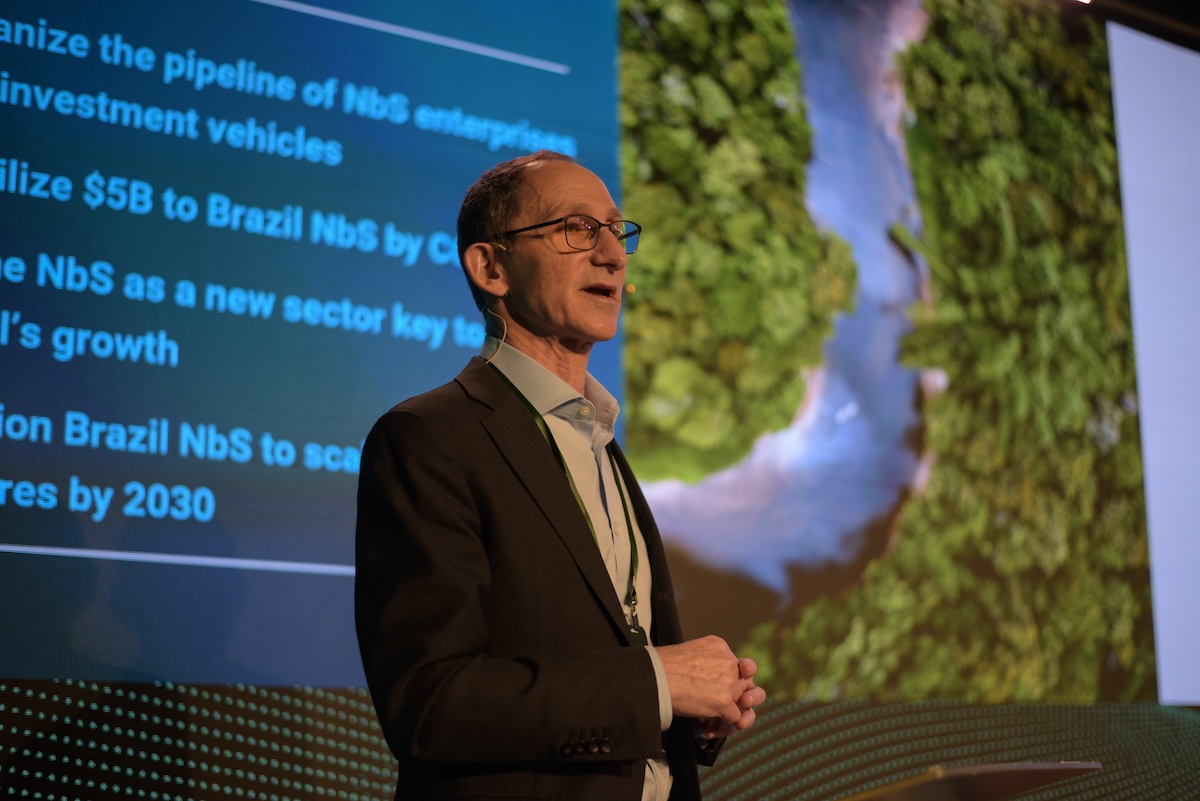
Sao Paulo-based advisory firm Converge Capital and Capital for Climate, a climate investment platform for large investors, are working to mobilize $5 billion for nature-based projects in Brazil by the time COP30 begins, the partners shared at the Converge.
Supporting the fundraising target were early survey results from Deloitte that identified nearly two dozen nature-based project developers in Brazil that are in the market for $5.5 billion. Half the need is for equity financing and just under 40% is for debt, with grants and concessional financing rounding out the rest.
On the supply side, about 16 investors surveyed have pledged $3.8 billion for nature-based solutions in the country between now and 2027. About 57% is earmarked for credit and debt, and 43% for equity.
Because nature-based financing is still a nascent part of the climate finance landscape, “it’s important to bring data and case studies with relevant information” to help bridge the gap, Capital for Climate’s Tony Lent said.
Blending finance for nature
The disconnect between the capital supply and demand isn’t a scarcity of investment opportunities, lack of pipeline maturity or industry sophistication, observed Blue Like an Orange’s Cristina Penteado at Converge Capital Conference.
“We’re talking about the pillar of capital mobilization, and for that, three areas need to be addressed: scale, liquidity and the risk-return equation,” she said.
To spur banks to do more nature-based project lending, the Brazilian government’s Eco Invest program offers banks low-cost financing from the National Fund for Climate Change via auctions. Financial institutions bid at the auction with commitments to leverage capital they “win” to raise funding from domestic and international private investors.
The first auction, held last year, put up nearly seven billion reais in public funding; the government expects project developers to leverage nearly six-times the capital in private investment. The second auction, announced in April, is aiming to match one billion reais from the public climate fund with private commitments to projects restoring degraded land in five of the country’s ecological zones.
Sao Paulo-based fund manager KPTL is in the market with a blended-finance fund to encourage private investors to back restoration projects. The Amazonia Regenerate Accelerator and Investment Fund is looking to raise $30 million for bioeconomy projects in Brazil, Ecuador, Bolivia, Peru, Colombia, Guyana and Suriname. It has a debt and an equity tranche, to suit different investor risk profiles. The blended finance structure lowers the risk for bioeconomy projects in the Amazon, “where the project pipeline is less mature,” explained KPTL’s Danilo Zelinski.
KPTL has so far raised $9 million, with anchor funding from the Inter-American Development Bank’s IDB Invest program, the Green Climate Fund, and family offices.
Estímulo, a Brazilian impact fund manager, is coming to market with a blended-finance debt fund that aims to raise 60 million reais for small businesses in the Amazon. Fundo Amazônia, coming to market next month, as an FIDC, for “Fundo de Investimento em Direitos Creditórios,” a Brazilian financial instrument for debt securitization. It will have a 30 million reais senior tranche and a matching subordinated tranche.
Mobilizing ‘poly-capital’
Capital mobilization is just one part of the puzzle in ramping up Brazil’s nature-based solutions.
“We’ve perceived the need for innovations to mobilize “poly-capital” – not just financial capital, but also occupational and intellectual capital – to address the challenges surrounding impact investments,” said Marina Cançado of Converge Capital.
Converge helps accelerate climate and nature investments with support from banks, asset managers, family offices and startups.
Régia, a partnership between asset manager JGP and state-owned Banco do Brasil’s BB Cap, is leveraging a strategic pipeline advantage from Banco do Brasil, the country’s largest agribusiness financier, to source deals in everything from the bioeconomy to the energy transition. The firm has eight billion reais ($1.5 billion) in assets under management and aims to reach 20 billion by year end.
Startup Mútua is assisting investors in their impact investment decision-making processes with an AI-based software solution. The prototype for its platform was developed with a map of 2,000 projects in Brazil’s food sector and tested with 45 family offices, venture capital funds, philanthropies and other impact investors. An open version is slated for release in September.
Such tools, explained Mútua’s Lucas Matarazzo, are addressing a growing interest from impact investors in “systemic investment, which requires a deep understanding of problems.”