
Last Sunday’s Emmy Awards, honoring the best in TV programming and streaming over the past year, featured several of our favorite ‘Pop Impact’ productions. Among the contenders were Severance (27 nominations, 6 wins), Black Mirror (10 nominations) and Paradise (4 nominations).
The Emmys don’t have any awards for impact or sustainability, so we had to step in and create our own. As host Nate Bargatze said in his opening monologue, TV makes us laugh, cry, and learn. We would add, TV shows can also help shift opinions and catalyze action.
Here are the winners of ImpactAlpha’s first-ever “Sustainability Emmys.”
Most Impactful Clip – Ocean
It’s a telling sign when a clip goes viral before the full feature film is even available for streaming. David Attenborough’s Ocean was a masterpiece of documentary storytelling, but the clip that most people will remember is the never-before-seen footage of bottom-trawling – essentially dragging a net with a metal chain across the bottom of the ocean and destroying everything in its path, often in search of just a single marine species. It’s hard to imagine anyone, even people who love to eat fish, feeling comfortable with the amount of “byproduct,” or unintended catch, that comes with this approach to commercial fishing. As Attenborough says in the film, “The idea of bulldozing a rainforest causes outrage, yet we do the same underwater every day. Surely you would argue it must be illegal.”
“We hope the images of the devastation and waste become a wake up call that bottom trawling must stop in marine protected areas,” said National Geographic’s Enric Sala, who served as executive director of the film as well as one of the scientific advisors.
That wake up call has certainly been delivered, with many people around the world now demanding that governments take action to ban bottom-trawling. The EU already has a goal to ban the practice in all marine protected areas (MPAs) by 2030, while similar discussions are underway in the UK and other countries. Time will tell if future documentaries about our oceans tell a tale of destruction or recovery.
Most Haunting Clip – Paradise
What environmental disaster can be so sudden and apocalyptic that humanity has to flee to a hastily constructed underground bunker? Fans of Paradise, a dystopian thriller streaming on Hulu, finally got their answer in Episode 7, dramatically titled “The Day.” I’m not trying to be hyperbolic when I say this was one of the most intense episodes of TV I’ve ever watched, right up there with the infamous “Red Wedding” (Game of Thrones) and the two-part finale to The Pitt. It was like an entire season of 24 wrapped into a single episode.
“The Day” is one continuous drip feed of shock and adrenaline as viewers are treated to a first-hand glimpse of what happens when the s**t hits the proverbial fan. The clip that hit home the hardest for me was seeing senior members of the US administration break down into hysterics once they realized they weren’t selected for one of the few bunker slots.
While fictional stories – and some real ones – occasionally give us the brave hero willing to “go down with the ship” or “do what needs to be done,” in reality most people will revert to their most base instincts when their survival is threatened. Paradise makes for great TV, but it’s also sure to inspire more than a few climate-themed nightmares.
Most Heartwarming Moment – Toxic Town
This is one of the toughest categories to judge because the reality is that most entertainment media doesn’t offer a positive spin on sustainability. Instead, it’s usually depicted as something that’s in the way of economic growth or impossible to achieve, or both. That was certainly the case in Toxic Town, a Netflix drama based on a true story of industrial pollution, government corruption and congenital health defects in Corby, a mid-sized town in the UK.
But every once in a while, the good guys – or in this case, the good moms – get a win. I encourage anyone interested in the full story to watch the four-part miniseries, which includes memorable performances by Aimee Lou Wood and Jodie Whitaker. But the scene that sticks with me the most (spoiler warning!) is when the characters played by Wood and Whitaker organize a meeting for all the women in their town to see who else has children with health defects and might be interested in a class-action lawsuit. Not knowing what to expect, they are visibly floored when the room quickly fills up with women determined to get an answer about what was happening to their children.
It’s a reminder that even in the face of powerful forces, community and collaboration can still make a difference.
Most Hilarious Moment – The White Lotus
Shout-out here to the Ratliff family and especially Timothy Ratliff – played by actor Jason Isaacs, perhaps best known for his portrayal of Lucius Malfoy in the Harry Potter films – for showing what it’s like for a rich person to lose everything. And of course a shout-out to creator Mike White, who has turned each season of The White Lotus into a wildly imaginative and enjoyable perspective on the many excesses, foibles and contradictions of the ultra-wealthy.
One recurring theme is that what seems to matter most to the rich is not actually reaching the top of the income pyramid, but rather the status that comes with it. So when Ratliff’s income is threatened and he faces the horror of not just prison but (gasp!) a middle class lifestyle for his family, he will do anything to spare them the humiliation. Well, almost anything. The White Lotus teaches us that if an increasingly unhinged father figure hands you a smoothie, think twice before drinking it.
Best Critique of Capitalism – Common Side Effects
There are so many great contenders for this award, from Severance (the struggle of workers against an overbearing employer) and Silo (ditto), to Andor (the struggle of the poor and disenfranchised against an authoritarian empire) and Black Mirror (the perverse ways in which technology can reshape our lives).
I was also tempted to give this award to Mountainhead, which creator Jesse Armstrong wrote to explore what made tech moguls want to “cut everything else away and rebuild.” But the tech bros satirized in Mountainhead aren’t so much interested in capitalism as they are their own version of a techno-utopia, which is less about maximizing profits and more about creating a space free of government interference or really any interference of any kind.
But in the end there can only be one winner, and there was only one true mic drop moment that made me want to stand up and cheer for the underdog. That moment came from the animated show Common Side Effects, which featured one of the best dialogues that shows how a capitalist mindset can distort what’s actually best for public health. A chef’s kiss to the writers behind Jonas Blackstein, a titan of industry who says the quiet part out loud in a chilling monologue about why health is antithetical to the healthcare industry’s business model.
“Cure everybody, and you’re out of business. Why would anyone work?… Economies will collapse.”
Best Greenwashing Callout – Nine Perfect Strangers
There aren’t many great candidates for this award, perhaps because sustainability is rarely treated as core to the plot. The one exception that comes to mind is Cleaner, an HBO Max film that features a cringeworthy corporate video espousing an energy company’s commitment to renewable energy – despite the fact that the company has a long track record of environmental exploitation and pollution. But the rest of the film let me down for its sensationalism of some environmental activists as antihumanists, a fringe social theory that makes Extinction Rebellion look tame by comparison.
So I’m going to go a bit outside the box by giving this award to Nine Perfect Strangers, a Hulu show that explores the mental health crisis through the lens of psychedelic therapy. Over the course of 15 very satisfying minutes during the finale of season 2, one of the guests (or patients?) gets reamed out for his cynical efforts at reputation-washing a company that makes money through the sale and use of militarized drones. While it was hard to tell whether his apologies were genuine, what was clear is that he found it easy to justify his actions even after being exposed. This is a useful parallel for how greenwashing works in the real world in that most organizations know what they’re doing – “look at this shiny thing!” – and just don’t care.
Perhaps more business and political leaders would care about people and the environment if they took psychedelics. As long as the doses are administered by a qualified professional!
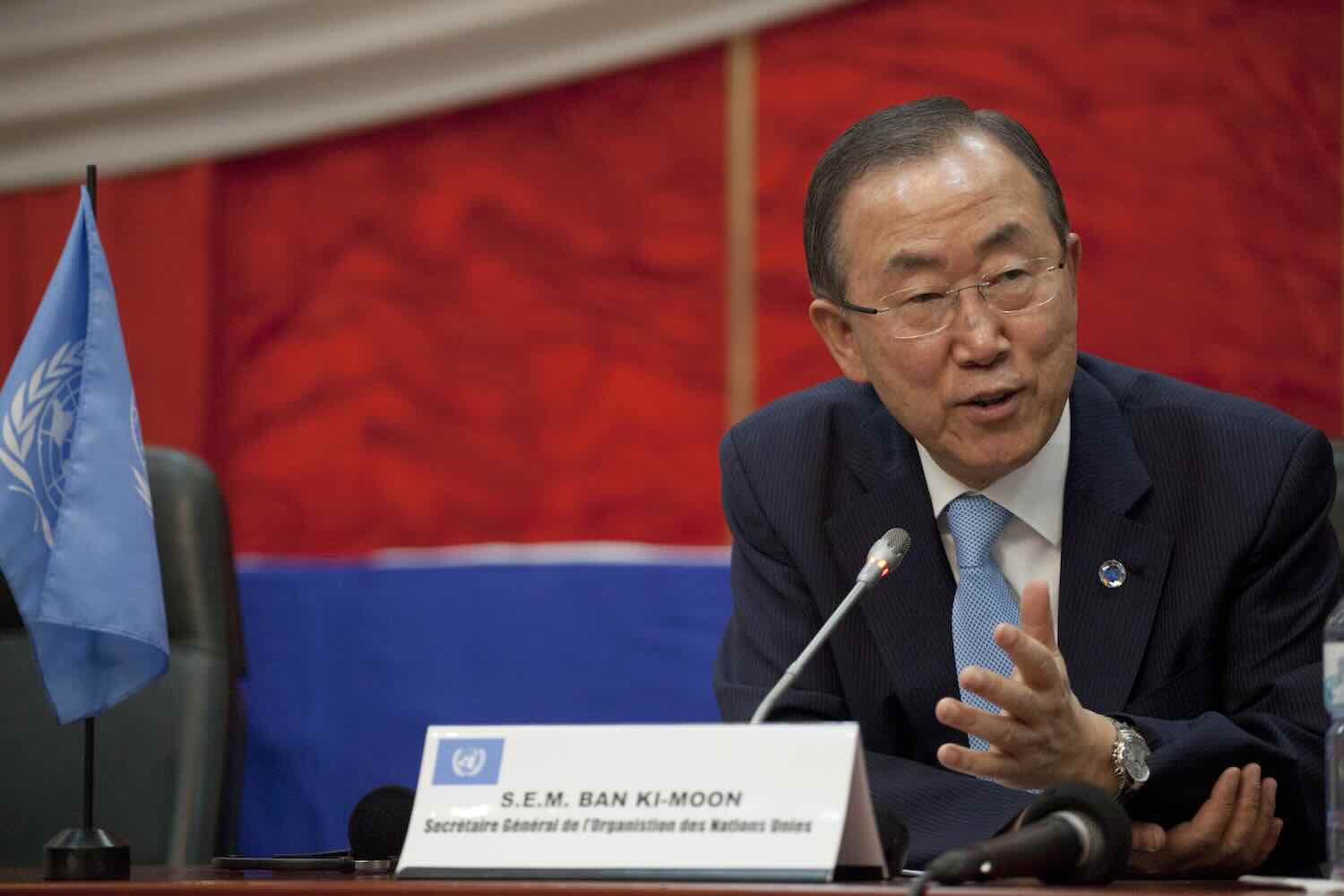
Biggest Climate Hero – Ban Ki-Moon (The Quiet Diplomat)
There is perhaps no job more thankless than Secretary General of the United Nations: More than 250 member countries with vastly different political agendas. A Security Council with 15 members, including 5 permanent members who have turned veto power into an art form. Constant media and public scrutiny for issues happening around the world.
Despite the impossible task set before him, Ban-Ki Moon oversaw some of the most important developments in the history of multilateralism during his tenure as Secretary General between 2007 and 2016. He created UN Women, the first UN agency dedicated to women’s rights. He championed LGBTQ rights at a time when the subject was still taboo for many countries. He advocated for peace in conflict zones across the Middle East and Africa. He spearheaded the launch of the 17 SDGs. But the accomplishment he’ll likely go down in the history books for is his shepherding of the 2015 Paris Agreement. Ban personally lobbied US President George W. Bush to do more to curb greenhouse gas emissions, and played an active role in convincing some of the biggest polluters to ratify the agreement.
The Quiet Diplomat (streaming on Apple TV) captures both the highlights and lowlights of Ban’s career, one that looks all the more impressive given the recent deterioration in multilateral institutions. Ban shows that actions do indeed speak louder than words, and is a powerful reminder of how much we can accomplish by overcoming our divisions to work together on shared challenges.
Biggest Climate Zero – Tommy Norris (Landman)
Industry has a strong case here for its sensationalist references to ESG, sustainable investing and clean energy that seem more intended as clickbait than actual plot devices. But the show spends more time pointing out the hypocrisy of people trying to address climate change than it does casting doubt on climate change in the first place.
So instead I’m giving the award to Landman, an otherwise excellent show that managed to piss off lots of people in the sustainability movement for its unprovoked attacks on renewable energy and its misleading glorification of the fossil fuel industry. Sammy Roth of the LA Times has done an excellent job of pointing out the many flaws in the narrative, so I won’t repeat them here. But I reserve most of my scorn for Landman creator Taylor Sheridan.
It’s one thing for climate denialists or fossil fuel lobbyists to parrot these kinds of talking points, but I expected better from a writer who has a decent track record of capturing the nuance inherent in many debates about sustainability (see: Yellowstone, Lioness). Just look at this nonsensical word salad that Sheridan fed to Tommy Norris (played by Billy Bob Thornton):
“We’re gonna run out of [fossil fuels] before we find its replacement… the thing that’s gonna kill us all is running out before we find an alternative. And believe me, if Exxon thought them fսck¡ng things right there were the future, they’d be putting them all over the goddamn place. Getting oil out of the ground’s the most dangerous job in the world. We don’t do it ’cause we like it. We do it ’cause we run out of options.”