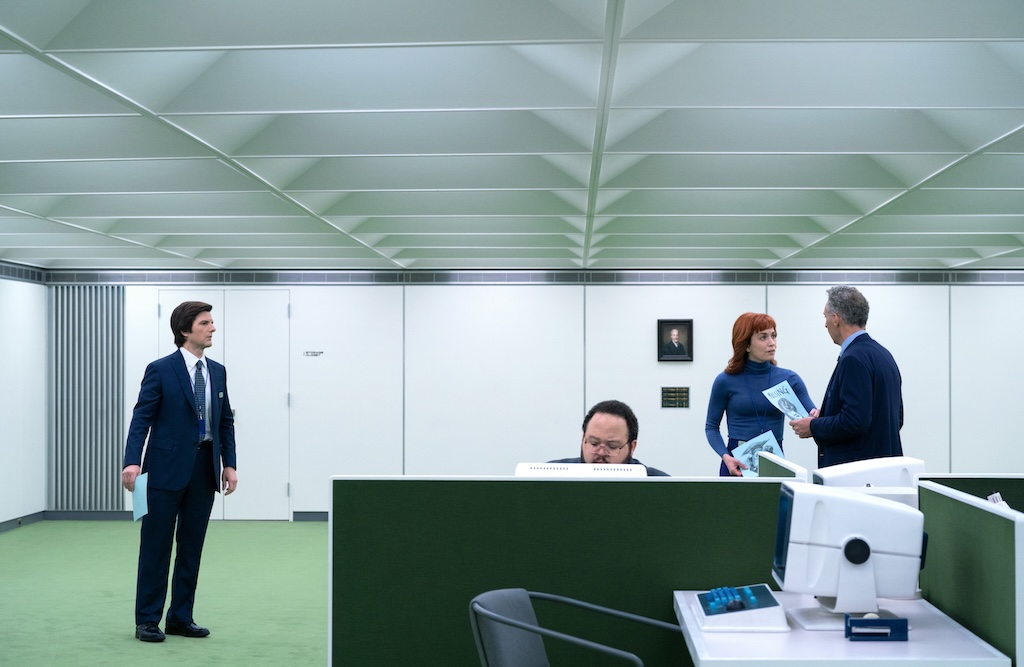

Score: 11 (Accuracy – 3.5; Entertainment – 4; Impact – 3.5)
Stream seasons 1-2 on Apple TV (trailer)
Spoiler level: Medium
Severance is many things, perhaps so many things that it resists categorization into any genre and doesn’t resemble any show in recent memory. It feels like a dystopian combination of Office Space and The Truman Show, except more dark and absurdist in every possible way. The closest parallel is probably Black Mirror, although Severance will make you laugh more than it makes you squirm.
I would describe it as an allegory on work-life balance – the difficulty of finding a comfortable equilibrium and the extreme steps people are willing to take to achieve some semblance of balance.
The future of work and the commodification of labor
For the four employees of Lumon’s Macrodata Refinement (MDR) department, that extreme step (spoiler warning!) involved voluntarily agreeing to have a chip surgically implanted into their brains to shield their work selves from their life outside of the office, and vice versa. Each character has both an “innie” (their life inside the office) and an “outie” (their life outside the office), and never the twain shall meet. Their innies are completely unburdened by external pressures, and their outies have no knowledge of what they do all day.
Here is the pledge everyone must make prior to undergoing the severance procedure:
“I have, of my own free accord, elected to undergo the procedure colloquially known as severance. I give consent for my perceptual chronologies to be surgically split, separating my memories between my work life and my personal life. I acknowledge that, henceforth, my access to my memories will be spatially dictated. I will be unable to access outside recollections whilst on Lumon’s severed basement floor, nor retain work memories upon my ascent. I am aware that this alteration is comprehensive and irreversible. I make these statements freely.”
Credit creator Dan Erickson for this provocative vision of a world in which people can “disassociate from certain realities of their life,” something that Erickson himself admits is “something I wish I could do.” But it’s the implications of this decision that makes Severance a scathing critique of capitalism, “a show that looks at the way that this capitalist system discourages the fullness of humanity and how it encourages people to diminish themselves a little bit and the dangers of that.”
What fascinates me about Severance from a sustainability perspective is what it says about the future of work and the commodification of labor. If DOGE was a corporation instead of a rogue pseudo-government agency, I’m sure they wouldn’t hesitate to put microchips in a few employees in the name of productivity. Let’s not forget that Musk already has a company that does neural implants!
The big philosophical question in a future in which severance is possible – it’s not, at least not with current technology – is whether workers would have free will to decide how they want to offer their labor, or whether they will feel forced by economic or social pressures. How many people would “sever” themselves for $1 million? $10 million?
Outies vs innies
The main protagonists begin to offer their own theories for why their “outies” would sentence their “innes” to such a fate.
For Zach Cherry (played by Dylan George), the rationale is simple: “sh¡t must have gotten pretty bad. Famine, plagues, et cetera. So what is a desperate humanity to do?”
Helly (played by Britt Lower) wonders: “Am I livestock? Did you grow me as a food and that’s why I have no memories?”
The audience is left guessing as to the answers of these questions, which is part of what makes Severance such a captivating watch. But the hints offered by the Lumon overseers don’t exactly inspire confidence.
For instance, here is how Harmony Cobel (played by Particia Arquette) explains the importance of MDR’s work: “The good news is hell is just the product of a morbid human imagination. The bad news is whatever humans can imagine, they can usually create.” Then a few episodes later she says “the surest way to tame a prisoner is to let him believe he’s free.”
Not exactly what they teach you in corporate leadership training, although honestly not that different from Jack Welch’s leadership style or that of many of today’s CEOs who value the bottom-line more than worker well-being. Consider the growing evidence that workers are feeling more dissatisfied than ever.
- Only about half of U.S. workers say they are satisfied with their job, with younger generations the most unsatisfied (Pew Research Center, 2024)
- A majority of Americans think companies should prioritize paying workers a fair, living wage as well as providing benefits and work-life balance (JUST Capital, 2023)
- Globally, 87% of people said they did not feel engaged with their work, and 8% said they were suffering; 52% of employees say they are watching for or actively seeking a new job (Gallup, 2023)
There is a litany of similar stats and studies, which collectively suggest that “quiet quitting” isn’t just a short-term phenomenon, but rather a signal of the fundamental reshaping of the modern workforce. Employees are increasingly disengaged at work – not because they’re lazy or easily distracted – but because there are fewer and fewer tangible benefits of going above and beyond. Why put in the extra effort if there’s no commercial or moral incentive?
The natural end point of this philosophical dilemma is a world similar to the one portrayed in Severance.
In their 1848 treatise, The Communist Manifesto, Karl Marx and Friedrich Engels wrote that: “Owing to the extensive use of machinery, and to division of labour, the work of the proletarians has lost all individual character, and, consequently, all charm for the workman. He becomes an appendage of the machine, and it is only the most simple, most monotonous, and most easily acquired knack that is required of him.”
This process of standardization is what Marx called the commodification of labor, in which “the special skill of the worker becomes worthless” and “the object which labour produces–labour’s product–confronts it as something alien.”
Chris Hayes makes a similar point in his new book, The Sirens’ Call, in which he writes about the modern attention economy and how the aggressive pursuit of “clicks” and “eyeballs” has “reordered our politics and the very fabric of our society.” Instead of taking pride in our work, many of us are “reduced to a wage or an eyeball,” which “is to find oneself alienated from some part of oneself.”
There’s even a new-age Marx archetype in Severance named Dr. Ricken Hale (played by Michael Chernus) who writes a self-help book called The You You Are, which, incredibly, you can actually read online. In one of his many Ricken-isms, he writes that “Your job needs you, not the other way around.”
But the MDR workers in Severance don’t seem to see it that way – in fact, they don’t have any idea what the purpose of their job is or what Lumon does. And maybe that’s the point? After all, it’s not hard to imagine people of the future being given mindless tasks just to keep them busy, even if that job could be easily automated out of existence. If it turned out the culmination of my life’s work was to make a generative AI a little bit smarter, I’m not sure I would want to know.