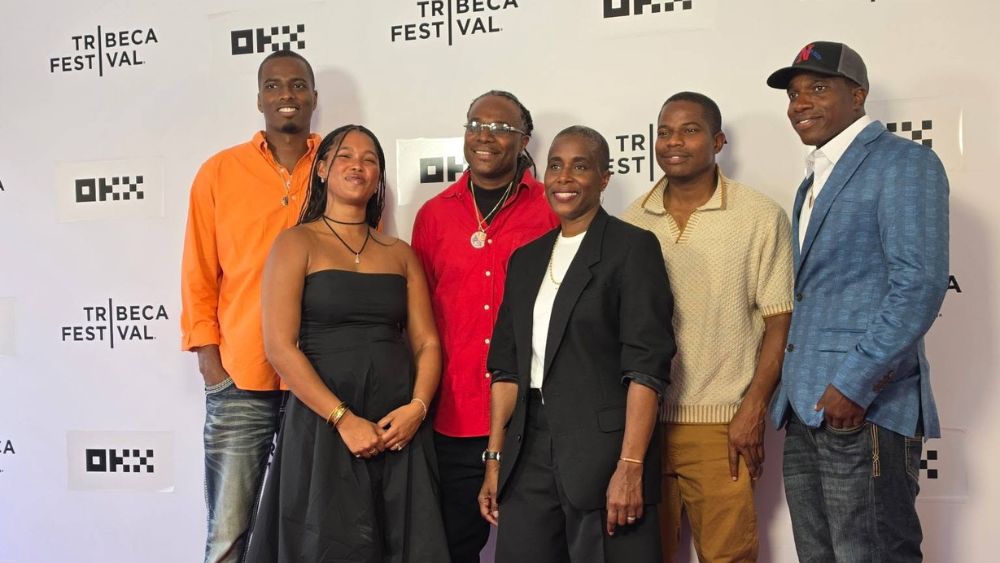
Directed by Zoey Martinson
Entertainment: 5, Impact: 4
WHFF Jury Award winner for Feature Narrative – Comedy
Change can be scary. From rapid technological advances to shifting cultural trends, it’s easy for many communities to feel left behind.
This is especially true of the millions of small fishing communities around the world that are increasingly forced to contend with powerful commercial fishing operations, volatile weather patterns and confusing rules and regulations. It’s enough to make anybody snap and pine for the simpler days of the past.
Or if you’re Atta Oko Sackey, a proud Ghanaian fisherman who is pushed into early retirement, then you find guidance where you can – like a sarcastic talking fish who promises to reveal a “secret message” that will solve all of Atta’s problems.
That’s the concept behind The Fisherman, a scathingly funny film that explores how fishing communities are being forced to adapt to the modern world through the lens of one cranky old fisherman (Atta, played by Ricky Adelayitar) and his Gen Z associates (including Endurance Dedzo, Ghana’s most-popular dancer).
There is much to admire about The Fisherman, from the stunning shots of the Ghanaian coast to the bawdy humor that brings a much-needed reprieve to tense situations. Atta provides the pulse for the film, but it is his fish companion and young partners that tie the story together.
There are of course plenty of sustainability references littered throughout The Fisherman, but they are subtle rather than overbearing, like a dash of lemon on a well-prepared plate of fish. (Just don’t eat Koobi, the talking fish!)
The most obvious is repeated references to commercial fishermen, many of whom are illegally sailing into protected waters and depleting local fisheries, leaving little but scraps for the fishing communities who rely on a stable supply of marine life. This is a major problem across many parts of the world, especially in Ghana where an estimated 2.2 million people – including 100,000 fishermen – depend on the sustainability of these fisheries and the sectors they support.
One study published in Nature showed that roughly 75% of industrial fishing is currently undisclosed, meaning it’s near-impossible to monitor their activity to see if they are straying from international waters or exceeding their catch limits. Unfortunately, most governments are powerless to do anything about the illegal fishing crisis, even when it leads to food insecurity and job loss for local populations.
But the main characters in The Fisherman don’t spend their days cursing at their all-powerful rivals – they take it in stride and continue to put their best foot forward.
A similar scenario plays out when Atta and his team go to a bank in Accra, the Ghanaian capital, to apply for a loan so they could buy their own boat. Modern challenges rear up again when the friendly banker tells Atta he needs a birth certificate and valid ID to apply for the loan, and that the bank would only be able to offer a three-year loan due to his age. Such record-keeping was unheard of where Atta grew up, and getting the necessary documents would take more time than they have to spare. So the protagonists look for other ways to raise the cash through Accra’s robust shadow economy.
This outcome will be familiar to anyone who’s studied or worked with underbanked populations. Indeed, access to financial services is one of the most popular investment themes among impact investors. According to the GIIN’s 2024 “State of the Market” report, more than half of investors surveyed had allocations to the financial services (including microfinance) sector, making it the third biggest recipient of impact AUM behind only energy and housing. These investors understand that being able to open a bank account or apply for a loan can be a lifeline for the millions of people across emerging market countries that grew up outside of the financial system. An estimated 1.4 billion people worldwide are currently underbanked, according to the World Bank, and as many as 400 million micro-enterprises in emerging markets are informal.
These small businesses, like Atta’s aspiring boat crew, are the lifeblood of many economies and are essential for preserving the kinds of short-on-luck communities that bankers will never visit. After all, not everyone can rely on a talking fish to save them.
It’s a credit to The Fisherman and the vision of director Zoey Martinson that these complex themes of inequality and unfairness are showcased through humor and visual storytelling. Facts and figures will always have their place in addressing sustainability challenges, but the readers of a new scientific study are unlikely to feel the same surge of empathy and compassion that they get from watching fictional but lovable characters confront the realities of living in a changing world.
You can take the fisherman away from the sea, but you can’t take the sea away from the fisherman. In other words, external circumstances may change, but people will still be drawn to what they know. They deserve a chance at a livelihood like anyone else.