
Last night’s Academy Awards took place just weeks after the most destructive wildfires in US history. The Dolby Theatre, the venue for the 97th awards ceremony, is less than 20 miles from the devastated Pacific Palisades. Many people who work in the film and entertainment industry lost their homes, giving them a first-hand perspective on climate chaos and social upheaval.
The hope is that these and other personal experiences of living in an unsustainable world can lead to stories, which are proven at eliciting more powerful reactions than facts and statistics alone.
“Stories are compasses and architecture, we navigate by them, we build our sanctuaries and our prisons out of them, and to be without a story is to be lost in the vastness of a world that spreads in all directions like arctic tundra or sea ice,” as Rebecca Solnit, one of today’s most skilled climate storytellers, puts it.
Fortunately, there are signs that the film industry is ready to take on sustainability as a key narrative and storytelling device.
Several of this year’s Oscar winners and nominees have sustainability themes embedded into the plot, from stories about the tribulations of animals trying to survive environmental catastrophes (The Wild Robot and Flow), to the controversial politics of resource extraction and exploitation (Dune: Part Two), to characters confronting the damaging effects of discrimination and inequality (Nickel Boys and Wicked).
There is no shortage of sustainability themes on the small screen either, with popular TV shows like Billions, Loot and Paradise all offering different perspectives on the types of issues that investors, philanthropists and government officials must contend with in a fast-changing world.
Audiences are clearly hungry for more of this type of content. For example, a 2023 study by the Yale Program on Climate Change Communication found that 48% of Americans want to see more climate-related content in TV and film. Additional research by Rare showed that 70% of audiences want to see more climate-friendly actions on screen.
Rating system
To bring more attention and scrutiny to these storytelling efforts, I’m launching, in partnership with ImpactAlpha, a kind of Rotten Tomatoes for the impact investing crowd. I’ll be reviewing sustainability-themed films and TV shows, along with Q&A’s with storytellers and commentary on developments across popular entertainment.
The key questions for the impact investing industry are whether these representations of sustainability are accurate, entertaining and, perhaps most importantly, impactful? The entertainment industry can play an important role in introducing mainstream audiences to concepts that may seem complicated, overwhelming or politically charged.
The last thing we need is more disinformation about the costs of the energy transition (Landman) or sensationalized hot takes about ESG (Industry).
To help separate the gems from the groaners, I’ll be rating films and TV shows on a scale of 0-15, with a maximum of five points in each of three categories:
- Accuracy – Are the depictions of sustainability generally accurate? Is it a fair illustration of how people in sustainability think and interact?
- Entertainment – Is the film or show genuinely entertaining? Are people going to enjoy watching it? Are they going to tell their friends to watch it?
- Impact – How will this film or TV show inspire people to change their behavior? Will there be a long-lasting impact after they’ve finished watching?
Flow (2024)
Score: 8 (Accuracy – 1; Entertainment – 4; Impact – 3)
Spoiler level: Low
Streaming on Max (trailer)
If ever there was proof that you don’t need facts and figures to tell a powerful story about climate change, it’s the Latvian animated film (and Oscar winner!) Flow.
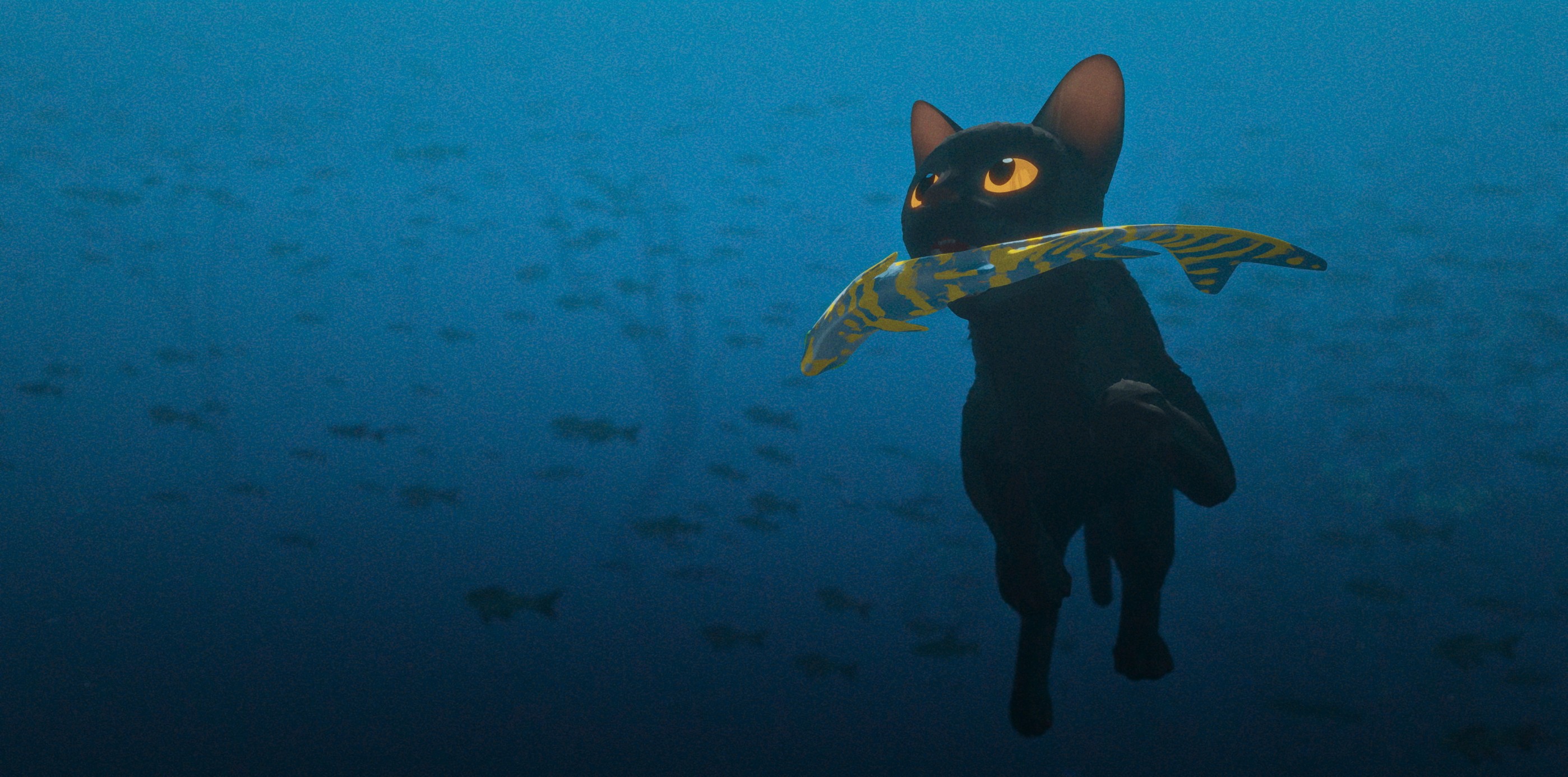
Without a single word of dialogue – at least human dialogue – Flow is able to convey the terror and drama of being caught in a climate disaster. The film follows a cat whose home is devastated by a great flood, forcing the feline to find refuge on a boat alongside other animals who must overcome their differences to survive.
If you’ve ever wondered if cats, dogs, capybaras, lemurs and secretary birds can coexist in a confined space, then this is the movie for you.
There are parallels between Flow and The Wild Robot. Both films feature animals as the primary protagonists, with humans relegated to a largely passive role. In the case of Flow, the only hint of a human presence is a scattering of manmade structures and objects – buildings, boats, carvings, etc. – that the natural environment has long since overtaken.
While Flow isn’t overt in its presentation of climate change and environmental crises – and the director has been vague on the true source of the flood or what happened to the humans – it’s hard to watch the film without thinking about what many parts of the world will look like in a few decades. In just the past couple of years, we’ve seen record flooding in the U.S. (North Carolina, Kentucky), Spain, Brazil, China and many parts of Africa. Water-related disasters in 2024 killed an estimated 8,700 people and displaced more than 40 million. These numbers will only get worse as climate change wreaks havoc on water cycles, with increasingly severe storms and droughts.
There isn’t nearly as much data or research on the effects of flooding on wild animals, most of which don’t have the ability to get to higher ground or access to any kind of early warning system. (Birds are a notable exception, which may help explain why they and their ancestors, like dinosaurs, have had one of the most successful track records of any animal on Earth.)
Flow is therefore a powerful reminder that human activity has spillover effects for the natural environment. Even if humans are able to adapt to the dangers of climate change, many animals will become endangered or go extinct. Some biologists predict that 35% of animals and plants could go extinct by 2050 as a result of climate change and changes to land use. Already, we’ve seen massive reductions in freshwater species (83%), terrestrial species (38%) and marine species (36%). This tragic loss of life has led to more experts referring to the modern era as the “sixth mass extinction” (also sometimes called the Holocene extinction or the Anthropocene extinction).
The cat at the center of Flow obviously isn’t aware of any of this – the cat is just trying to survive in a world that seems determined to kill it. And much like the animals in The Wild Robot, the cat quickly realizes that survival requires collaboration and cooperation with other creatures it would normally consider as threats. It’s a touching sentiment and one that we could all use more reminders of.
Even if Flow isn’t the most realistic depiction of a natural disaster – there’s no way animals would actually be able to steer a boat – I still think the underlying themes of resilience and perseverance are important ones to hold close as humans (and animals) learn to contend with more great floods in the coming years.
As director Gints Zilbbalodis said in his acceptance speech, “We’re all in the same boat. We must overcome our differences and learn to work together.”
The Wild Robot (2024)
Score: 12 (Accuracy – 3; Entertainment – 4.5; Impact – 4.5)
Spoiler level: Low
Streaming on Peacock (trailer)
This movie is an emotional rollercoaster, in the best possible way. Everyone I know that’s seen this movie has ended up shedding more than a few tears, myself included. (The film was nominated for Best Animated Feature Film, and also received nods for its sound and score.)
On the surface, this film about a shipwrecked intelligent robot presents as a family-friendly journey into the animal kingdom that shows the true meaning of community and teamwork – less Lion King and more A Bug’s Life.
Beneath the surface, there are a variety of sustainability themes that tug at your heartstrings:
- The image of the Golden Gate Bridge underwater
- The apocalyptic fire that tears through the forest
- The bitter cold that endangers all living creatures
- The precarious links in the food chain
These are all tropes we’ve seen before on the news or in sci-fi novels. What I think sets The Wild Robot apart is how it shows the power of community and collaboration in addressing these challenges. Just because it’s a robot and a bunch of wild animals doesn’t make it any less inspirational or heart-warming.
The scene that broke me was when the animals – normally stuck in a predator vs. prey mentality – were forced to huddle together for warmth to survive a brutal winter storm. Foes became friends. Whether a creature was at the top of the food chain or the bottom, they relied on each other in a symbiotic way. Consider this dialogue between Fink, a fox voiced by Pedro Pascal, and Roz, a robot voiced by Lupita Nyong’o.
Fink: Most of you hate me, and I hate most of you. Everyone in here hates someone else. But here we are. And here’s the deal. First one that walks out that door is dead, and if we can’t keep it together in here, everyone’s dead. We all got one chance to see next spring.
Roz: I know you all have instincts that keep you alive. But sometimes, to survive, we must become more than we were programmed to be.
This is how nature functions in the real world. Every living thing learns to live in harmony with its environment – except, of course, humans (Agent Smith knew what he was talking about!). Perhaps this is why the humans in The Wild Robot needed to build sophisticated robots to do basic tasks.
The real question for viewers is why so many humans struggle to feel the same kind of empathy for other humans, let alone other creatures and the natural world? Why is it easier to imagine empathic animals, or even robots, than it is humans who actually want to look out for each other?
Part of the answer may have to do with the debilitating effects of social media, which has trapped us in our respective bubbles and made it harder to connect with people from different backgrounds or with different opinions. The rise of trolling as a messaging tactic is a troubling sign that many online users no longer care about the feelings of anyone outside of their immediate bubble.
If you turn your phone off and let yourself escape into the world of The Wild Robot, you may find that feeling empathy and compassion for animals – not to mention a motherly robot – is as much a part of human nature as breathing and sleeping.
If we learn to treat animals and other living things as worthy of our protection and affection, over time the natural environment will reward us with clean air, water and soil. Maybe we won’t even need intelligent robots like Roz to do our dirty work.
To protect the natural environment and reverse biodiversity loss, we need to stop thinking about the environment in economic terms and start thinking about it in emotional terms. Consider the intrinsic value of being able to go on a hike in the woods, or go for a swim in a nearby watering hole. You can’t put a price on a perfect sunny day any more than you can monetize the migratory patterns of birds. Some people will try to do so, nonetheless.