Having participated in more than ten international impact investing forums across Latin America, Europe, and Asia over the past two years, one message is increasingly clear: windows of opportunity are opening for Latin America, and Brazil is well positioned to seize them.
The latest Global Impact Investing Network report, launched last month in Berlin, confirms this mix of optimism and restraint. The market continues to expand, but the pace has slowed: growth declined by about 30% compared to the previous year. Investors are prioritizing “safer” assets, with mature companies and familiar geographies taking center stage. Europe and the United States absorbed more than half (52%) of new allocations in 2024, while Latin America received 17%.
At first glance, that 17% might seem modest. Yet, in relative terms, it signals progress. The region has surpassed Africa (10%) and Southeast Asia (7%) in new allocations, a notable shift in investor attention. Even more promising: roughly one-third of global investors surveyed plan to increase allocations to emerging markets within the next five years, with Latin America among their top targets.
This new momentum offers a window for Brazil, but only if we can tackle a persistent obstacle: the global investment community still underestimates the country’s potential.
Educating global investors about Brazil
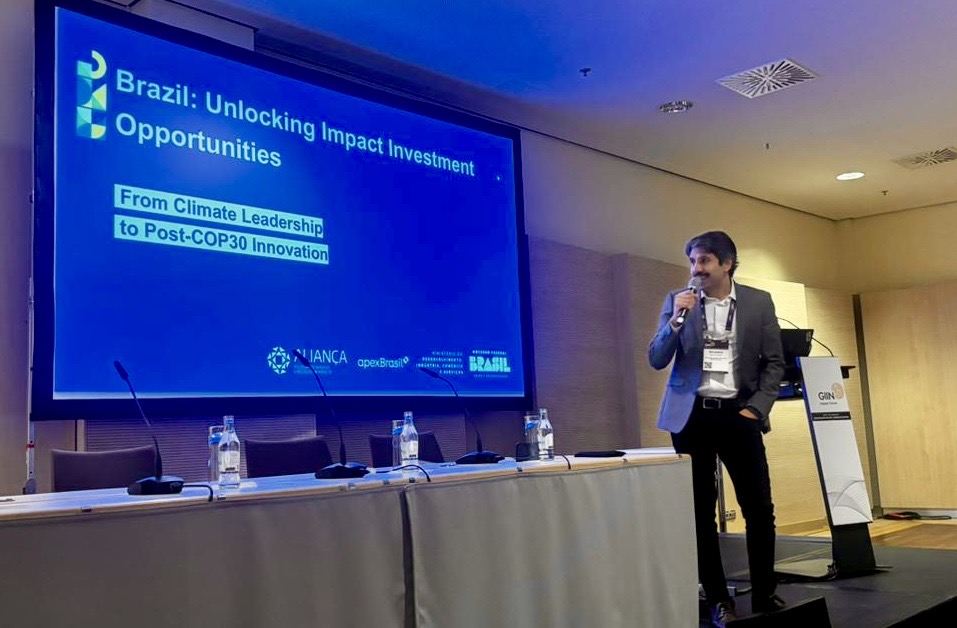
This information gap became clear during a recent session we hosted at the GIIN Impact Forum in Berlin. Together with ApexBrasil, Aliança pelo Impacto convened the first-ever Brazil-focused session in the forum’s current format. Six Brazilian impact fund managers took the stage to showcase our vibrant ecosystem of scalable, innovative impact businesses supported by a robust and sophisticated capital market.
Among them: MOV is tackling the high value-added bioeconomy connecting food and health systems through innovation and inclusion. Vox’s new regenerative agriculture fund aims to de-risks the transition to sustainable, zero-deforestation agriculture across the Amazon and Cerrado. SP Ventures is an agrifood and climate tech investor that strengthens agricultural resilience. Fama Re.Capital is advancing climate, equality and socio-bioeconomy verticals under the principle that decarbonization is non-negotiable.
Together, these funds demonstrate that investing for impact in Brazil means delivering both financial performance and measurable social and environmental outcomes.
We learned that global capital is willing to engage with Brazil – but it needs to understand it first. Investor education, therefore, isn’t just an auxiliary activity; it’s one of the most catalytic levers we have to unlock capital flows into the country.
Climate action has become the central driver of impact investment globally, and Brazil’s leadership on this front is both natural and strategic. According to GIIN’s survey, 86% of the 308 respondents invested in climate-related solutions in 2024, representing a total of $1.5 trillion in impact capital.
This context offers Brazil a dual opportunity. First, to position itself as a climate investment hub ahead of COP30, which will take place in Belém, in the heart of the Amazon. And second, to demonstrate how public and private actors are building innovative mechanisms to mitigate risks and enhance returns for climate-focused investments.
One promising example is EcoInvest, a new platform designed to tackle one of the main barriers cited by foreign investors: currency risk. By offering financial instruments that hedge against exchange rate volatility, EcoInvest seeks to make Brazilian climate projects more attractive and scalable for international investors.
Brazil in the global spotlight
With COP30 on the horizon, Brazil has a unique opportunity to redefine how the world perceives its economy: not just as a natural resource giant, but as a laboratory for regenerative and inclusive growth. The event is already catalyzing cross-sectoral mobilization among ministries, development banks, and private investors, all seeking to position climate and nature-based solutions at the center of Brazil’s economic transformation.
But visibility is not enough. To translate attention into capital, Brazil must maintain a consistent, coordinated presence on global stages. That means investing in storytelling, data transparency, and performance metrics that demonstrate the country’s capacity to deliver measurable, risk-adjusted impact at scale.
At Aliança pelo Impacto, we see this as part of our mission: to curate and connect Brazil’s leading impact fund managers, entrepreneurs, and public agencies to international networks of capital and expertise.
If Brazil succeeds in building this bridge, the upside is tremendous. Sectors like clean energy, which has tripled in size globally over the past five years, are ripe for expansion in Brazil. The same applies to sustainable agriculture, where the country is already a global leader in productivity but still has room to grow in regenerative and low-carbon practices.
Emerging thematic areas: from the circular economy in the Northeast to biodiversity credits in the Amazon basin are beginning to show the scale and innovation investors look for. Yet to truly shift the needle, Brazil’s impact ecosystem must continue proving its ability to combine ambition with discipline, scaling what works while learning quickly from what doesn’t.
Brazil’s global impact ‘brand’
The next phase for Brazil’s impact economy won’t be defined solely by capital inflows. It will depend on our ability to coordinate, communicate, and co-create a shared national narrative that aligns local solutions with global goals. COP30 provides the right stage for this rebranding. What we do with it: the partnerships we form, the policies we advocate, the investments we enable will determine how much capital flows toward the future we claim to represent.
In the end, what will distinguish Brazil is not only its natural abundance but its capacity to turn that abundance into shared prosperity. That means designing financial mechanisms that value forests standing, communities thriving, and innovations scaling responsibly.
The numbers tell us the world is looking for where to place its next impact bet. The stories emerging from Brazil suggest we’re ready to host that conversation, not just as a destination for capital, but as a partner in shaping the next decade of global impact investing.
Ricardo Ramos is the executive director of Aliança pelo Impacto.
Guest posts on ImpactAlpha represent the opinions of their authors and do not necessarily reflect the views of ImpactAlpha.