
Greetings Agents of Impact!
In today’s Brief:
- Overheard at the Employee Ownership Ideas Forum + a worker-owner’s story
- Unlocking African pension funds for early stage infrastructure
- Small business crowdfunding
- Policy wins driving impact economies
Featured: Ownership Economy
In the polarized US Capitol, employee ownership brings lawmakers together. The idea that hardworking Americans should own a stake in the companies they are helping to build is resonating across the aisle in a US Congress otherwise divided along party lines. Employee stock ownership plans, or ESOPs “are where Karl Marx and Adam Smith meet in warm embrace. It’s like, ‘Workers of the world unite,’” Senator Bill Cassidy, a Republican from Louisiana, said last week, getting a laugh at the Employee Ownership Ideas Forum, co-hosted by the Aspen Institute and Rutgers University’s Institute for the Study of Employee Ownership and Profit Sharing. “We all talk about an economy that works for everybody. I’m such a big believer in employee ownership because I think that’s an opportunity to match that rhetoric with action going forward,” said Senator Chris Van Hollen, a Democrat from Maryland.
- Loan guarantees. Hollen plans to reintroduce legislation to set up loan guarantees for private investment funds that finance ESOP conversions. ESOP conversions have been limited by the necessity of the selling owner to finance at least part of the sale to the workers. That means waiting for years to fully cash in on their exit – a disincentive compared to an immediate payout from a private equity buyer. A guarantee program would help bring in private financing to replace the seller’s share of the financing and encourage more retiring business owners to sell to their employees. In the Senate, the bill is co-sponsored by Republican Senators Jerry Moran of Kansas and Todd Young of Indiana. At the forum, Representative Blake Moore, a Republican from Utah, said the win-win of employee ownership is core to “the new world of social impact, the double bottom line, and the things that companies are trying to do to improve lives of those in their communities.”
- Hands off: Employee ownership can ensure Canadian businesses stay Canadian. When the 350-year old Canadian department store chain Hudson Bay was forced into liquidation this month, it was a reminder of how foreign investors can prey on domestic companies. Canadian communities may lose 80 local stores, along with 9,400 employees at one of Canada’s most iconic brands. A weak Canadian dollar and tariff challenges for Canadian businesses that export to the US could spur more private equity-led buyouts of Canadian firms, warns Matthew Mendelsohn of Social Capital Partners, a Toronto-based nonprofit focused on the creation of employee ownership trusts under Canada’s new law. “Employee-owned companies, which are shown to be more innovative and resilient during economic downturns, can bring much needed stability,” he writes in a guest post on ImpactAlpha. Read Mendelsohn’s full post.
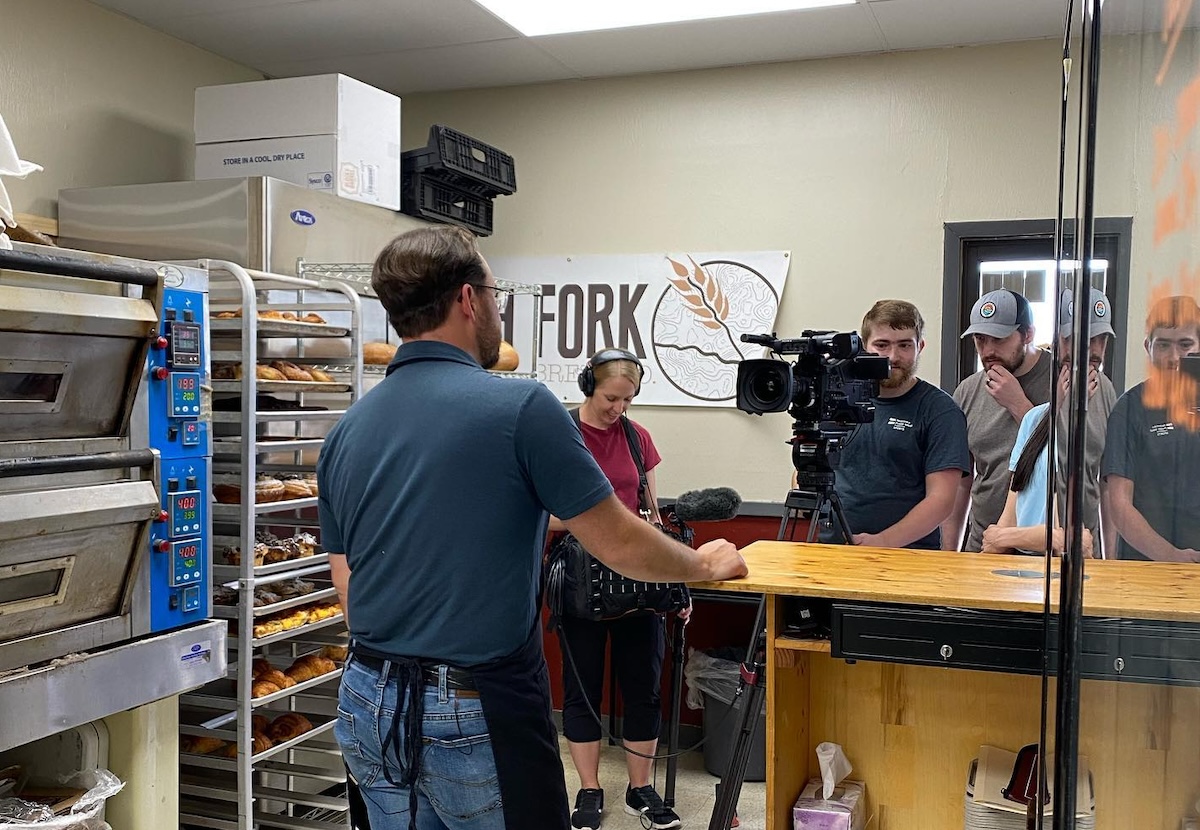
- A worker’s journey to ownership. A Black, single father, Kevin Sims had been out of a stable full-time job for about a year when he got hired as a technician at Web Industries. The Massachusetts-based company makes aviation and medical products using flexible materials like foams and composites. When the company’s human resources representative told Sims that Web was 100% owned by its employees through an ESOP, Sims says he “didn’t understand what that meant and I didn’t ask too many questions. I was just happy to have a job.” That was almost 10 years ago. Sims, now 52 years old, is set to graduate from culinary school and plans to use his ESOP payout to start a food-truck business that he can later pass down to his son. Read Sims’ story.
- Keep reading, “In a polarized US Capitol, employee ownership brings lawmakers together,” by Roodgally Senatus on ImpactAlpha. ImpactAlpha’s coverage of the Ownership Economy is supported by the Sorenson Impact Foundation.
Dealflow: Catalytic Climate Capital
Nigerian infrastructure investor gets catalytic commitment to unlock pension fund investment. ARM-Harith helps infrastructure developers in West Africa with project equity and project development financing. The firm is in the market in hopes of raising $250 million for its Climate and Transition Infrastructure Fund, or ACT Fund. FSD Africa Investments, a UK government-backed investment firm, invested £10 million ($13.2 million) in with a goal of crowding in Nigerian pension funds. FSDAi wants to unlock three-times its investment from local institutional investors, which have been reluctant to back early stage African infrastructure projects like those that ARM-Harith invests in. To get pension funds more comfortable with its approach, the fund will make regular distributions to investors to provide liquidity (see, “Restive LPs look to secondaries and creative exits to recoup capital”). FSDAi invested three-quarters of its capital in Nigerian naira “to mitigate the impact of foreign exchange volatility for pension funds,” the partners said in a statement.
- Structured exits. ARM-Harith is a joint venture between Nigerian financial services firm ARM and South African infrastructure fund manager Harith General Partners. They incubated the ACT Fund at the Global Innovation Lab for Climate Finance. The fund makes equity investments in infrastructure projects from a hard currency tranche. Once the assets are operational, it swaps out the hard currency equity for local currency debt, invested through a separate tranche. Investors willing to take on construction risk can invest in the equity tranche for potentially higher returns. At the operational stage, senior debt providers assume less risk, but accept a lower rate of return. “The unique blended–currency mechanism addresses high transaction costs and lead times, barriers that have constrained the project pipeline in West Africa, while shortening and simplifying the project exit process to allow efficient redeployment of capital in further projects,” according to the Lab’s project brief.
- Share this post.
Honeycomb Credit raises $750,000 from Upstart Co-Lab. Since it launched eight years ago, Honeycomb Credit has helped small businesses raise capital from more than 25,000 retail investors and foundations. The investment crowdfunding site has supported thousands of restaurants, makers and mom and pop shops, many in underserved areas, in raising close to $50 million for equipment purchases, working capital and expansion. Honeycomb’s focus on diverse, creative businesses helped it snag a $750,000 investment from Upstart Co-Lab. “By investing in a platform like Honeycomb we help create the infrastructure for these small businesses to grow,” Upstart’s Laura Callanan told ImpactAlpha. Callanan helped mobilize $600,000 from foundations in 2022 to invest in local, creative businesses alongside Honeycomb’s individual investors (see, “Foundations join the crowd to invest in creative startups through Honeycomb Credit”).
- Crowdfunding merger. Honeycomb this week acquired IFundWomen, or IFW, a business crowdfunding peer that has helped mostly women-owned businesses raise $200 million in grants and early investment capital. “Our two companies have been addressing distinct phases of the funding lifecycle,” Honeycomb’s George Cook told ImpactAlpha. With IFW’s early-stage funding and support and Honeycomb’s focus on growth-stage funding, “we found our businesses complement each other in an almost uncanny way, in addition to being a tremendous cultural fit,” said Cook. The deal follows Honeycomb’s acquisition late last year of Raise Green, a crowdfunding site for green project finance. Terms of the IFW deal were not disclosed.
Dealflow overflow. Investment news crossing our desks:
- German development finance institution DEG made a $28 million equity investment in YieldCo, a unit of France’s GreenYellow that develops solar projects in Vietnam and Thailand. French impact investment firm STOA Infra & Energy also invested. (DEG)
- Maxwell Street Capital Partners secured a line of credit from Lafayette Square to fund its investment in warehousing and logistics company Port Jersey Logistics in New Jersey. Lafayette Square will also provide worker and managerial assistance to help Port Jersey Logistics reduce turnover and improve job quality and productivity. (Lafayette Square)
- Nyobolt raised $30 million for its battery storage and fast-charging systems to power data centers and the transportation sector. (Reuters)
- Lagos-based Arnergy, backed by Bill Gates, raised a $15 million Series B extension round to drive solar adoption in Nigeria. (TechCrunch)
Impact Voices: Policy Corner
From Colombia to Turkiye, impact policy wins drive impact economies. Global leaders and stakeholders will descend on a much-changed Washington, DC, next week for the spring meetings of the World Bank and International Monetary Fund. In a global environment marked by shifting alliances and tightening budgets, impact investing can emerge as a crucial “value for money proposition,” writes Sebastian Welisiejko of GSG Impact in a guest post on ImpactAlpha. Drawing on GSG’s network across 50 countries, Welisiejko identifies what he calls “key policy wins” that governments can implement to enable impact economies that drive “inclusive, climate-resilient growth.”
- Policy wins. Governments are launching wholesale impact funds – investment vehicles that channel capital through intermediaries – such as the UK’s Better Society Capital and Ghana’s Ci Gaba Fund. As regulators, they are developing taxonomies to classify sustainable investments and tailoring international sustainable disclosure rules for local needs. Colombia, for example, introduced its Green Taxonomy in 2022, which “aligns with global standards, while emphasizing land use and forest preservation, given the country’s agricultural goals,” writes Welisiejko. He says outcomes-based financing schemes have been successfully implemented in the UK, Sierra Leone, Turkiye and elsewhere.
- Keep reading, “From Colombia to Turkiye, impact policy wins drive impact economies,” by Sebastian Welisiejko on ImpactAlpha.
Agents of Impact: Follow the Talent
Blue Earth Capital names Philipp Müller, previously with BlueOrchard Finance, as CEO… Next Street announces Charisse Conanan Johnson as CEO. Her co-CEO, Michael Roth, is stepping down… Go ESOP’s Daniel Goldstein joins the advisory board of the Workforce and Organizational Research Center… Sorenson Impact Institute is hiring a manager of impact measurement in Salt Lake City.
ReFED is looking for a capital initiatives analyst… The Teachers’ Retirement System of the State of Illinois has an opening for an investment officer to focus on diverse and emerging managers… Green Climate Fund is on the hunt for a senior project specialist for agriculture and forestry in South Korea… Impact advisory firm Sagana is recruiting a consulting director for Africa.
👉 View (or post) impact investing jobs on ImpactAlpha’s Career Hub.
Thank you for your impact!
– April 16, 2025