

Diasporan remittances to Nigeria are at an all-time high, an impressive feat, and an important one in the context of drastic cuts to USAID and other official development assistance, or ODA. In 2024, Nigeria received almost $20 billion in remittances, much larger than ODA in the same year.
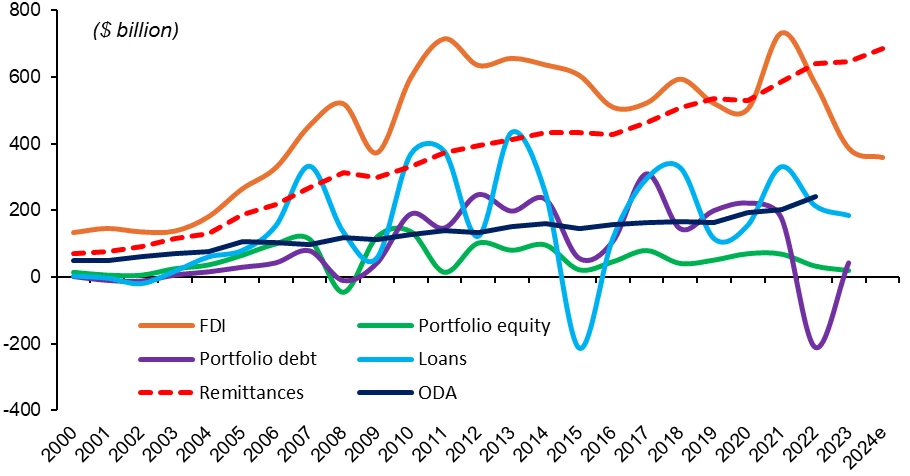
It’s not surprising, really; remittances to Africa have risen steadily in the last twenty years. Based on the dotted red line in the World Bank chart below, which shows remittances to low- and middle-income countries, or LMICs, since 2000, we can expect diasporan remittances to continue to rise.
Remittances to LMICs continued to outpace FDI and ODA combined
This wave of optimism and potential has its challenges: While ODA has been very coordinated and intentional with impact measurement, diasporan remittances have not.
The most recent report by FP Analytics and the Ford Foundation on the state of Nigeria’s diasporan philanthropy ecosystem captures this fact. Although diasporan philanthropists and impact investors expressed ambitious plans for the country’s agricultural sector, this ambition was not matched by a rigorous approach to impact measurement. As FP Analytics put it:
“Yet, few of those interviewed systematically measure—or had plans to measure—the impact of their philanthropic activities. The lack of monitoring and evaluation stems, in part, from the often informal nature of many interviewees’ philanthropy.”
The other day, I was talking to the founder of an impact investment collective to understand his organization’s approach to impact measurement. In his words: “We’ve been so caught up with impact that we often forget to do the work that leads to impact…”
This is a sensible argument. Even the Stanford Social Innovation Review admits that there are situations where an obsessive focus on measuring impact can be counterproductive, and it even describes ten reasons why you shouldn’t measure impact.
But there is evidence that the Nigerian diaspora does not measure impact. For starters, let’s loop back to the research by FP analytics. Although the interviewed philanthropists had ambitious long-term goals for the country’s social infrastructure, very few of them had defined metrics for tracking impact.
Second, the country is very deficient in tracking SDG data on children’s health, gender equality and other indicators, which is a real pain. As an applied researcher, I have to work with old datasets that don’t reflect current conditions.
In the meantime, remittances continue to rise in response to diasporans’ ambitions and hope for the country. We need solid measuring systems to back that ambition up.
Where to start?
Diasporans could start by funding social organizations already measuring impact in the country. For example, in the last twelve years, BudgIT Nigeria, through its flagship monitoring tool, Tracka, has consistently monitored and provided data on development projects across the country. Since then, it has expanded its monitoring programs to cover local government spending, primary health care and other social issues. Coordinated funding to such an organization could expand the measurement rails needed to drive impactful diasporan giving.
Secondly, we need larger collective philanthropic infrastructures that award capital based on burden of need, potential for impact and potential for financial return. Such infrastructure will naturally compel data collection and measurement, and shift the current trend away from giving solely based on personal, tribal or historical ties.
For example, Kwanda pools philanthropic funds from the African diaspora and funnels them to development projects across Africa. Members fund projects based on the strength of need, sustainability and commitment to impact monitoring. Currently, there are projects across multiple sectors in different countries, from Angola to DRC to Zimbabwe, all with real-time evidence.
A similar structure dedicated to the Nigerian diaspora could help reverse the current inequitable distribution of diasporan remittances. For example, from 2013 to 2018, more than 85% of diasporan remittances from the UK were fed into private housing and real estate, with less than 2% allocated to health.
In addition, according to the latest report by the African Philanthropy Forum, the southwestern part of Nigeria has the highest proportion of philanthropic activity, while the northeast has the least. Yet the northeast region arguably has the greatest potential for impact, since it has Nigeria’s lowest human development indices on health, economic productivity and education.
Lastly, there is a need for impact measurement professionals and applied researchers like me to keep communicating the importance of impact measurement. How this communication should look is what I’m keen to experiment with: it could be publishing op-eds like this, or getting on podcasts, or starting a Substack. Whatever the medium, we have to constantly engage with the philanthropists, impact investors and grant makers.
Nigeria’s diaspora is hopeful and ambitious for their home country. They are willing to back up their ambition with catalytic capital. And they need all the help they can get to leverage their resources with solid impact measurement. There is room for impact practitioners, managers, and evaluators to engage with them.
Nzube Ifediba is the director of Paper and Quill Consulting.
Guest posts on ImpactAlpha represent the opinions of their authors and do not necessarily reflect the views of ImpactAlpha.