
Few things are more likely to make an impact leader screw up their face in discomfort than talking about measurement. It doesn’t matter if you’re talking to a philanthropic funder, a corporate social impact leader, a nonprofit visionary or a community organizer — impact measurement unites them all through its persistent trickiness to achieve with ease and confidence.
Leaders regularly name the dream of “one unified way to measure impact” as the north star of collaborative work streams. It would save so much time! And allow for so much synergy! But the quest for such simplicity may be misplaced as momentum builds around place-based approaches to social impact which require a localized mindset and actions that are led by specific community needs.
For the last three years, NationSwell has facilitated a Place-Based Collaborative that brings together a coalition of funders and practitioners, to share learnings and advance place-based work. Participants include George Kaiser Family Foundation, Annie E. Casey Foundation, Tony Pipa at Brookings Institute, KPMG, MassMutual Foundation, and Cisco. Storytelling to build awareness for place-based models is important, and we created case study with BlackRock Foundation and the Spartanburg Academic Movement, or SAM, to showcase the incredible work they have done to sustainably revitalize the economy and talent pipeline in Union County, South Carolina.
Talking about that work, SAM CEO Russell Booker said that “measurement became a tool for learning and coherence, not compliance. It functioned as a flashlight, not a hammer.” That was a lightbulb moment. As a Collaborative, we wanted to help build the field of place-based funders by showcasing why it really matters how you approach measurement — not just as an exercise in data collection or as an organizational challenge to ensure clear storytelling, but as a manifestation of the values that shape the work itself.
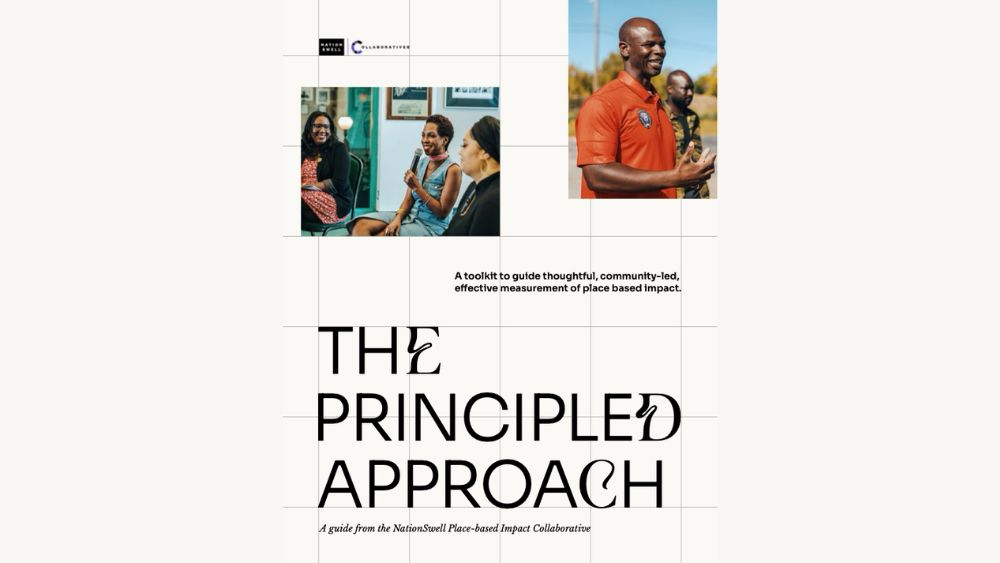
So we created a place-based measurement toolkit that is values-led, with practical guidance to show how an adaptive yet principled approach to impact measurement is possible and successful.
Nuanced approach
The toolkit is designed not as a rigid framework. Such an approach would flatten the nuance that makes place-based work effective. Each community has a specific history, culture and set of present needs; thus, philanthropically backed solutions and organizational approaches to measurement should reflect that reality.
Instead, the toolkit is a powerful set of clear principles to follow, backed up by real life case studies and best practice examples.
Make space at the table
Declaring an initiative “a success” has real world impact on what resources a community has access to, and which solutions thrive; thus who gets to define success must be taken seriously. Partners for Rural Impact put this into practice with their Community Champion Strategy in Union County, South Carolina. By working with 37 community champions (with both formal and informal power and influence), they were able to engage over 700 community members of all ages and backgrounds to shape the pathways for economic opportunity and growth in the region.
Answer critical questions
Measurement should not be about collecting data for data’s sake. Instead, it should be focused on time bound questions to answer. The McKnight Foundation, for example, employs a systemic signals approach to measurement in Minnesota. In order to effectively shift population level prosperity measures, they regularly track root cause signals, such as what functions in the region are strengthening cooperative ownership models, how community finance organizations are leveraging capital, and how trust is building between lenders and affordable housing organizations.
Follow roots and ripples
Humility is key to success in place based work, including how you measure success. Funders must be willing to address root causes embedded in that community’s history and systems, and acknowledge the ripple effects of prioritizing certain initiatives. Dr. Booker and the Spartanburg Academic Movement were careful to find shared goals and spot places where they could support existing efforts; not necessarily create new workstreams; and approached the question of education pathways holistically, considering the importance of culture and local pride in Union County, South Carolina.
Start small and build up
Nurturing small, locally rooted initiatives may not seem appealing to funders seeking impact at scale, but this strategy has proven to be effective in driving lasting change in places across the country. The team at Learn to Earn Dayton, Ohio, started their PreSchool Promise work with very local pilots looking at how holistic measures of thriving — including access to housing and healthy food — impact kindergarten readiness. By guiding those efforts they now have over 120 partner sites offering high quality learning and wellbeing support, and proven results across the region.
Embrace progress over perfection
A simplistic view of impact measurement would suggest progress is linear. Place based pioneers like Coalfield Development in Appalachia prove that it’s OK — better, even — to accept a more iterative path. Jacob Hannah, CEO of Coalfield Development, acknowledges this: “We cannot redirect the billions of dollars that left Appalachia, but we can combine the skilled people and revitalized places to incubate social enterprises that perpetuate new markets, dollars and jobs. It’s decentralized, human-based, scrappy and relies on iteration at the hyper-local level with trust.”
Look to the future
The true success of place based philanthropy is whether it helps to set a community up for long term success that can be sustained long after the philanthropic “risk capital” has moved on. ImpactTulsa in Tulsa, Oklahoma, created a measurement model that tracked how a range of local factors — including evictions, lack of transportation, poverty — impacted cradle to career outcomes. The Mayor of Tulsa has now adopted that approach to create a shared outcomes model across the city.
Thoughtful, community-driven impact measurement will never be easy — but it is essential. And with extra guidance from the toolkit, we hope that we can reduce the frown lines for leaders as they roll their sleeves up and prepare to harness the power of measurement to shape progress with their community.
Amy Lee is chief strategy officer at NationSwell. Check out NationSwell’s Place Based Measurement Toolkit here.
Guest posts on ImpactAlpha represent the opinions of their authors and do not necessarily reflect the views of ImpactAlpha.