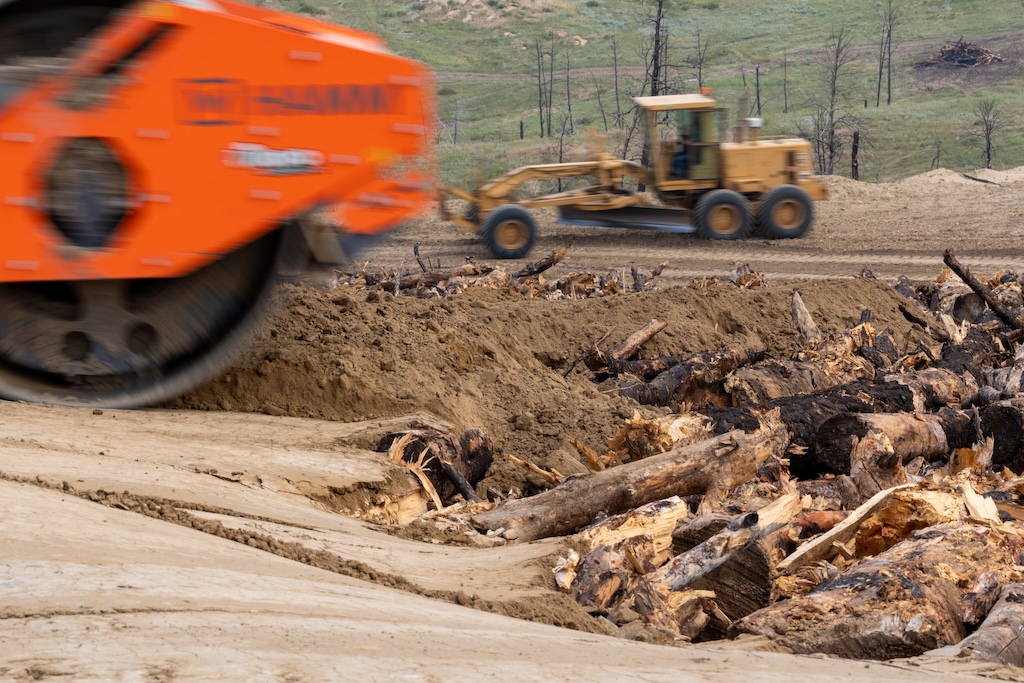

Millions of tons of burnt, dead Lodgepole pines, Douglas firs and other trees dot the wildfire-scarred hills of Montana. Mast Reforestation wants to bury the snags and to get paid for doing it.
The Seattle-based forestry company in January announced the first sale of its carbon credits from its “biomass burial” business. Such “removal” credits fetch a higher price in the voluntary carbon markets, even after steep volume discounts for Mast’s corporate buyers, which include the Royal Bank of Canada, CNaught and Muir AI.
The sale of 4,277 carbon removal credits from the burial of more than 10 million pounds of dead trees is a signal that Mast, with generous VC backing, may finally have found a sweet spot in the volatile carbon markets.
“What we identified with biomass burial is what is turning heads today within the carbon market,” Mast’s Grant Canary tells ImpactAlpha. “This work has specific and unique features which are exciting to buyers, and it has co-benefits which are exciting to buyers.”
It’s the latest pivot for Mast, which a decade ago started as DroneSeed. Back then, the company operated remote-controlled drones that released seed-and-nutrient “pucks” that were intended to jumpstart new forests in burn zones. Much of the promised carbon savings from that approach failed to materialize. A year ago, Mast threw in the towel on the sale of “forecasted mitigation units” from some of its reforestation projects.
The company told one project partner last year that drone- and hand- planted seedlings at one site had “experienced significantly higher than expected mortality rates and that the surviving seedlings had exhibited slower than expected growth rates.”
Instead, Mast changed its business to biomass burial, announcing another $25 million in financing in February of 2025. That Series B round was co-led by its longtime investor, Chamath Palihapitiya’s Social Capital, along with the Los Angeles-based climate VC Pulse Fund.
The company’s twists and turns tell the tale of the voluntary carbon markets, in which credits are sold to corporations seeking to make good on their net-zero commitments. As in the classic “hype cycle” of many new technologies, carbon credits reached a peak of inflated expectations several years ago as a tool for financing a low-carbon economy (see this post from 2021, “That feeling when investors realize carbon is going to $100 a ton sooner than they expected”).
Revelations about rampant miscalculations of climate impacts, and in some cases outright fraud, sent the market into a trough of disillusionment. Particularly hard hit were the credibility of credits generated by projects intended to avoid carbon emissions. Prices also fell for so-called “ex ante” credits sold on the expectations of future carbon removal, especially when the source of that removal is reforestation of degraded land.
By burying fire-killed trees, Mast hopes to complete the hype cycle and climb the slope of enlightenment. The burial method sequesters carbon without relying on the future growth of new trees. Mast says it will monitor for emissions from the underground chamber that stores the trees for at least a century, and has established a “permanence trust” to finance the effort. Mast will continue to practice reforestation at burial project sites, but as a non-financial co-benefit for landowners.
Wary of headline and other risks, corporate buyers have shown a strong preference, and willingness to pay higher prices, for projects that can near-guarantee greenhouse gases will be locked away for a long time.
At Mast’s MT1 project in southern Montana, Canary says, “We got from excavation to issuance in nine months. For 4,277 credits that is pretty remarkable.”
Drone-powered
What’s also remarkable is the patience Mast’s backers have shown as the company finds its footing. Canary and his co-founders incubated the idea for DroneSeed at Techstars’ Seattle Accelerator in 2016.
Dropping seed balls from the sky had a mixed success rate. That meant DroneSeed needed a lot of tree seeds. With the decades-long decline of the US timber industry, supply was tight. The company’s $36 million Series A financing in 2021 accelerated DroneSeed’s vertical integration. Led by Social Capital, the round included Alexis Ohanian’s Seven Seven Six, an early stage VC fund based in Florida, along with Nancy Pfund’s DBL Partners and Marc Benioff’s TIME Ventures.
The financing allowed DroneSeed to purchase Silvaseed, a seed bank that has operated in Roy, Washington since the late 19th century. In 2022, the company acquired California’s largest tree nursery, Cal Forest Nurseries, as well. Those two companies now operate as wholly owned subsidiaries of Mast.
The company was now eager to cash in on carbon credits for reforesting wildfire burnzones – with or without drones.
In 2021, DroneSeed began work on the Henry Creek reforestation project in Oregon, using drones and traditional hand-planting methods. The credits were sold out by the end of 2022. Mast’s website promoted the sale of another round of offsets from Henry Creek in the form of “forecasted mitigation units” in the spring of 2024. A different section of the website estimates that more credits would be online by December 2025. A Mast spokesperson confirmed that the credits have gone to market.
Even when DroneSeed rebranded as Mast in 2023, it was inking a series of project financing deals with Carbon Streaming, for the Sheep Creek Reforestation, Baccala Ranch Restoration Project and Feather River Dome sites.
In January of 2025 Mast informed Carbon Streaming about the higher mortality rate and slower growth. Mast no longer considered the project plan and budget for Sheep Creek and Baccala to be viable, and “as a result, [Carbon Streaming] no longer anticipates generating cash flow from the Sheep Creek Reforestation Stream, and its fair value is $nil as of March 31, 2025,” according to the news release from Carbon Streaming.
In the same filing Carbon Streaming said that Mast had terminated the Baccala project. Baccala can no longer be found on Mast’s website. None of the Mast projects are listed in the “portfolio” section of Carbon Streaming’s site. The spokesperson for Mast says that the company “will be focused only on biomass burial going forward.”
Biomass burial
While the voluntary carbon markets have fallen off a cliff since the frothy days of 2022, corporate commitments from the likes of Microsoft, Stripe and Shopify are generating sustained demand for high quality – and higher priced – carbon removal credits. The race is on to bring more high-quality and durable carbon dioxide removal credits online.
New firms with novel technology are cropping up to tap into that premium part of the market, through methods like biochar pyrolysis and enhanced rock weathering.
“There’s a big demand on the part of buyers that know they’re going to need credits going forward,” says Jennifer Jenkins of Rubicon Carbon, a broker of credits that is not involved with Mast. “They’re locking in that supply today. They’re making agreements with developers.”
Mast is looking to cash in on that demand for high-quality credits. While still small, the MT1 project is a significant step up for the nascent and promising carbon removal method.
“The Mast project really moved the numbers forward,” says Daniel Sanchez of Carbon Direct, a corporate carbon consultant that in November acquired the climate tech platform Pachama. “We were looking at really small projects before that. This is the biggest one that I’ve seen.”
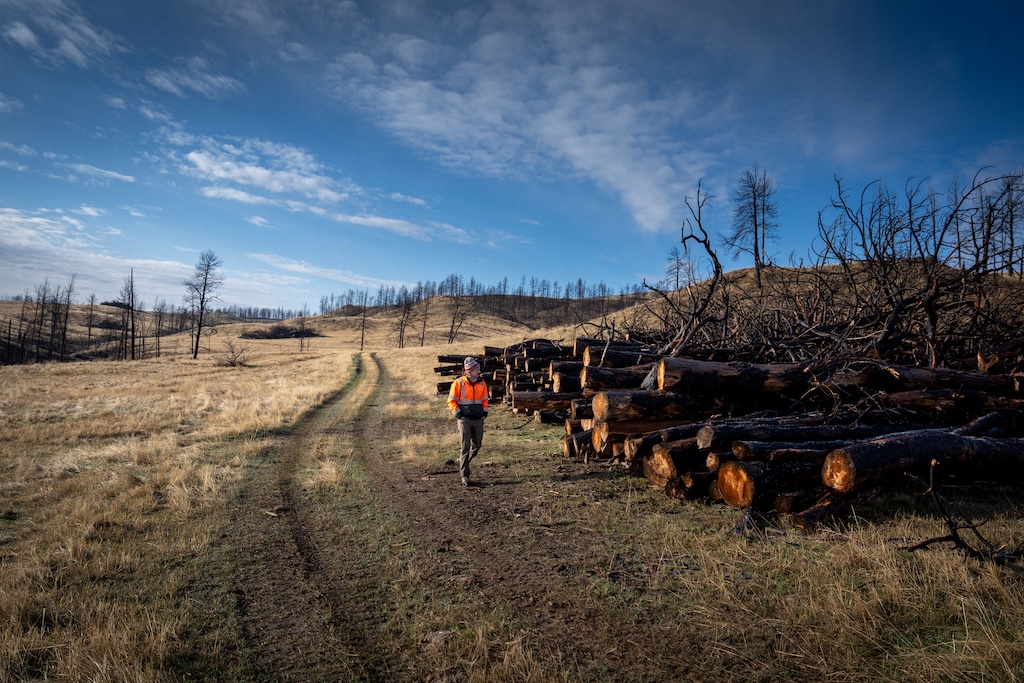
Montana and the western part of North America have an enormous amount of carbon stored in biomass, though some experts warn that many of the dead trees are remote and hard to access. Another risk: Most forests in the US are on public lands managed by a federal government that has itself pivoted away from climate action.
For Mast’s latest credits, individual buyers were able to purchase one metric ton, the global standard unit, for $225 as of September 2025. Corporate buyers negotiated lower prices depending on the volume, timing, and duration of the purchase agreement, according to a Mast spokesperson.
Mast says they pre-sold 80% of the biomass burial credits through the registry Puro.earth, which requires three months of monitoring showing zero emissions before the issuance of biomass burial credits. The project received an ‘A.pre’ pre-issuance rating from BeZero Carbon, indicating low project execution risk.
Mast plans to use some of the profits from the sale of credits to plant native trees on site. That makes biomass burial attractive to private landowners who want to restore their land but may not be able to afford pricey reforestation work. Additionally, Mast employs local contractors to do the work, in areas where forestry and mill jobs have been in decline for years.
Twisting roots
The February 2025 Series B financing gave Mast additional runway to find a viable model.
“With the board we looked at biochar, we looked at IFM [improved forest management], we looked at a couple of other credit methodologies,” says Canary when asked how his investors felt about the company’s pivots.
The scientific basis for storing carbon by burying biomass is well founded, according to Carbon Direct’s Sanchez, who leads the Carbon Removal Lab at UC Berkeley. While trees are alive, they suck up carbon dioxide; when they die and decompose, they release it. If you can stop a dead tree from decomposing or being burned to a crisp, you’ve removed carbon dioxide from the atmosphere.
Other US companies trying to scale biomass carbon removal and storage projects include Breakthrough Energy-backed Graphyte, Utah-based Woodcache PBC, and biomass burial pioneer Ning Zeng’s Carbon Lockdown. The companies bury the biomass in earthen vaults, depriving it of the oxygen that causes decomposition. They then monitor the burial chambers for signs of emissions with technology similar to what’s used on landfills.
“When I first heard about the idea of biomass burial my initial reaction was that’s the stupidest thing I’ve ever heard of,” the Nature Conservancy’s Joe Fargione tells ImpactAlpha. “Then I looked into it further and it turns out that it’s actually a good idea.”
Another benefit: These millions of pounds of biomass don’t need to be transported far away to be processed, as they would be if milled or burned for energy. Fargione says there are many other sources of biomass for burial, also known as wood vaulting, including from wildfire-fuel thinning, agricultural residues that are currently burned, and storm- or hazard-removed trees.
The question for venture-backed Mast and other biomass burial companies is: can the approach remove carbon at scale, and thus deliver high-quality carbon credits to finance the operations?
Mast is looking to break ground on a 20,000-metric ton project in 2026, Canary says. Mast’s plans call for three projects of a similar size next year. After that, Canary hopes to sell 150,000 metric tons of carbon from biomass burial per year.
“We looked at this and said, ‘We think this is very comparable to good biochar, which is really seeing strong uptake,’” Canary says. “In communicating that to investors, we set project budgets. We brought in the team internally to make that shift. And we have been able to execute.”