
Only a year ago, community lenders gathered in Los Angeles to celebrate years of groundwork that had delivered historic opportunities and expanded funding for community development financial institutions under the Biden administration.
Now they’re watching that progress come undone.
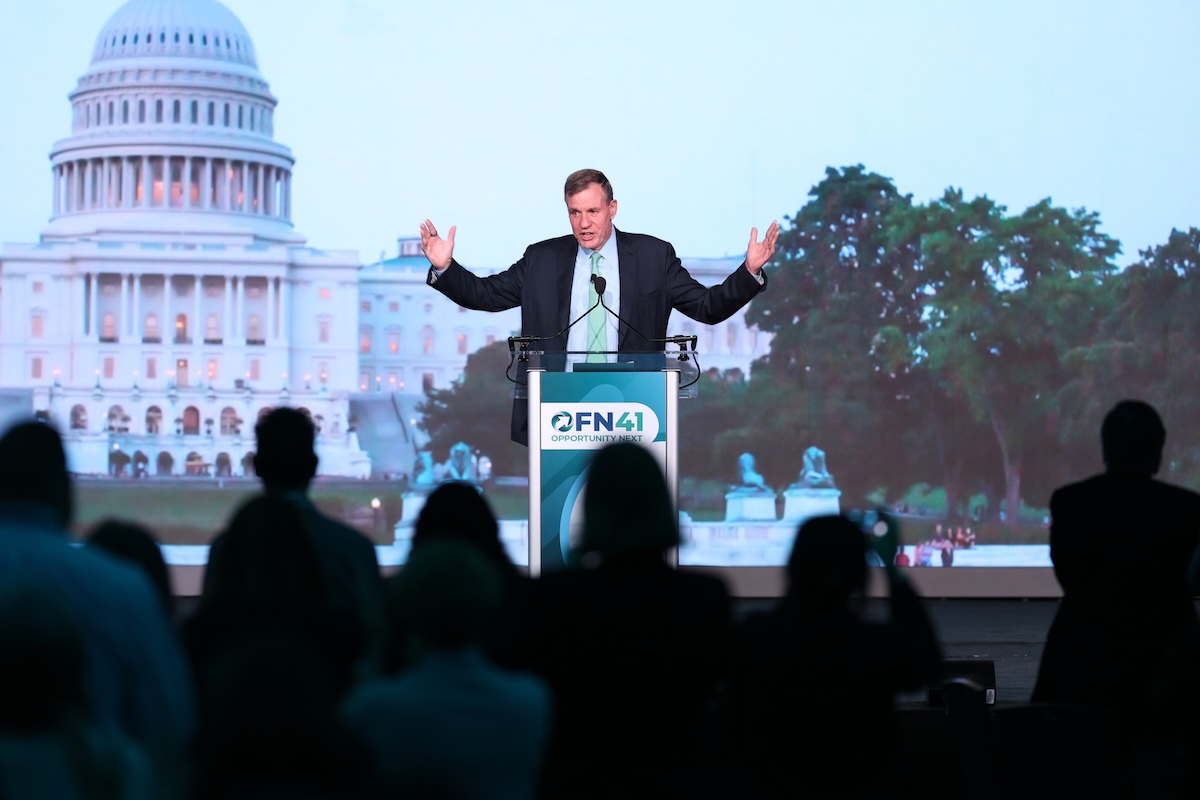
At this year’s conference of the Opportunity Finance Network, in Washington DC last week, the lenders to low-income communities faced up to the dangers of losing not only the Treasury Department’s CDFI Fund, but critical funding streams that are dependent on it. The CDFI Fund certifies lenders’ eligibility for bank investments under the Community Reinvestment Act and for New Markets Tax Credits, a critical source of financing for small businesses, mixed-use real estate and affordable housing in capital-starved neighborhoods.
Also slipping away is the Greenhouse Gas Reduction Program, a $27 billion Biden-era program aimed at establishing a network of lenders to finance green projects in low-income communities. Release of the bulk of the GGRF funds, approved by Congress and awarded last year, is stalled in a legal battle that has dragged on since March.
“As the kids say, we’ve got opps,” Harold Pettigrew of the Opportunity Finance Network told the crowd of more than 2,200 community development professionals, using slang for “opponents.”
The CDFI Fund, a Treasury Dept agency established in 1994 that certifies and funds the mission-driven lenders, is an important source of funding for CDFIs, which as mission-driven lenders serving low-income operate on the slimmest of margins. Each year the fund awards hundreds of millions of dollars in grants to help CDFIs expand their loan capacity or technical expertise.
“Where I really fear the wheels stop turning is when you have to serve those very low-income households, whether it’s housing, small business, or food assistance,” Kimberlee Cornett of the Robert Wood Johnson Foundation shared with ImpactAlpha. “How do we operate in a depleting subsidy environment?”
Political resiliency
The CDFI Fund has survived two attempts to kill it – a March executive order from President Trump and a proposed zeroing out of its budget in May. Both attempts were rebuffed after strong bipartisan pushback.
When a budget impasse shut down the government three weeks ago, the administration tried again, laying off the entire CDFI Fund staff as part of broader federal reductions in force. That move has been stalled, for now, by a federal judge.
The latest attempt to undermine the program has again been met with loud and bipartisan pushback. More than 100 Republican House and Senate leaders sent a letter to Treasury Secretary Scott Bessent late last week voicing concern about the cuts. The letter, said Senator Mark Warner (D-Va.), amounted to “the biggest show of Republican support pushing back on the Trump administration on any issue in the first 10 months.”
“We write to affirm our continued support for the Community Development Financial Institutions (CDFI) Fund and the role it plays in supporting our shared goal of creating economic prosperity throughout the country,” they wrote.
“We strongly urge the Administration to continue carrying out the statutory obligations of the CDFI Fund that are essential to ensuring private investments reach our states and districts.”
The fund has $348 million in appropriated funding waiting to be distributed, including $100 million specifically earmarked for housing production, according to the Georgia Social Impact Collaborative.
The importance of the CDFI Fund goes beyond its direct funding. Only half of the nation’s more than 1,400 CDFIs receive grants from the fund, but the office plays a key role in certifying CDFIs and administering the New Market Tax Credits program, which offer credits up to 39% of the cost of commercial development, healthcare and small business expansion projects in low-income communities.
With a new round of certification coming up — CDFIs are recertified annually — the shuttering of the CDFI Fund could leave CDFIs in limbo. Longer term, it could discourage banks from providing low-cost capital to CDFIs to fulfill their Community Reinvestment Act obligations: without certification, banks might not get CRA credit.
“If there is no CDFI designation, are banks going to be incentivized to work with us on the CRA side?” wondered Joe Sky-Tucker of Business Impact NW, a nonprofit that serves underbanked entrepreneurs in Alaska, Idaho, Oregon, and Washington, on a panel.
“Banks, credit unions, and nonbank CDFIs alike rely on Treasury-issued CDFI certification as the recognized standard for determining whether an entity effectively serves low-income communities,” wrote the American Bankers Association, Mortgage Banker Association and three other trade groups, urging the administration to reconsider. “Maintaining the capacity to administer this certification is vital to ensuring that capital continues to reach rural, small-town, Native, and other historically underserved markets.”
Credit risk
CDFI leaders at the Opportunity Finance Network conference express confidence that strong bipartisan support will once again save the day. The targeting during the shutdown of the fund and other programs identified as “Democratic” could be a bargaining ploy to give President Trump additional leverage.
“The hope is that this is a political chip to bring people to bear, and hopefully the budget goes through and things get rescinded,” Pravina Raghavan, who was head of the CDFI Fund until March, told ImpactAlpha. Raghavan was named CEO of Richmond, Va.-based Locus in July.
Given the attacks, CDFIs and their supporters have been planning for a scenario where support for the CDFI Fund no longer exists. “All of the past Trump budgets, we’ve been zeroed out,” said Raghavan. “It’s not the first time the fund has gone through a crisis.”
Raghavan pointed to Locus’ Community Investment Guarantee Pool and other credit enhancements for CDFIs as examples of what the field can do.
The most recent reduction in force order contradicts other signals that politicians on both sides of the aisle are recognizing the role of community lenders. Republicans made the new Market Tax Credits permanent in the One Big Beautiful Bill, for example. And shortly before the reduction in force order, they amended a defense bill to support CDFIs with the creation of a secondary market for CDFI loans. In September, Treasury announced a nearly $8.8 million round of grants for technical assistance to 56 CDFIs.
Even if the CDFI Fund is restored, cuts in food assistance, Medicaid and other programs are creating havoc for affordable housing, community health, small business loans and other CDFI priorities. Unemployment and tariff-driven inflation are hitting some borrowers hard, putting lending officers on high alert.
“We’re experiencing different risks every month,” said LISC’s Shawn Luther. “We’re evaluating as everything changes, whether it be changes in Medicare, whether it be potential budgetary risks to Section Eight (housing vouchers), tariff risks, to how are our portfolio borrowers doing in light of this. We’re looking at our small business portfolio, for example, to see what they’re importing.”
Business Impact NW typically sees about a 1% loan loss each year. “This year, it’s a little over 2%, so we’re seeing a spike in our losses.” said CEO Sky-Tucker.
Business Impact has also identified about $2 million of its business linked to federal programs, including the SBA microloan program, the Women’s Business Center and the Veterans Business Development program, that’s at risk.
“All of those programs this year have been under attack,” Sky-Tucker said. The CDFI has already laid off ten people this year and could be forced to lay off more if that federal funding vanishes.
In a May survey by OFN, more than half of CDFIs said it is now harder to access new debt capital, due to tougher lender requirements, higher interest rates and more selective underwriting practices. Nearly one-third of respondents, particularly smaller CDFIs, said that renewing existing debt has also become more difficult to obtain. The sectors struggling the most: consumer lending (67%), community services (64%) , small business (57%) and microenterprise (53%).
“There’s a lot of strength in this industry,” Cornett of the Robert Wood Johnson Foundation told ImpactAlpha. “It will continue because it needs to continue.”
Cornett worries about the sheer number of overlapping challenges facing the field, from a deterioration in consumer economics to lapsing subsidies and a potential lack of enforcement of the CRA, especially for smaller CDFIs. The federal cuts are also straining state and local governments, hampering their ability to pick up the slack.
“Some of the drivers that have enabled the system to work so productively are unstable or ebbing,” she said. In past crises, such as the Great Recession or the Covid pandemic, “you had the public sector leaning in to assist CDFIs,” she said.
“In this instance, you actually see the public sector leaning out. That’s where some of the quicksand lies.”