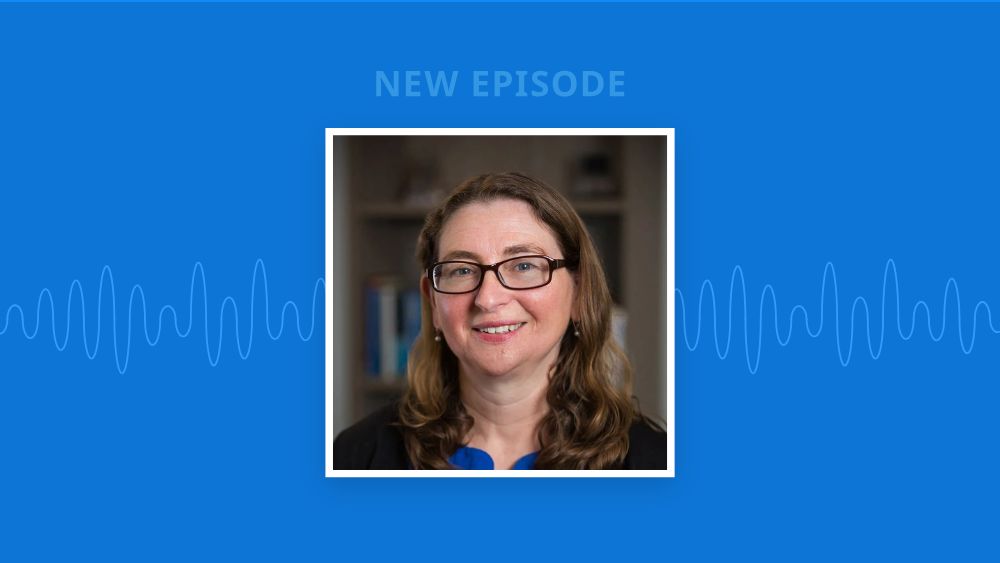
Two hundred and fifty years after the founding, 1803 Fund‘s Rukaiyah Adams has a theory about how the American experiment gets finished.
The people who were once treated as capital… are the ones who can reclaim American capitalism.
“In this moment, the work we’re doing isn’t just trading capital or moving money faster, it’s creating defensible economies that allow for permanence,” said Adams, who founded 1803 to reclaim land, enable community ownership and anchor economic opportunity in Portland’s once-bustling Black community of Albina (for background, see “In Portland, the 1803 Fund is rebuilding Black neighborhoods, zip code by zip code”).
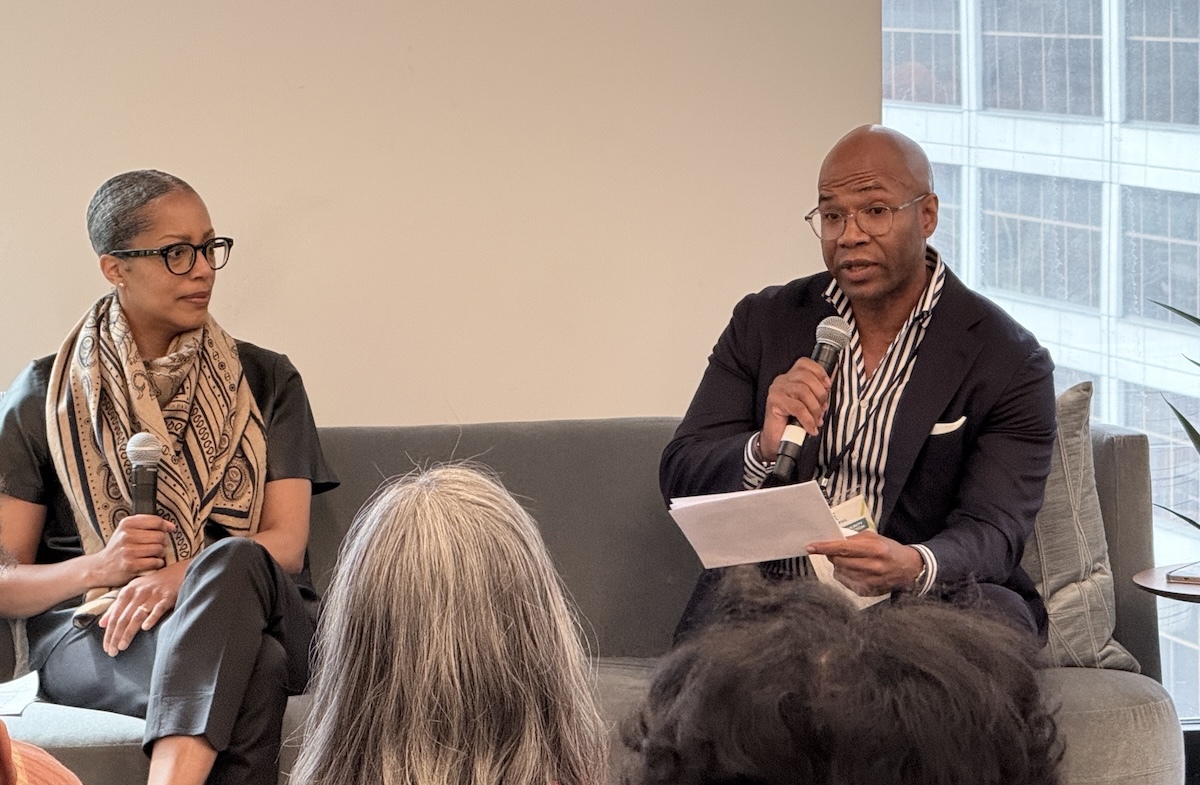
Adams, a lawyer who has managed investments for Meyer Memorial Trust and Oregon’s public employees pension fund, called on attendees at the Total Impact Summit in Philadelphia to flex their agency as investors and community members to regain control of the American economy.
“Don’t treat your investment portfolio like a risk mitigation machine, where you diversify to the point that you have no meaning in what you’re doing,” said Adams. “Choose the thing that will move the needle and have the ovaries to invest in that.”
Across the two-day event, investors from across the US sought to reclaim the narrative of American capitalism, and reshape how capital and innovation flow to drive economic prosperity and power for overlooked people and underserved communities.
From financial markets to housing to ownership structures, modern-day systems “were designed from a set of underlying beliefs about who matters, who participates, who owns, and who benefits,” noted ImpactPHL’s Kafi Lindsay in kicking off the proceeding. But those rules are neither inevitable nor permanent.
“Our task is not simply to make extractive structures slightly more efficient or slightly more fair,” she said, but “to design regenerative and reparative architecture rooted in the philosophy that democracy and economic participation belong to all of us.”
People vs. the robots
Lindsay could have also been talking about artificial intelligence, whose algorithms increasingly determine societal outcomes such as who gets hired, who gets capital, and who gets care. At a session on responsible AI that probed the technology in a place-based context, the discussion centered on using AI to empower people and to transform, rather than eliminate, jobs.
For Laura Weidman Powers of tech investor Base10 Partners, every venture is now an AI venture. “That’s the foundation from which we can think about, well, how do you do that responsibly?”
Base10 has translated complex ESG, DEI and climate frameworks into a governance model that works for even the earliest stage startups. It is now incorporating AI into those governance tools to inform due diligence and reporting and to guide portfolio companies in thinking through the implications of their AI tools.
AI ethicist and consultant Ravit Dotan wants to shift the AI narrative from alarming talk of a jobs apocalypse to a focus on worker-led empowerment.
“The usual story that you hear about the future of work is, AI is coming for our jobs. Go to the beach and discuss universal basic income, because you’re not going to need to work anymore,” she said. “I am not buying into that story.”
Dotan works with individuals and groups to envision how their professions can evolve and help them create tools to enable that vision. “We can start thinking about what we want to create,” she said.
So, too, can investors. Majority Action has advocated for shareholders to use their power to hold Big Tech firms accountable via proxy voting and other measures. The nonprofit is diving deep into data centers — perhaps the single most tangible way that AI is affecting communities.
The nonprofit recently brought a group of pension fund trustees to Memphis to see firsthand the effect of xAI’s Colossal data center, a massive data farm initially powered by dozens of unpermitted gas turbines that has continued a legacy of pollution and environmental injustice in the predominantly Black community of Boxtown.
The same health and noise issues affect a white, working class neighborhood on the other side of Colossal. Majority Action’s Whitney Shepard sees an opportunity to build bridges and make common cause on issues that affect all citizens.
“There is this moment of bringing a greater ‘us’ together,” Shepard said.
Thinking bigger
Impact capital providers are moving deliberately into underinvested communities, overlooked markets, and the systems that shape both. Even in the face of mounting political headwinds, leaders say this moment demands not caution, but creative capital structures, unlikely partnerships and collaboration at a scale the industry has rarely attempted.
“Every region, every institution, needs a leader who calls us to think bigger,” says Adair Mosley of Groundbreak Coalition, a coalition of more than 40 public, private and philanthropic institutions working together to close racial wealth gaps in Minneapolis.
Groundbreak was featured in the teaser for Power in Place, a new multimedia series debuted at Total Impact Summit from ImpactAlpha, ImpactPHL and MacArthur Foundation, showcasing places building ecosystems to invest in their own futures.
Mosley gave a shoutout to one such leader — McKnight Foundation’s Tonya Allen, who led Groundbreak’s founding after the death of George Floyd (see, “McKnight Foundation’s Tonya Allen on going ‘all in on mission’”).
“We’re constantly bringing ourselves to what is the kind of city, what is the type of region we want to live in, and how we ensure we put the structures, the edifices, in place so that everyone can thrive,” Mosley said during a fireside chat with Common Future’s Sandhya Nakhasi. “That requires a lot of design sessions [and] asking institutions, what is your self interest? And once we understand the self interest, then we’re able to synthesize that, and then get to an alignment.”
With $1 billion catalytic commitments, Groundbreak hopes to unlock up to $5 billion in private capital for systematically disadvantaged communities in the Minneapolis-St. Paul region. The thesis is that by investing in homeownership, business ownership, commercial developments and other assets that appreciate, such communities can start to build generational wealth like their more affluent peers.
“We are trying to create a more visible Black middle class through assets that actually appreciate,” Mosley said. “We recognized that we needed capital at the scale of the challenge, that we could not incrementally be able to solve this.”
Groundbreak and McKnight Foundation are backers of Brick by Brick, which is returning about 400 single-family homes in the Twin Cities to local ownership after they had been acquired by a private equity firm in the aftermath of the 2008 financial crisis. Mosley says Groundbreak will deploy roughly $30 million this year.
Transforming systems
Capital providers are leaning into systems change. Deborah Frieze, through the Unlock Ownership Fund, is tapping into some of the $300 billion sitting in donor-advised funds, or DAFs, to invest in employee ownership, community ownership and other ownership economy solutions.
Frieze has also launched a new fund called the Palestinian Impact Initiative to invest in small and mid-sized enterprises in the capital-constrained West Bank.
“There are people in the West Bank who have been hustling and being economically resilient through struggle for a long time,” Frieze said during a panel discussion. “But there’s no liquidity.” Frieze is working with on-the-ground partners who have local knowledge and solutions, but lack the capital to implement them.
The catalytic capital fund is looking to raise $5 million to make at least 30 investments in small and mid-sized local enterprises, with a focus on women- and youth-owned businesses. “We’re finding a way to get liquidity to them with an 18-month vacation period and 2%-5% interest rates and seven-year terms.”
A theme that emerged over the two-day conference was that impact is a constantly-evolving process. Impact “was always meant to be the pursuit of solutions, which means a journey,” said Rey Ramsey of the Nathan Cummings Foundation. “You’re supposed to continue to learn, you’re supposed to continue to grow, and you’re always supposed to be in pursuit. Until we fix North Philly, you can’t say the work is done.”
Or, as ImpactPHL’s Lindsay said in her closing remarks, “The future never arrives by announcement. It is practiced into existence, day by day, by people willing to act before certainty appears.”
“You are stewards of direction,” she told the assembled impact investors. “Every allocation you make is a signal. Every mandate carries values. And every time horizon reveals what, and who, truly matters.”