
Affordability is only the beginning.
Creating an abundance of affordable housing, healthcare, energy and transportation was the animating issue of the year. On the agenda for 2026: Expanding access to ownership of appreciating assets and other wealth-building opportunities. With the AI disruption hard upon us, there’s no time to lose.
Fair sharing of the prosperity that comes with innovation and economic growth is both an urgent policy priority and a compelling investment opportunity.
To help focus that agenda, ImpactAlpha has been assembling a “playbook for shared prosperity” with examples of strategies and initiatives that build wealth, support families and restore communities (submit your favorite initiatives – or your own – through this simple form).
Many common-sense strategies enjoy bipartisan support. The “baby bonds” included in this year’s tax and budget bill, which give newborns born through 2028 $1,000 in federal funding, are a down payment on a long-held priority for asset-building advocates. Billionaires Michael and Susan Dell this month pledged $6.25 billion to expand the program with $250 each for children under 11 (see also, “Stackwell seeks to help young investors start to compound their wealth early (podcast)”).
There’s also increasing bipartisan support for policies to expand transitions to employee ownership, especially as millions of baby boomer business owners prepare to retire.
And new financing mechanisms are expanding access to home ownership in ways that can be fair to both borrowers and investors (hint: it’s not the 50-year-mortgage). There’s increasing attention to ways to protect existing home owners as well, from expensive repairs, rising taxes and utility bills and predatory lenders.
“Creating prosperity for all is really front and center on the minds of people across the country. Home ownership is one of the pillars, and it’s just out of reach,” Utah investor Jim Sorenson told ImpactAlpha last month. “The environment now is more receptive and so we do view that as a positive – and we hope that these things are carefully looked at because you can also create more problems with bad policy.” (Disclosure: Sorenson Impact Foundation is an investor in ImpactAlpha and sponsors our Ownership Economy coverage.)
Purple power
A rising economic tide for all and increased financial security for US families could go a long way to healing the artificial divisions plaguing the country. In both the spring and the fall, ImpactAlpha criss-crossed the country to discover strategies that are working in rural and urban areas and in red and blue states (find a sampling here, here, and here)
At the Kenan-Flagler School of Business at the University of North Carolina in Chapel Hill an all-day forum produced by ImpactAlpha with GOOD TRBL, a collaboration of North Carolina fund managers and ecosystem builders explored equity and ownership for small businesses, lower cost of capital for majority-minority cities and colleges and startup capital for underestimated founders.
“We needed this,” more than a few people said after the screening of our award-winning mini-documentary, “Equity and Ownership,” at the Aspen Institute in Washington DC in April. Kimberlee Cornett of the Robert Wood Johnson Foundation, which supports ImpactAlpha’s shared prosperity coverage in municipal bond markets, homeownership preservation and other areas, had urged Agents of Impact to wear purple to emphasize that affordable housing, small business financing, good jobs and healthy communities are not “red” or “blue” issues.
Napoleon Wallace, the serial North Carolina innovator who is the subject of the 20-minute film, kicked off his occasional column as a contributing editor at ImpactAlpha with a call to action: “For America’s 250th birthday, let’s build a playbook for shared prosperity.” Agent of Impact Martin Eakes of Self Help Credit Union offered hard-won insights for helping working families survive and thrive.
Among the strategies we found compelling were “entrepreneurship through acquisition,” which help would-be entrepreneurs source, vet, purchase and manage businesses. The impact twist: Creating pathways to upward mobility for workers through profit sharing and employee ownership plans, as well creating good local jobs to keep businesses anchored in their communities.
A “community investment trust” in Portland, Ore. already is helping neighborhood families build wealth and community ownership. Nearly 350 lower-middle-class residents in southeast Portland have a small slice of the upside appreciation of a well-kept strip mall. Many have already taken distributions, totaling more than $300,000, a 2X return. Community Investment Trust has spun out from Mercy Corps Ventures to bring the model to additional cities.
Also in Portland, the 1803 Fund is restoring the historically Black Albina network, backed by $400 million from Nike billionaire Phil Knight, with the aim of transferring ownership to a community owner real estate investment trust. In a guest post, Grounded Solutions Network’s Devin Culbertson and Devin Murphy on Integrated Purpose laid out a roadmap for financing the future of community ownership.
Blueprints for shared prosperity
Agents of Impact are moving shared prosperity from aspiration to execution. In partnership with the W.K. Kellogg Foundation, ImpactAlpha spotlighted proof points from Kellogg-backed managers who are showing how capital can build wealth, deliver essential services and create durable economic opportunity.
The goal is to surface “real, investable examples of how markets can work better for communities,” Kellogg’s Cynthia Muller told ImpactAlpha.
Navajo Power is modeling what a just transition can look like at utility scale. Its 750-megawatt solar project near the Painted Desert sits on the former footprint of the Navajo Generating Station, turning the loss of coal jobs into an opportunity for community-led renewal. With billions of dollars of projects in development across Tribal nations, Navajo Power is pairing clean energy with ownership, jobs and self-determination.
“The Navajo Nation was the battery for the Southwest,” Navajo Power’s Brett Isaac said on an Agents of Impact podcast. “Indigenous communities have the resource potential to site projects of the size and scale that we need.”
Giving founders the tools they need to build wealth through ownership can help families achieve stability across generations and communities break cycles of poverty.
“Wealth creation is not just a financial milestone. It is a structural change agent,” Kim Folsom of Founders First Capital Partners wrote in a guest post. Last year, Founders First began tracking tracking projected wealth creation among the entrepreneurs it supports. Kellogg Foundation is an investor in Founders First.
“Measuring wealth creation is critical if we want to capture the real story of economic mobility,” Muller told Folsom. “Revenues and jobs matter, but the ability of entrepreneurs to build appreciating assets is what shifts generational trajectories and strengthens our economy.”
Apis & Heritage Capital Partners is reframing private equity around worker ownership. When the firm acquired Accent Landscape Contractors, it transferred the firm to 114 new worker-owners.
“He didn’t want to sell to the sharks,” Todd Leverette said on an Impact(ed) podcast, describing the founder’s decision to sell to employees instead of competitors. “When we introduced the idea of selling to his workers, he was floored by the opportunity.”
Apis & Heritage is scaling a mezzanine-debt model that allows workers to acquire 100% ownership without putting up capital, turning buyouts into wealth-building engines.
Maycomb Capital’s Educational Resources Impact Fund shows how private credit can unlock growth where other capital can’t. The fully committed demonstration fund has backed education providers serving millions of students, filling what Maycomb calls “a critical funding gap that neither philanthropy nor venture capital has been able to meet.”
The takeaway, says Maycomb’s Miljana Vujosevic, debt can be “a powerful tool to grow mission-driven organizations,” and one that investors are increasingly recognized for its disciplined risk-return profile and measurable impact.
Continuing the conversation
At the Neighborhood Economics gathering in Chicago in September, I shared the stage with Lyneir Richardson, whose Chicago TREND real estate fund has scored an exit on another shopping center, this one in the Chatham neighborhood, netting hundreds of neighbors / investors a solid five-fold return on their investments of between $100 and $5,000. With the Brookings Institution, Richardson has produced “A playbook to buy back the block.”
And I interviewed Wilson Lester and Talib Graves-Manns, who are expanding Partners in Equity from North Carolina to Chicago and other cities to help small business owners buy the commercial properties where they operate as a way to build assets and generational wealth.
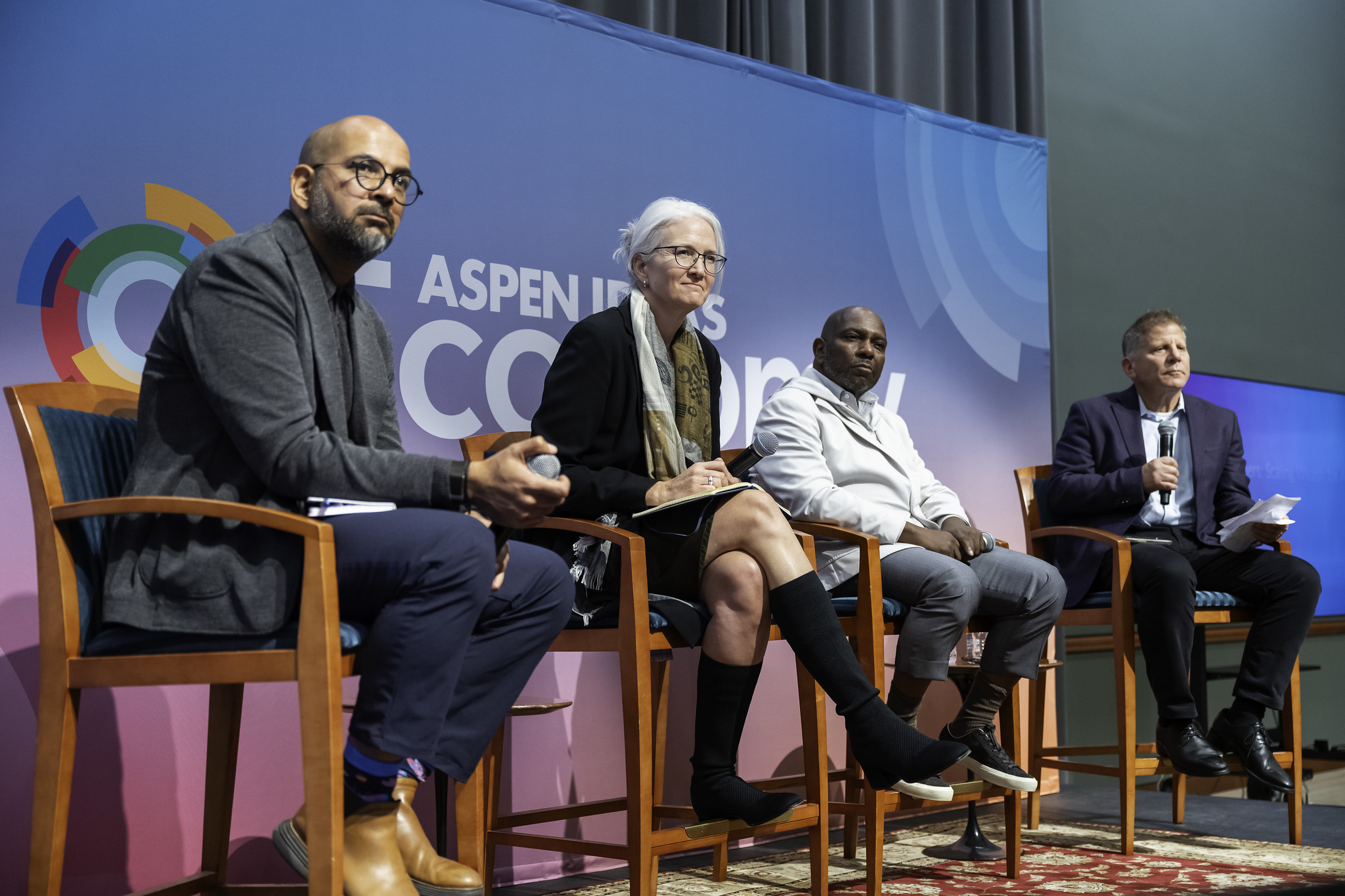
Our panel at the first Aspen Ideas: Economy conference, held in Newark, NJ, tried to cook up a way to represent an investment portfolio’s “wealth footprint” in much the same way as it’s now possible to calculate its carbon footprint.
“Everything you do on your balance sheet has an impact on whether you’re extracting or putting back wealth in the community,” said Gary Community Ventures’ Santhosh Ramdoss. “How do you share a little bit more of it?”
In Philadelphia, Kensington Corridor Trust is turning local assets into levers of power that enable local residents to shape real estate investment and development in the emerging neighborhood. The Trust, owned and governed by local residents, most of whom are low-income people of color, has acquired 31 commercial and mixed-use properties.
“What we do is we purchase real estate on the avenue, and take it off of the traditional speculative market,” Adriana Abizadeh-Barbour said on our panel at the SOCAP conference in San Francisco in October. “It is a decommodification model. It’s also an anti-displacement model.”
And in Cincinnati and Columbus, Ohio; Syracuse, NY; Fairfield County, Conn.; and the Adirondacks region, children’s hospitals and community foundations, nonprofits and corporations, and banks and local governments are coming together to finance preventive measures and other investments that are “upstream” of vulnerabilities in health outcomes, educational achievement and economic opportunity.
I learned about such collaborations at the “Making Missing Markets” gathering at the Federal Reserve Bank of New York, where I interviewed the Fed’s David Erickson. “Why can I invest in a company that makes a pill that lowers blood pressure, but I can’t invest in a neighborhood that does measurably the same thing?” Erickson asked (crediting Maggie Super Church, who created the Healthy Neighborhoods Equity Fund in Boston to make such investments possible).
“Predistribution” strategies can cut workers, residents and communities in for a larger share of the gains. The glimmering of an AI-driven productivity boom makes such strategies all the more urgent. How should the spoils of such productivity gains be distributed?
“There should be a citizens’ share” of AI companies and the software itself, Rutgers Business School’s Joseph Blasi declared at the Aspen Ideas: Economy gathering, so that more humans are invested in AI’s gains.
More than a decade ago, Blasi co-authored the book, “The Citizen’s Share,” to argue for broad-based profit sharing and employee ownership, an idea whose time has come.