Let’s ground this question in a classic holiday scenario: the loud uncle at the big family dinner.
This uncle is a big proponent of AI. He even pulls out his phone to loudly ask ChatGPT to help him with arguments about how the environmental impact of AI isn’t a big deal.
Right as he finishes talking, a hush falls over the dinner table.
You find that everyone around you is frozen. Your uncle, still, phone in one hand, massive bite of potatoes about to fall off his fork, in the other. Only you can move or see.
A genie appears and gives you a choice: You can either have your uncle disavow AI, stop the hundreds of queries he poses per day, or trade in his gas-powered sedan for an EV.
Which should you choose?
The EV.
And it’s not remotely close.
AI and the massive infrastructure build-out unquestionably have a negative direct impact. Land is being cleared, concrete poured, water rerouted and gas turbines used.
But we in the environmental movement need to be cautious about what causes we champion, particularly when it comes to pressuring or shaming those around us into taking more climate-friendly actions.
The formula for which campaign we should choose is simple:
1) The greatest likelihood of generating lasting behavior change
*
2) The greatest environmental impact
=
3) The campaign we should all focus on.
Any campaigns to pressure individuals to stop using tools like ChatGPT, Gemini, or Claude for environmental reasons do not pass this test. Or at least, there are many actions and campaigns that we should rank far above it.
Quantifying the impact of AI
A November 2025 study at Cornell projected what the macro impact of AI will be on its current trajectory by 2030.
Here’s a direct quote from their findings:
“The team found that, by 2030, the current rate of AI growth would annually put 24 to 44 million metric tons of carbon dioxide into the atmosphere, the emissions equivalent of adding 5 to 10 million cars to U.S. roadways. It would also drain 731 to 1,125 million cubic meters of water per year — equal to the annual household water usage of 6 to 10 million Americans. The cumulative effect would put the AI industry’s net-zero emissions targets out of reach.”
Any emissions increase where you’re talking about “millions of cars” is a major bummer and worth attention.
But it’s also not gigantic…
Let’s look at it in terms of people. In 2024, the average emissions per American was 14.2 tons per year.
So, using the highest estimate that 44 million metric tons of CO2e will enter the atmosphere, the escalating build-out and use of AI in the US is equivalent to the US adding about another 3 million Americans.
The latest estimates say the US has about 342 million people in it. So, in the context of the whole country, the AI expansion over the next 5 years will result in the emissions equivalent of a 1% increase in population in the US.
Not nothing, but far from a step function or any massive jump.
Emissions per query
AI models have been rapidly increasing their efficiency on energy use and emissions per search.
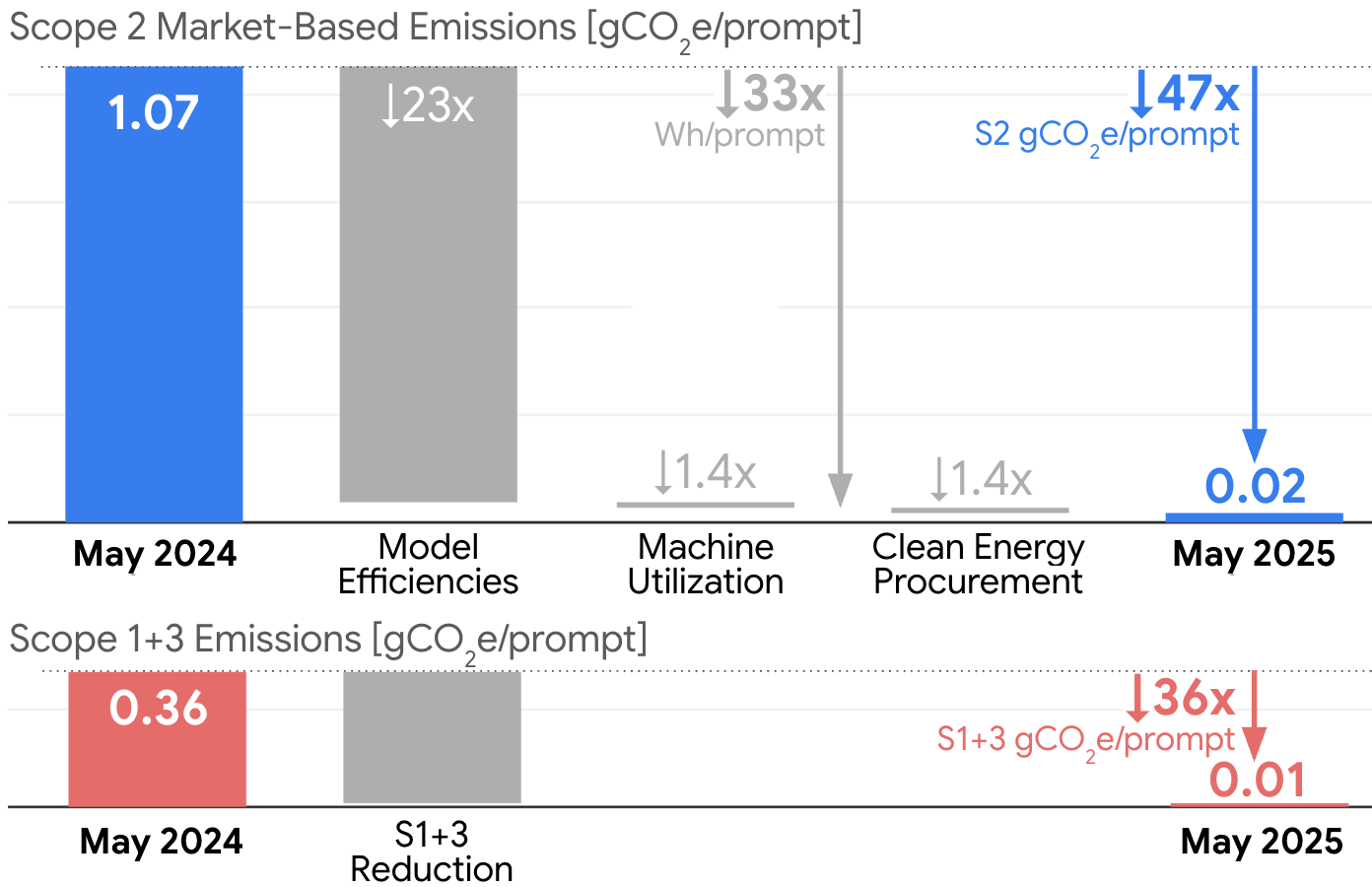
Here’s a chart that Google presented in its own analysis on the emissions difference per prompt from May 2024 to May 2025.
As you can see, the 47x drop in a single year is pretty staggering:
That same report also shows dramatic improvements in water usage. A single Gemini query now uses about five drops of fresh water, thanks to far greater water recycling and recovery at data centers.
Even if we assume the rate of efficiency improvement suddenly plateaus, at 0.02 grams per search, that’s still not nothing for climate impact. How do we put the impact of an individual query into context?
In my research for this article, I found this Substack by Andy Masley pretty compelling.
He walks through assumption by assumption to get to the total emissions per search, including estimates for training the model and the embodied carbon of AI chips. He then puts AI use in comparison with other activities an average American may do. He basically saved me from having to do a lot of the same math.
The full newsletter is worth reading, but I wanted to share the conclusion in its entirety here as it’s eye-opening and also provocatively funny:
“The full carbon cost [of an AI query] is ~0.28 g CO2 / prompt.
This is the same amount of carbon emissions as:
- Running a microwave for 3 seconds
- Using a laptop for 1 minute
- Running a clothes dryer for 1 second
- Driving a sedan 5 feet
- Playing a PS5 gaming console for 15 seconds
It’s 0.0005% of the average American’s daily emissions. An American emits ~200,000 times as much every day. You have to prompt ChatGPT 2,000 times in a day to increase your emissions by 1%, but prompting it that much would take up a lot of time and probably prevent you from doing other high emissions activities like driving, so unless you were constantly prompting ChatGPT every moment while multitasking with everything you do, it would be very very hard to actually raise your emissions at all using ChatGPT. It seems like, even with all the hidden costs included, ChatGPT is much more likely to lower your emissions, because it emits so much less than the average ways Americans spend their time.”
Beyond the humor of it, I think points like this are important to make.
If we are to collectively push for a shift in individual actions that will reduce greenhouse gas emissions, is reducing individual AI search usage the right hill to die on?
Pick your battles
Why is it worth drilling down on this so much?
Because climate activism is a finite resource.
We should be following a simple calculus for what kinds of campaigns we take on:
What has the greatest likelihood of success * the greatest climate impact?
I would argue that a continued campaign to switch Americans to EVs is superior in both of these categories, along with a number of other individual climate actions.
So, unless you have a friend or relative who has already:
- Switched to an EV
- Installed a heat pump
- Electrified their cooking, drying and heating
- Insulated their house
- Reduced meat consumption significantly, if not eliminated it
- Switched to a fossil-fuel-free bank and investments (just saying)
Then you may want to focus on these actions first. Each has distinct benefits over the status quo and will likely have a far greater climate impact.
But… could AI still be really bad for the environment?
Without a doubt, there is a world where we look back in ten years and point to the inception of AI as a major negative for climate change and the environment overall.
One direct example of this is for the fossil fuel industry itself.
AI models could make identifying oil and gas geological reserves much cheaper and more effective, which could help elongate the economic lifetime and utility of fossil fuels.
This is already happening:
- Why This Couple Quit Microsoft to Challenge Its Fossil Fuel Ties (Business Insider)
- Ex-Microsoft Employees Warn of AI’s Role in Accelerating Fossil Fuel Growth (Sustainable Times)
But it’s not really fair to share such speculative arguments without considering the other side.
There is also a world where AI could prove really helpful in addressing climate change.
One of the biggest barriers for reaching a 100% carbon-free electric grid is the grid itself.
The grid must constantly balance supply and demand in real time. It’s very hard, and the intermittency of renewable energy paired with rising electricity usage from data centers, EVs and heat pumps, is making that balancing act even harder.
One of the big promises of AI is its ability to understand complicated systems and plot better courses of action to take.
Such technology advances could help us transition from a grid designed for 24/7 coal plants to one that works for cheap renewables plus energy storage.
Many such efforts are early, but they are certainly exciting. Here are some headlines:
- GE Vernova says it’s acquiring French startup Alteia to deliver grid AI to utilities (Axios)
- Finnish startup secures €3.8M to scale AI-driven virtual power plant for energy storage (ArcticStartup)
- Four ways AI is making the power grid faster and more resilient (MIT Technology Review)
We just don’t know yet how the use cases of AI will impact the climate.
We can be fairly certain it will make sourcing and delivering energy more efficient and thus cheaper, but which side will it benefit more? Fossil fuels or renewables?
Only time will tell, but if we in the climate movement are to make a stand on AI, it’s probably energy better spent following in the footsteps of that couple who quit Microsoft because of their sales of AI services to fossil fuel companies.
So, how should you feel about AI?
Nobody actually knows what the future of AI will bring. But we do think we can add value and commentary on those more narrow-sub questions related to AI that you may have heard less on:
- How is the enthusiasm about AI impacting stock market risks and rewards?
- How could it impact the broader economy and maybe your job?
- How is AI directly impacting the environment?
- Should discouraging AI use be a collective climate campaign?
Back in the 2010s the environmental movement had a surprisingly viral campaign: replacing single-use plastic straws.
The campaign was one of the more successful individual and corporate actions the movement has had.
But was it the right campaign to get behind?
Plastic straws represent less than 1% of the total plastic thrown away in the world.
And let’s be honest. The alternatives: paper straws and BYO straws are all meaningfully worse.
This fails both sides of our “likelihood of long-term success * impact” test.
But to give the campaign against plastic straws its due, it was born out of a previous generation of environmental actions. One where being more environmentally conscious went hand in hand with some kind of sacrifice.
Yes, your paper straw is turning to mush in your drink, but at least it won’t get stuck up a turtle’s nose.
The environmental movement is so fortunate to now have many categories where the environmentally friendly alternative is as good as or better than the more polluting status quo.
We have a winning hand. We just need to play it correctly.
Zach Stein is a co-founder of Carbon Collective. ImpactAlpha has partnered with Carbon Collective to provide a monthly analysis on how individuals, companies, and organizations can incorporate the realities of our changing climate and energy systems into their investments. The analysis originally appears in Carbon Collective’s newsletter. All content is solely for informational purposes and should not be used as the basis for investment decisions.