
When President Trump visits Abu Dhabi at the end of his Middle East trip this week, he’ll be looking to attract more of the United Arab Emirates’ capital to the US.
One of the biggest UAE investors is increasingly investing other people’s money as well.
With $330 billion in assets and the backing of Abu Dhabi’s government, Mubadala Investment Company is best known for its huge endowment and large private equity and private debt holdings.
The state-owned sovereign wealth fund is attracting increasing attention as an asset manager itself, raising money as well from other investors who are keen to draft behind Mubadala’s deep investments in artificial intelligence and other advanced technologies.
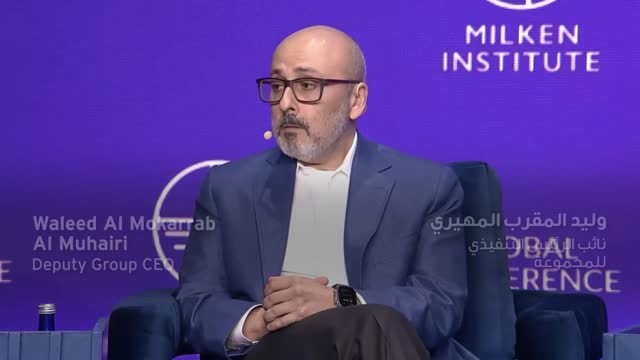
“Most of the time people think of us as capital allocators, but the truth is, in our GP-led businesses – and we have two at the moment – we’re the managers,” Waleed Al Mokarrab Al Muhairi, Mubadala’s deputy group CEO, said at the Milken Global Conference in Beverly Hills last week.
That helps explain the announcement from the $40 billion holding company TWG Global last month that Mubadala would anchor and lead the syndication of a $10 billion investment in TWG, which owns Guggenheim Investments and Guggenheim Securities as well as the Los Angeles Dodgers, the Lakers and Chelsea FC.
A good chunk of that money will come back to Mubadala in the form of TWG’s commitment to place $2.5 billion with Mubadala Capital, the group’s alternative asset management arm with $27 billion in asset under management. TWG also took a minority “GP stake” in Mubadala Capital and said it aimed to increase its commitment over time to $20 billion from itself and its partners.
“Partnering with Mubadala Capital enables us to access outstanding investment opportunities that demand both visionary insight and substantial resources,” TWG’s Thomas Tull said at the time.
In March, the UAE said it would invest $1.4 trillion in the US over 10 years, in AI, semiconductors, manufacturing, and energy as it diversifies its economy away from oil. Last week, Trump said he would reverse Biden-era limits on exports of advanced AI chips.
Mubadala has been at the center of a series of major AI financing initiatives, including the Global AI Investment Partnership, with Microsoft and BlackRock, which announced in September that it aims to raise $30 billion for AI data centers and infrastructure. Mubadala invested through MGX, the technology investment company Mubadala formed last year with G42, an Emirati holding company.
In January, MGX was a partner, alongside OpenAI, SoftBank Group and Oracle, in the $100 billion Stargate venture to finance AI infrastructure.
“I think we’re probably the only sovereign investor that has positions, from an LLM perspective in Anthropic and Open Ai and xAI,” Al Muhairi said at Milken. “We wouldn’t have put as much capital as we have into MGX and into AI if we didn’t think that this was going to be a long term trend that was going to help fuel growth, globally speaking.”
As an asset manager, Mubadala is scooping up some of the capital that is flowing to Abu Dhabi and the United Arab Emirates from Europe, India and other places. Increasingly, private equity funds, hedge funds and wealthy family offices are setting up shop.
“You’re seeing capital flows coming in at a basis and rate that we have never seen before,” Al Muhairi said.
Mubadala is capitalizing on other trends as well, including the emergence of private credit and the rise of secondary funds able to buy out private equity stakes from increasingly restive LPs. Mubadala Capital’s Private Equity Fund IV closed at $3.1 billion, surpassing its $2 billion target, and is acquiring large holdings from other private equity funds seeking exits.
Last month, Mubadala Investment and Fortress Investment Group announced a $1 billion partnership to deploy private credit, including asset-based lending, corporate credit and real estate finance. Mubadala last year acquired about 70% of Fortress from SoftBank Group.
“As a large sovereign, as an allocator, private credit has been the fastest- growing asset class from an allocation perspective for the last three years. It’s also been one of the best performing that we’ve had,” Al Muhairi said.
“It started because we had this grand notion that we saw that there was this white space where we thought we could actually disintermediate some of the large banks,” he added. “It turned out to be a complimentary piece of paper, as opposed to saying, ‘We’re going to do something that the banks weren’t doing.’”