

Greetings, Agents of Impact!
🟢 Get the ImpactAlpha Edge. A warm welcome to the team from Altes Capital, the latest subscriber to ImpactAlpha Edge. Better visibility lowers the cost of action. ImpactAlpha’s new intelligence platform maps more than 3,370 allocations from over 1,450 LPs and 1,490 fund managers to reduce the friction of discovering aligned investors. Join Altes and more than 90 institutions now subscribed to ImpactAlpha Edge. Learn more – and book a demo.
In this week’s LP/GP:
- Next50’s investor roadmap for the longevity economy
- Private credit for European farmers’ green transition
- InvestEco’s fourth sustainable food fund
- Seeding a generation of diverse fund managers
Featured: Valuing Aging
Next50 is cutting checks to GPs seeking alpha in aging across energy, housing and infrastructure. Aligning its portfolio of publicly listed equities taught Next50 Foundation that companies and strategies that value and support aging could be found in unexpected places. Now, the Denver-based foundation is applying that learning as it rotates its private equity portfolio. Next50 is looking at a pipeline of managers that are thinking about healthy aging across economic wellbeing, social inclusion, health and the built environment. The $285 million foundation this week invested in Enable Ventures, which is applying its own lessons from investing in disability solutions to aging, Next50 tells ImpactAlpha exclusively. The premise is that aging, like disability, is not a condition to accommodate, but rather a market to build for; solutions built for people with disabilities could scale naturally to older adults. “Aging and disability are deeply intertwined, yet the market has ignored both,” says Next50’s Peter Kaldes. “We’re betting on a generation of technologies that will let older adults live, work and participate on their own terms.”
- Investor roadmap. Next50 is hoping to send a signal to other private equity LPs. Over the coming decade, older adults will outnumber children in the US for the first time. Globally, the over-60 population is on pace to exceed two billion by 2050. The “longevity economy” is projected to reach $8 trillion by 2030, yet it attracted just $8.5 billion in investment in 2024. With Next50 as an anchor client, JPMorgan Chase’s private bank created “Support Aging” as a thematic investment screen that is now used by other clients as well. Next50’s new Aging Investing Roadmap, developed with Sorenson Impact Institute, seeks to bring other investors along in embedding the needs of older adults into capital decisions. Its taxonomy places investments on a spectrum from age-responsive, which avoids harm; to age-integrated, which views older adults as stakeholders; to age-centered, a more intentional approach focused on driving improved outcomes. “Aging is the next mega trend,” Kaldes writes in an introduction to the roadmap. “The demographics are certain, the implications economy-wide, and the capital requirement measured in trillions.”
- Aging-lens. ImpactAlpha and Next50 have partnered to expand coverage of investment opportunities in healthy aging, and to chronicle the foundation’s efforts to align its endowment investments with its programmatic mission to value and support aging. The foundation has had a handful of age-oriented fund investments that predate its new investment framework, including Washington, DC-based 1843 Capital, which invests in what it calls the “100+ year healthspan,” and Age1, a San Francisco-based venture fund focused on early-stage tech companies working to extend healthy human lifespans. Other aging-focused funds include Elder Ventures, and Equitable Ventures. In France, UMR, the retirement savings arm of French mutual insurer Group VYV, earlier this year earmarked €350 million ($398 million) for a five-year “aging well” investment strategy, and last week selected Paris-based managers Serena and Makesense to manage a €75 million aging-focused European impact fund.
- Keep reading, “Next50 is cutting checks to GPs seeking alpha in aging across energy, housing and infrastructure,” by Roodgally Senatus and David Bank.
🟢 Live on Edge: Healthy Aging
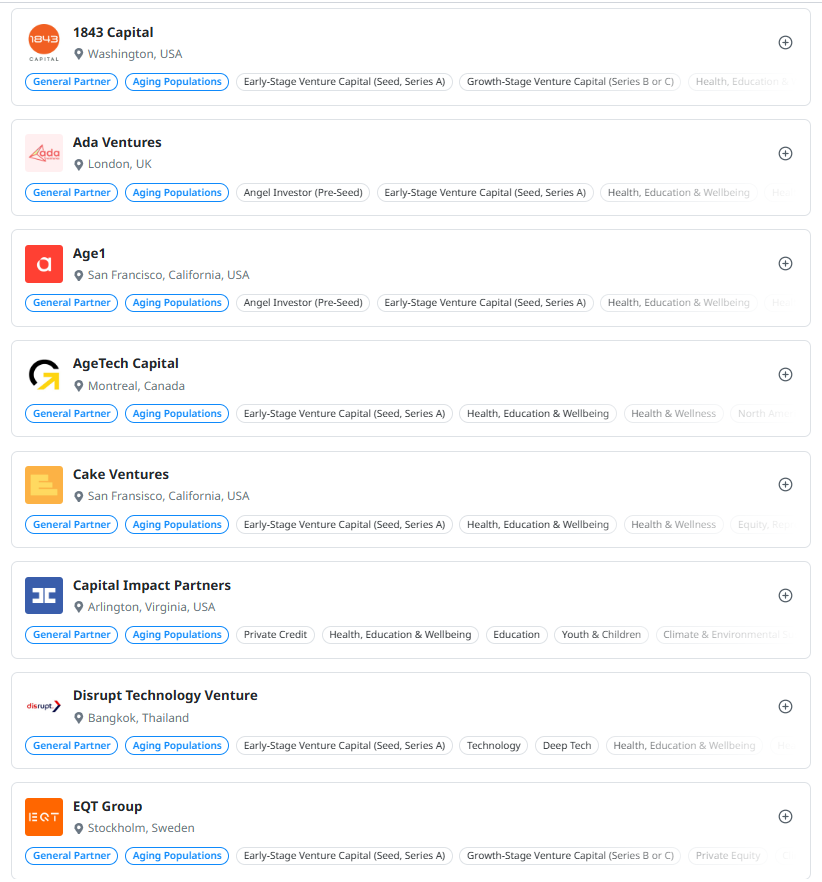
Dozens of LPs and GPs investing in solutions that value aging. ImpactAlpha’s reporting illuminates emerging impact markets by making them more visible and connected. Our coverage of the Ownership Economy, for example, now includes more than 140 GPs raising funds that focus on home, employee and community ownership. In partnership with Next50 Foundation, ImpactAlpha is taking a deep dive into another fast-emerging market: solutions for healthy aging.
- Healthy aging. ImpactAlpha Edge is tracking at least 28 GPs investing in aging solutions, and 50 LPs backing those funds. With over 60 allocations, Edge spotlights LPs such as Pivotal Ventures and Better Society Capital, which have made multiple investments in the sector; the database maps the longevity ecosystem as well as the capital flows and partnerships driving its growth.
Sponsored by Carbon Collective 401(k) & 403(b)
Who does ImpactAlpha trust with its 401(k)? Two years ago, ImpactAlpha chose Carbon Collective as its 401(k) advisor. The San Francisco-based B Corp. is on a mission to make funds that incorporate long-term climate reality a key component of every 401(k) plan. ImpactAlpha employees have access to a range of investment options across multiple investment philosophies: climate, ESG and low-fee passive. In addition to prompt customer service, Carbon Collective offers annual market reviews and quarterly finance 101 sessions. Says ImpactAlpha’s Zuleyma Bebell, “Carbon Collective has helped us offer employees investment choices that align with their values and financial goals, while making retirement planning more accessible and engaging.”
Dealflow: Private Credit
With InSoil, private credit steps in for Europe’s green farming transition. Climate change, global supply chain disruptions and a dearth of capital are squeezing Europe’s farmers. Their futures, and that of the food supply, depend on a transition to greener practices. “We cannot proceed as we did for the last 20 years,” said Laimonas Noreika of Lithuanian climate finance company InSoil. “The farmers know it, and they are ready for a change. What they need is finance, knowledge and derisking.” InSoil secured a €120 million ($138 million) credit facility from UK-based Pollen Street Capital to ramp up lending to Europe’s small and mid-sized agriculture businesses. Traditional lenders have left a more than €60 billion financing gap for Europe’s farmers and food processors, including about €19 billion in needed green financing. The deal between InSoil and Pollen Street is one of the largest private credit commitments to sustainable agriculture lending in Europe, both parties said.
- Financing farmers. Since launching in 2020, InSoil has backed the sustainable agriculture transition of more than 3,500 agri-businesses in Europe. Pollen Street’s credit facility will mostly support businesses in Poland, which has more small farms than other parts of Europe and a younger farmer population eager to shift to regenerative agriculture, Noreika told ImpactAlpha. The remaining 20% to 30% of the capital will finance farmers in Lithuania.
- Catalytic capital. Noreika sees European agriculture entering a “new investment cycle,” with sustainable agriculture becoming “an investable asset class for institutional capital.” InSoil nevertheless secured a guarantee from the European Investment Fund’s InvestEU program for the underlying loans. The guarantee both buffers Pollen Street’s risk and allows InSoil to lend to farmers at lower than average rates and lend to riskier clients, said Noreika. “We wouldn’t do it without it. It’s a key element in the transaction.” Paul Varty of Pollen Street said the guarantee offered “compelling structural protection,” for his firm, which manages more than €8 billion in private equity and credit strategies for global institutional investors, banks, foundations and family offices.
- Share this post.
InvestEco closes its fourth and largest sustainable food fund. The Toronto-based venture capital firm got its start in 2002 in renewable energy, biotechnology and climate tech. In 2012, it launched its strategy to support sustainable food brands. It has reached a final close of C$106 million ($74.6 million) for its fourth Sustainable Food Fund, with much of the backing coming from government programs and agencies. Canada’s Social Finance Fund, a federal fund-of-funds program launched in 2023, committed through two of its wholesalers, Boann Social Impact and Realize Capital Partners (see, Canada’s Social Finance Fund aims to build an investment ecosystem with ‘wholesale’ impact capital”). Other investors: Farm Credit Canada, a federal agriculture and food lender; Export Development Canada, the national export-credit agency; the Business Development Bank of Canada, the federal small business lender; and Québec’s Fonds de solidarité FTQ, which is capitalized by Quebec’s workers. Private investors and family offices also committed.
- More.
British Business Bank commits £90 million to 10 female and diverse-led microfunds. The UK’s state-owned development bank is supporting diversification of the UK’s investment and asset managers by seeding a new generation of fund managers. Its £400 million ($529.3 million) Investor Pathways Capital initiative, launched last year, deployed its first £90 million in 10 new early-stage and impact funds in order to help them bring in other investors and build track records. Among the cohort: Future Impact Ventures invests in low-carbon technologies; Mustard Seed Fund backs companies addressing the effects of AI on energy, the workforce and other sectors; and Almanac Ventures supports industrial decarbonization and efficiency. Each manager is working to raise between £10 million and £20 million. Four of the 10 managers are from the UK’s racial minorities and six are women-led.
Dealflow overflow. Investment news crossing our desks:
- Generation Investment Management closed its second Sustainable Private Equity Fund with more than $1 billion in commitments. The fund has a 12-year life and flexible holding periods, which the firm says allows it to pursue investment returns over a longer period. (Generation)
- Private equity firm KKR agreed to acquire the US and Canadian operations of EDF Power Solutions, a 5.6-gigawatt portfolio of renewable energy, storage, EV charging and microgrid assets. (EDF)
- TLG Capital reached a $120 million second close for its second Africa private credit fund, which provides bank-guaranteed loans to small and mid-sized businesses. The fund is backed by the African Reinsurance Corp., Calvert Impact, Proparco and 19 other investors. (TLG Capital)
- Singapore’s Clifford Capital secured S$446.3 million (US$344 million) for its Energy Transition Acceleration Finance Partnership to finance energy-transition infrastructure in Asia. Temasek and the Monetary Authority of Singapore are the anchor investors. (Clifford Capital)
- Amsterdam-based Pymwymic launched a €100 million ($115 million) food and agriculture tech fund. (Impact Loop)
Agents of Impact: Follow the Talent
The Rockefeller Brothers Fund names Ian Solomon, dean of the University of Virginia’s Frank Batten School of Leadership and Public Policy, as its eighth president and CEO, succeeding Stephen Heintz, who is retiring after 25 years… Jon Lukomnik steps down from VanEck’s US and European fund boards after two decades… Acumen is hiring a senior associate of institutional partnerships in New York.
The Nature Conservancy seeks an associate director of agriculture finance in Arlington, Va… The Ford Foundation is hiring a program associate for mission investments in New York… CPP Investments has an opening for an associate on its sustainable energy team in New York… Yale’s Economic Growth Center is looking for a communications associate in New Haven.
👉 View (or post) impact investing jobs on ImpactAlpha’s Career Hub.
Thank you for your impact!
– July 1, 2026