
India’s government is making a push to build up its nuclear capacity in a bid to convert 50% of its energy needs to renewable sources by 2030. Unlike past efforts, the government is looking to foster development and investment in new nuclear technologies, including small, modular reactors, and promising methods for producing nuclear fusion.
Entrepreneurs and investors are encouraged by the government’s stance. Startups like Hylenr Technologies, Pranos Fusion and Anubal Fusion are working on smaller and potentially safer nuclear energy production methods. The two fusion companies have secured backing from local venture capital firms like Speciale Invest, Industrial 47.
Such technologies are likely still years from producing power on a commercial scale, and will require large volumes of capital to first for modelling and testing in controlled environments.
“If it does work, it’s really going to push society ahead,” says Vishesh Rajaram of Speciale Invest, an engineering and deep tech-focused VC firm in Chennai.
Rahul Seth, founder of early stage investment firm Industrial 47, is anticipating at least $1 billion in private investment in India’s nuclear sector in the next five to seven years.
New nuclear mission
India is one of the few emerging market economies with operational nuclear energy plants. Traditional, large-scale nuclear facilities are notorious for high price tags and long development timelines, and projects in India’s nuclear sector have been racked with delays. Nuclear therefore accounts for just 1.5% of India’s energy mix; the country still depends on coal to meet most of its energy needs.
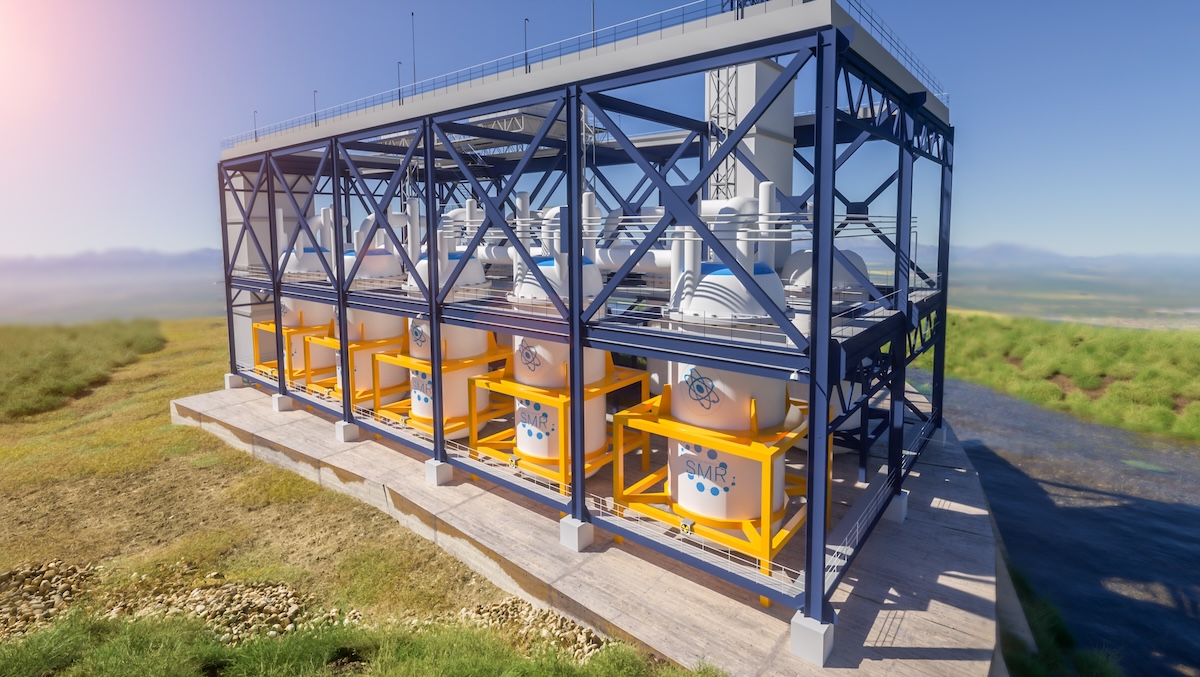
In February, the government announced its “Nuclear Energy Mission” to reinvigorate the sector. It wants to generate 100 gigawatts of power from nuclear facilities by 2047, up from about eight gigawatts today. The government is budgeting 200 billion rupees ($2.3 billion) to support research and development for small and modular reactors, with a goal of getting five such facilities up and running by 2033.
The mission “is ambitious, and I believe it is timely,” says Nandakumar Janardhanan, an energy expert with the Institute for Australia India Engagement.
Asian countries have shied away from nuclear as an energy source since the meltdown of the Fukushima plant in Japan in 2011. Governments in the coal-guzzling region are showing renewed interest in nuclear to meet their renewable energy transition goals.
Unlike traditional plants, which produce large quantities of highly toxic waste that present serious public safety concerns, new technologies offer the promise of virtually unlimited renewable, clean and waste-free power. Small reactors, meanwhile, are more manageable from a cost and safety standpoint, says Janardhanan. “India has no other way to move to a low-carbon energy mix.”
Emerging technologies
India already has a design for a small, 220-megawatt reactor using heavy pressurized water – similar to the technology used for its large reactors. It is seeking new designs to build powerful small-scale reactors of up to 300 megawatts with the potential of being standardized and manufactured in a factory. Such models could power energy-intensive industries, like steel and aluminum.
Hyderabad-based Hylenr Technologies has developed a reactor that uses low-energy nuclear reactions to generate excess heat for power. The company hopes to create a compact model for a continuous source of energy that could be used for specialized purposes, such as powering space missions.
Two other startups – Pranos Fusion and Anubal Fusion – founded last year are developing nuclear fusion technology, an ambitious yet advancing process for generating virtually infinite clean energy by replicating the atomic reactions in the sun.
The Pranos team is studying the use of plasma to fuse atoms to produce energy. It is for now working on simulations to figure out how the plasma will behave and react, says Seth, whose firm Industrial 47 backed the company.
“Modeling can actually be a very low-cost way to get into nuclear fusion,” he says.
Pranos hopes to be able to develop a tabletop prototype system for fusion reactors in the next 12 to 18 months, Seth adds.
Anubal Fusion is attempting to crack nuclear fusion using high-powered lasers.
“It’s going to need some high-powered computing, simulations, and some smart people,” says Rajaram, whose firm Speciale Invest made an equity investment in Anubal last year.
Anish De, global head of energy and natural resources at KPMG, is encouraged by new developments in the nuclear sector, but skeptical that commercial production from new methods or reactor formats is possible within a couple years.
“Such advanced, compact and mass-manufacturable reactors will require a decade of rigorous testing and demonstrations,” he says. He expects commercial models to be ready only after 2035.
Private sector engagement
Such engagement by private companies and investors is exactly what India’s government is hoping to achieve through the Nuclear Energy Mission, as well as possible regulatory changes. Historically, the government has controlled nuclear energy production with strict laws that put unlimited liability for any nuclear incident damages on nuclear equipment and material suppliers and plant operators. This has deterred private companies’ engagement in nuclear plant development.
Now, the government has indicated it will relax these laws and is actively seeking private partnerships to build its small reactors. The Naveen Jindal group and Tata Power have shown interest in producing nuclear energy under a revised regulatory framework.
Investors are hopeful that the government’s thrust on nuclear will benefit startups. Government missions for other industries, like semiconductors, have opened up grant funding to seed new tech startups and frameworks to collaborate with the public sector, observes Speciale Invest’s Rajaram. “All of those have been very helpful.”
Numerous kinds – and large volumes – of capital will be needed to fund research, development, construction and scaling of different nuclear components and systems, small and large, says Sama Bilbao y León of World Nuclear Association, a trade association based in London.
“There is opportunity for investment [across] the entire value chain of nuclear,” she says.