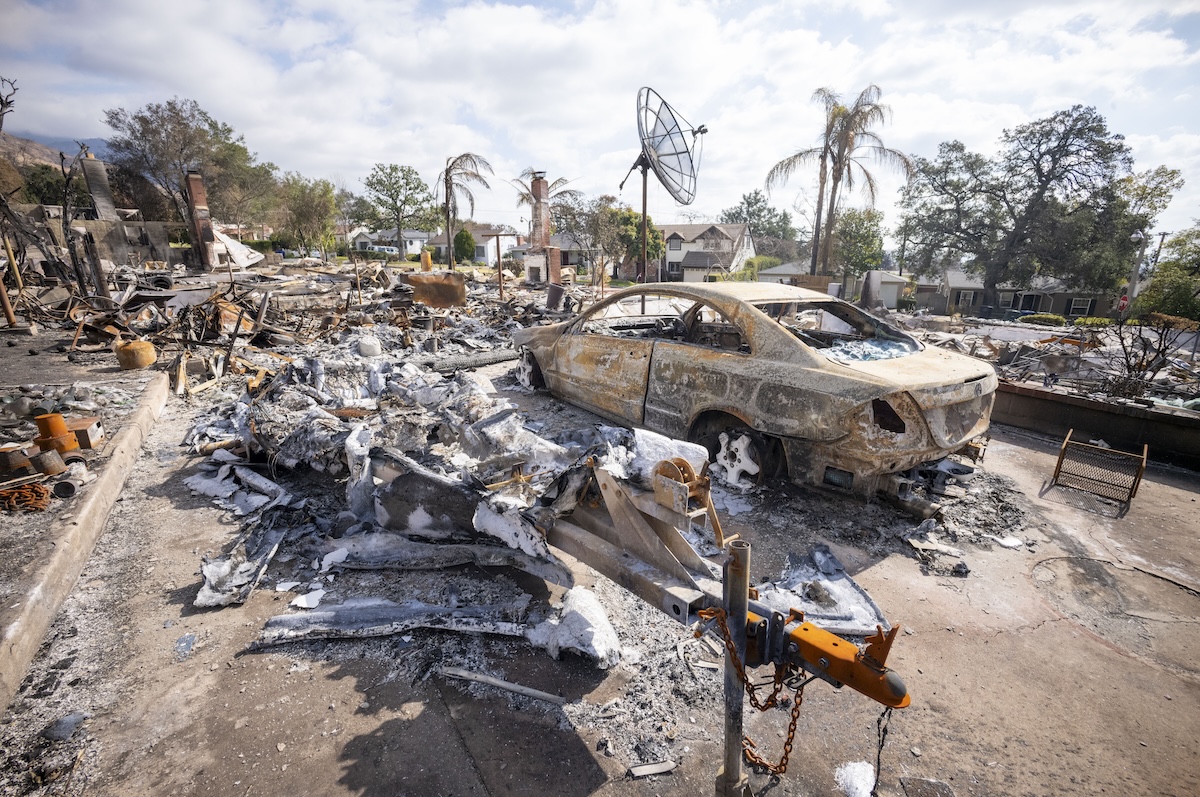
It wasn’t only houses.
The string of blazes that tore through the Pacific Palisades, Altadena, and other Los Angeles neighborhoods destroyed recreation centers, street lights, water pumping stations and much more. The damage to public infrastructure in the city of Los Angeles topped $350 million in the first three days of the fire, according to a city report.
Much will have to be rebuilt. But the fires themselves have made paying for it all that much trickier.
The Los Angeles fires have underlined the escalating climate risks to the once-sleepy municipal bond market. As the climate conspires to upend this market, muni issuers and investors could be thrown for a loop.
Already, the ratings agency S&P has downgrades bonds issued by the Los Angeles Department of Water and Power, while rival rating agency Fitch has put a host of LA issuers on Rating Watch Negative, meaning they are now more likely to be downgraded than they were before the fires.
“This is a big deal,” says Tom Doe, founder and president of Municipal Market Analytics (MMA), an independent research firm. “Mike Tyson said: ‘Everybody’s got a plan until you get a punch in the face, right?’ Well, I think this was a pretty good punch.”
Ratings downgrades
US cities and counties often issue debt to fund public spending. There are some $4 trillion of municipal bonds – or ‘munis’ – outstanding, and analysts polled by Bloomberg expect around $500 billion to be sold this year, paying for everything from schools to sewer systems.
The debt instruments are typically snapped up by institutional and retail investors, helping fill out the fixed income allocations in workers’ retirement accounts and mutual funds. Pimco’s Municipal Bond Fund, for example, has some $3.3 billion of assets under management. Nuveen’s High Yield Municipal Bond Fund has $14.8 billion.
The bonds are seen as safe, higher-yielding than some other credits, and essentially boring. An added bonus is their tax-exempt status – making their interest payments that much more valuable.
To be clear, there’s no indication (yet) that fire-affected muni issuers will default on their obligations. In a public webinar on the implications of the disaster on credit markets, Amahad Brown, who analyzes US local governments for rating agency S&P, said “there’s considerable strength across Los Angeles County, with total taxable valuations of around $2 trillion” that should support local issuers.
S&P’s downgrade on bonds issued by the Los Angeles Department of Water and Power was partly out of concerns it could be found liable for contributing to the fires’ outbreak. Rival rating agency, Fitch, also put a host of LA issuers on Rating Watch Negative.
These warnings echo other, earlier crises that shook muni markets. Hundreds of municipal issuers were battered by Hurricanes Milton and Helene last year, for example. And the future looks worse. S&P analysis suggests that 545 US counties are exposed to two or more types of climate shocks under a medium-to-high likelihood climate change scenario.
Alice Hill, senior fellow for energy and the environment at the Council on Foreign Relations and former senior director for resilience on the National Security Council, spells out why climate shocks are such a threat to muni issuers. LA’s woes put this risk front and center.
“With homes destroyed, people move away. Businesses close. Property values decline. In turn, tax receipts drop, limiting available cash for municipalities to pay their debts. Rebuilding efforts can bring back revenue over time, but as climate extremes continue to pound communities, those communities could find themselves in a downward economic spiral.”
Adaptation financing
The scope of Los Angeles’s challenges could also provide the catalyst for much-needed changes in how local governments prepare for disasters. “They’re going to have to invest in – prioritize – adaptation projects to help mitigate future climate risks,” says Doe.
Adaptation investments could well become mandatory for issuers in high-risk areas. A hefty chunk of the revenues used to pay back bonds come from property taxes. If climate shocks destroy homes, or cause their values to fall, then local governments’ tax revenues will shrink, making it harder to honor their obligations.
S&P’s Brown said local governments with smaller tax bases or limited liquidity could come under pressure “from reduced assessed value or decreasing local economic activity” caused by climate-related disruptions.
“Climate change can undermine the long-term credit worthiness of at-risk communities, especially if they are not investing in adaptation to reduce climate-worsened damage,” says Hill.
Market participants may not even wait for another extreme weather event before taking issuers to task, according to Frank Frievalt, director of the Wildland-Urban Interface FIRE Institute at Cal Poly San Luis Obispo. “When does it get recognized in the bond ratings that the revenue stream is coming from properties that we’re now starting to talk about being either underinsured or uninsurable?” he said on a recent episode of the Climate Proofers podcast.
“I think that’s an important point because if it does, it’ll be the first time local government has a direct financial consequence [from a climate-related disaster].”
Changes to federal policy floated by the new Trump administration could bring a muni market reckoning sooner rather than later. In his first week in power, the new president set up a council to review the Federal Emergency Management Agency (FEMA), which spearheads the government’s response to disasters. Among other things, the council will consider whether FEMA can operate more as “a support agency” to states’ own disaster relief efforts.
This could be a prelude to curtailing federal dollars for extreme weather events. Project 2025 — a roadmap for a Republican administration authored by the right-wing Heritage Foundation – calls on states to shoulder 75% of the costs of small disasters, with the federal government taking the remainder. Following “truly catastrophic disasters”, the federal government’s share would be capped at 75%.
A halt to federal aid could prompt cities and states to spend more to climate-proof their populations. Doe at MMA already believes muni bond issuance will rise to $1 trillion a year by 2035 to reflect the need for state and local governments to overhaul their infrastructure and protect people from climate shocks.
Not every locality will be free to ramp up issuance. Susan Crawford, senior fellow at the Carnegie Endowment for International Peace and writer of Moving Day, a blog on climate risk and adaptation, says that without a change in the system, “you will see a divide between cities that have the capacity to investigate their own physical climate risk and issue bonds accordingly, and cities that have none of that”.
One thing that could change the game is a scale-up of state bond banks, institutions that offer low-cost capital to localities by pooling loans from across communities. Bond banks are currently active in 13 states, according to the Brookings Institution.
Repricing risk
Another open question concerns muni’s tax-exempt status. Today, this acts as a de facto federal subsidy to state and local issuers. Investors like the tax exemption, and are therefore willing to accept lower interest rates from municipalities. Doe at MMA says this implicit subsidy comes to $40 billion a year.
There’s no guarantee that this exemption will be around forever. President Trump is keen to extend, and even expand, corporation and income tax breaks passed under his last administration. To stop this from exploding the deficit, lawmakers will have to find offsets – and the muni tax break could find itself in the crosshairs. “Right now the discussion is that the new administration wants to eliminate the exemption so that he [Trump] can extend his tax cuts,” says Doe. This could dent the appeal of munis.
Crawford isn’t so sure, though. “I think the appetite of investors is in place and not going to go away,” she says. “For them [investors] it’s a check-the-box enterprise. This is something that is categorized as lower risk than equities, therefore we need more of it in our portfolio,” she adds.
If the exemption is scrapped, one knock-on consequence could be that investors become more choosy about issuers based on their climate risks.
“People want to avoid paying taxes to such a large degree that they’ll buy municipal bonds even when there’s risks that they’re aware of, and that demand is so significant is that there’s almost no differentiation between in a city that has, let’s say, wildfire risk, and one that doesn’t,” says Doe.
Without the exemption, Doe says “maybe” this differentiation would happen.
Crawford agrees: “The ground really is shifting for bonds in riskier places, and it is high time that the markets started pricing in physical climate risk,” she says.
Louie Woodall is the editor of Climate Proof, a publication on climate adaptation finance, tech, and policy.