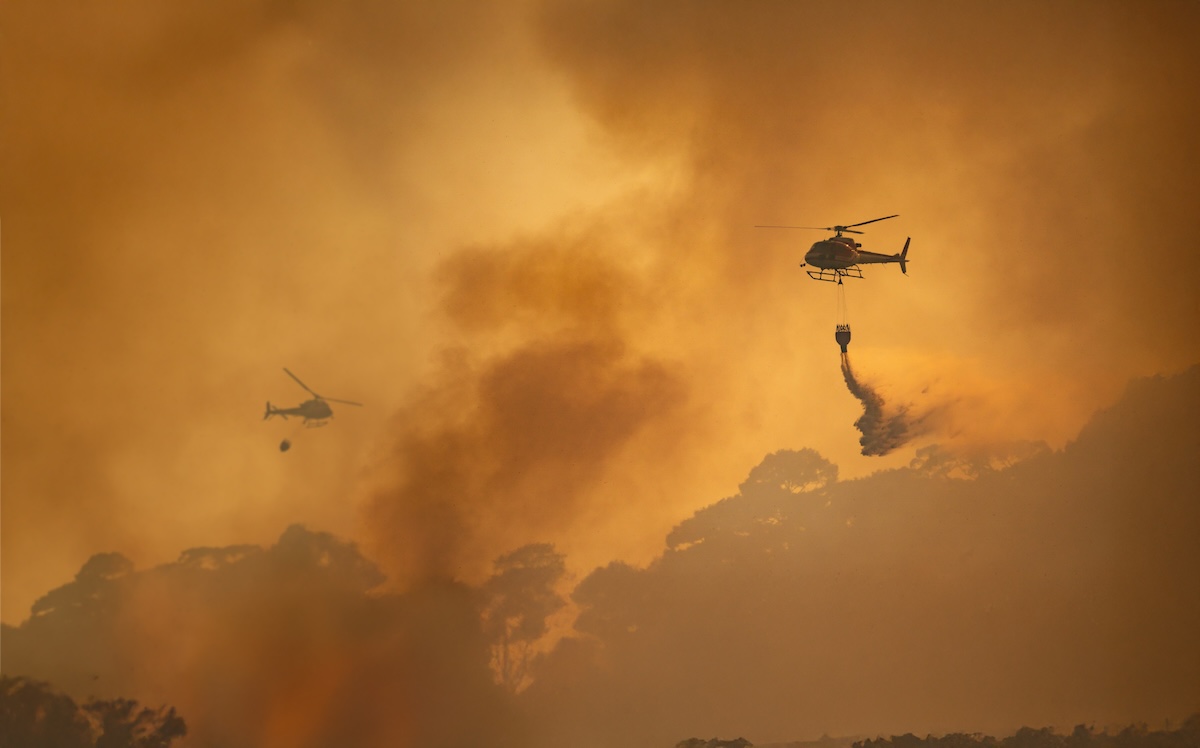
In September, it was Hurricane Helene and too much water. In January, it’s the Los Angeles firestorms and not enough water. Fueled by 100-mile-an-hour Santa Ana winds, the fires have killed at least two dozen people and destroyed thousands of homes.
The recurring reminders of a changing climate are spurring what Lightsmith Group’s Jay Koh calls the “unavoidable opportunity” of climate adaptation.
It is still unknown what sparked the fires in the Pacific Palisades, Altadena and other Southern California neighborhoods. Lightning has been ruled out; the other most common causes of such outbreaks are downed utility lines and human activity.
San Francisco-based Gridware has mounted tens of thousands of AI-powered sensors on utility poles to quickly detect anomalies that could affect the grid’s performance and ignite wildfires. On one of the hottest days last year, Gridware’s sensors helped detect a fallen tree on a power line that could have resulted in a catastrophic wildfire, says the company’s CEO Timothy Barat.
Gridware last week raised $26.4 million in Series A financing, led by Seqoia Capital, with participation from existing backers Fifty Years, Lowercarbon Capital, True Ventures, and Convective Capital.
Grid management
Barat got the idea to launch Gridware in 2009 while working as an electrical lineman in Australia. During Australia’s Black Saturday bushfires, the country’s deadliest, Barat says he “witnessed firsthand how the dangers of a vulnerable power grid are exacerbated by a lack of visibility.”
Since wrapping up a pilot with PG&E, which a year ago agreed to pay $45 million for its role in igniting the 2021 Dixie fire in Northern California, the company has signed on 18 major utilities in the US covering 1,000 miles of transmission lines.
“Power utilities require novel and emerging solutions to drive grid transformation and resilience,” Barat says.
He says Gridware’s revenues grew seven-fold last year.
Fire detection
No fire tech could have prevented the still-raging fires in Los Angeles, which broke out during a dry spell in what is normally the region’s rainy season. The average global temperature last year was more than 1.5 degrees Celsius warmer than the historical average, making it the warmest year on record and breaching a critical warming threshold.
San Francisco-based Torch Sensors has brought to LA an inventory of its early wildfire detection sensors, powered by AI and solar, to assist firefighters in monitoring for re-ignition.
“We have enough sensors for 300+ acres of real time coverage and can redeploy to areas needed most,” Torch Sensors’ Joseph Morris shared in a Linkedin post.
Convective Capital says it has a global pipeline of 600 wildfire tech startups. Its first fund raised $35 million in 2022; it’s seeking $75 million for its second fund to invest in early-stage startups that can detect and contain wildfires. Clerico, with support from the Gordon and Betty Moore Foundation, also runs the annual Red Sky Summit, which brings together fire tech funders and entrepreneurs (here are the takeaways from the November event). In Convective’s portfolio is Pano AI makes wildfire sensors to locate where new wildfires are being sparked. BurnBot is building robots and remote-controlled vehicles that can chop and burn invasive plants and other vegetation that fuel wildfires. Vibrant Planet makes software to help land managers implement better fire prevention and forest health practices.
In November, CrowdDoing’s Catastrophic Wildfire Prevention Consortium presented 10 wildfire tech startups, including the data-modeling platform Vibrant Planet, and Strong Water, which claims to increase the fire-fighting effectiveness of water by up to 10x.
People-powered relief
As in Asheville, NC, after Helene, a powerful mutual aid effort has sprung into existence in LA, as neighbors help neighbors cope with extreme loss and confusion. SidePorch’s Sean Knierim, whose family lost its home in the Palisades fire, recommends Community Organized Relief Effort, founded by Sean Penn and Ann Young Lee after the 2010 earthquake in Haiti. GoFundMe has compiled individual verified fundraising campaigns for fire victims on a single page.
Residents have also compiled spreadsheets to help displaced Black families and displaced Latino families. California Community Foundation’s wildfire recovery fund supports housing, case management, mental health, and medical care for displaced residents. The nonprofit Forestry and Fire Recruitment Program, based in LA, trains formerly incarcerated firefighters to work as wildland firefighters and forestry technicians.