Editor’s note: In Part 3 of this three-part series on neighborhood revitalization strategies in West Baltimore, ImpactAlpha’s Roodgally Senatus takes us on a visual tour of strategies that are restoring vacant houses to foster home ownership and community wealth in disinvested neighborhoods.
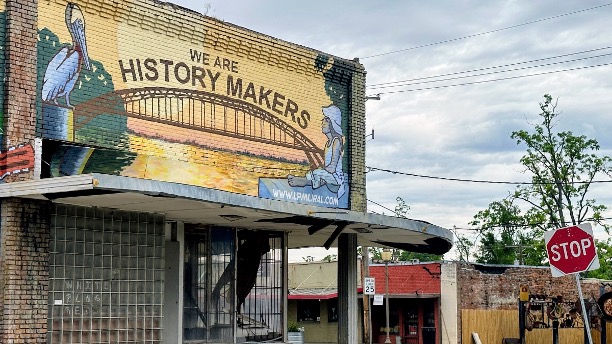
Across the street from a tiny yellow grocery and tobacco store on West Baltimore Street, the dilapidated Ford Building has languished, one of tens of thousands of blighted and vacant buildings in West Baltimore’s “Black Butterfly.” A vacant lot behind the one-time carriage factory has become a garbage dumping ground.
Once it is redeveloped as a 30,000-square-foot mixed-use space for retail, performances and artist lofts, the four-story building is expected to anchor a full-block revival of the once-bustling commercial strip of the Union and Franklin Square Park neighborhoods.
The three upper floors upstairs will have 30 affordable apartment units for local residents. At another building on the same block, housing priority will be given to single mothers and widows at a minimum rental rate of 30% of the area’s median income. A community-based microgrid will power the buildings with solar energy. ImpactAlpha visited the project site last month.
“People want to live here. I live here and I’m a Harvard Business School-educated woman,” says Nadine Ngouabe Dlodlo, the developer and West Baltimore resident behind the $17 million Ford Building project. “We deserve to have a thriving community.”

Dlodlo’s development firm, Women’s Home Preservation LLC, and its affiliated nonprofit Home Preservation Fund, last month secured $1.6 million from the Maryland Energy Administration. The grant was made through the state’s Maryland Smart Energy Community program, designed to provide local communities with technical assistance and financial incentives to implement energy-efficiency and clean energy upgrades.
“We’re bringing clean energy to power all of the housing units and commercial spaces on West Baltimore Street and possibly neighboring homeowners as well,” Dlodlo said. “The idea is to make this corridor future-proof and sustainable. We don’t want to retrofit 10 or 15 years down the line.”
The grant will provide immediate capital to break ground on the project this fall. Women’s Home Preservation has locked down project partners, including the global architecture firm Gensler and Whiting Turner, a national general contractor and construction management company.
By bringing in such strategic partners to support South Baltimore’s community revival, Dlodlo hopes to attract federal dollars, including incentives earmarked for Justice40 communities from the Inflation Reduction Act (for background, see, “Justice40: Frontline communities step up to deploy historic federal climate funding”). Federal and state efforts to promote racial equity, she says, “have to show receipts that they’re actually investing in our communities.”
Dlodlo is also looking to bring on large financial institutions and other partners to help drive the neighborhood’s sustainable economic development. The neighborhood is close to M&T Bank Stadium, home of the Baltimore Ravens, and to I-95, the main route to Washington, DC.
The ethnically-diverse and underinvested neighborhoods of Union and Franklin Square Park were thriving Black neighborhoods before redlining and blockbusting ushered in decades of neglect. Now, they are at risk of displacement and gentrification as speculative developers buy up vacant lots and buildings.
“It makes no sense that we still have this structural disinvestment,” Dlodlo told ImpactAlpha. “You have a lot of speculative developers who come into these communities to buy cheap and just let the property just sit, and they wait for the market to turn.”
Anti-displacement
In Part 1 of this series, ImpactAlpha introduced Parity, the nonprofit development company headed by Bree Jones. Parity is acquiring and fixing up dilapidated rowhomes in the historic majority-Black neighborhood of Harlem Park in northwest Baltimore for sale to “legacy residents” who share a vision of community wealth and thriving neighborhoods. Parity expects home buyers to reap an immediate equity boost of at least $100,000.

In Part 2, we took a deep dive into WaterBottle, the worker-owned co-op holding company led by David Lidz that includes Appalachian Field Services, a social enterprise construction company, and Rising Housing, an impact real estate portfolio management firm. Through the two entities, WaterBottle’s 34 Black and Latine worker-owners are purchasing and redeveloping distressed single-family homes in West Baltimore neighborhoods like Coppin Heights, Midtown-Edmondson and Liberty Square.
WaterBottle leases the homes to local marginalized residents at affordable rental rates that give them the option to buy into a portion of the property’s equity. The workers rehabbing the houses also get a share in the ownership of the homes.

Dlodlo’s Women’s Home Preservation bolsters such neighborhood revitalization strategies with a specific focus on building and preserving community real estate wealth and independence for single mothers and widows, and on clean energy, which lowers energy costs and improves air quality.
Like Parity and WaterBottle, the development company is aiming to drive community revitalization and ownership without displacement. Dlodlo’s Women’s Home Preservation is looking to buy the mostly-vacant block before speculative buyers scoop it up and further exacerbate Baltimore’s vacant real estate problem.
Women’s Home Preservation aims to put communities in control of neighborhood real estate assets and support local business ownership. The goal: to prevent the displacement of longtime residents and small business owners as neighborhoods change and gentrify. Dlodlo says she hasn’t set up a structure of shared ownership as of yet, but is strengthening Women Home Preservation’s governance structure as a means to combat displacement.

Community “corridor models” are emerging in Kansas City, Philadelphia, Los Angeles, and other US cities. On Kansas City’s east side, Jeff Mendelsohn’s LocalCode is partnering with Black female real estate developers on two large mixed-use commercial developments that will be majority owned by local residents once they’re completed and stabilized.
In Philadelphia’s Kensington neighborhood, a former textiles district a few miles northeast of downtown, Adriana Abizadeh’s Kensington Corridor Trust is using a neighborhood trust structure to acquire and redevelop mixed-use commercial properties that are governed by members of the community.
And on San Antonio’s majority-Latino west side, ESTAR West, a community-focused initiative led by former San Antonio mayor Henry Cisneros, is raising a $25 million real estate fund to acquire mixed-use real estate that create affordable housing for local residents and retail stores for local small business owners.
From Cameroon to West Baltimore
Women’s Home Preservation draws its name from Dlodlo’s own life experiences growing up in Cameroon with a widowed single mother and, after she came to the US, as an immigrant single mother herself.
Dlodlo was born to a middle-class family in Cameroon’s capital, Yaounde. Her tribe, the Bamileke, have a reputation for being “very industrious people,” she says. Her mother was an executive at a large bank and her father, an executive-level employee of the Cameroonian equivalent of the US Internal Revenue Service. Dlodlo’s father built a real estate housing portfolio with homes that were leased to international aid agency workers from Europe.
“Every now and then, my siblings and I would come back from school and find a lot of art at home,” she recalled. “We knew that one of his properties was ready to be shown because he was showing that property to Europeans who loved art.”
Dlodlo, the second of five children, lost her father suddenly at 15 years old. “He wasn’t sick. He just felt unwell and they took him to the hospital, and the hospital later pronounced him dead,” she remembered teary-eyed.
Dlodlo’s said her widowed single mother was hit with lawsuits from her father’s extended family in an attempt to snatch their real estate wealth. “When you’re a widow, the moment your husband dies, they’re coming for you,” she says. “But I never thought that would happen to my mom because she’s educated and had a powerful position at a financial institution.”
Dlodlo completed her undergraduate studies with a Bachelor of Commerce at the University of the Witwatersrand in South Africa. She gave birth to her now young-adult daughter, and held several positions in corporate banking and international government relations before coming to the US in 2006. When she moved to Washington DC after completing her MBA studies at Harvard Business School, she was desperate to make a transition from renter to homeowner at a time when most parts of DC was experiencing a surge in gentrification.
“Homeownership is essential. In my culture, you own your home before you even own a car,” she joked. “And here I was, having worked so hard in my life, having suffered the way I’d suffered, and reached the pinnacle of education at Harvard Business School, but I wasn’t able to buy a house.”

Angered by DC’s changing real estate market, Dlodlo and her daughter moved to Baltimore in 2019. Looking around at the vacant, abandoned buildings, especially on the city’s west side, she launched Women’s Home Preservation with support from community leaders in the Union and Franklin Square Park neighborhoods.
“When I got to West Baltimore and shared my vision with the community, they said they’d been looking for something like this since 2013,” says Dlodlo. “They had put forth a vision called the International Village in Union Square to rebuild that commercial corridor, where people of all nationalities, races and everything could find something relevant.”
Community-centered
Women’s Home Preservation has attracted grants from the city’s Affordable Housing Trust Fund, the state’s Historic Revitalization Tax Credit program, and the federal government through the National Park Service’s Historic Preservation Tax Incentives program. The grants will finance the renovation of the Ford Building and four other small to mid-sized mixed-use properties on W. Baltimore St, including a six-story mixed-use building with affordable apartment units and retail. The mixed-use project will have a bookstore-cafe and Dlodlo’s African-print online clothing store Isonah (named after her daughter).
Further financing came from The Reinvestment Fund, a Philadelphia-based community development financial institution, and Southwest Partnership, a coalition of seven Baltimore neighborhoods and institutions, including University of Maryland, Union Square Association, Franklin Square Community Association and the Barre Circle Community Association.
Women’s Home Preservation, through the Home Preservation Fund, is looking to raise $20 million to finance the Ford project and other smaller projects on the block. “Once the projects are stabilized, we can refinance and put in a mortgage, and then pay the limited partners,” Dlodlo says.

Women’s Home Preservation has brought on Bif Browning, the president of Union Square Association, and Donnel Nance Jr., a longtime resident and native of Union Square Park, as strategic advising partners. She hopes to engage more community leaders to increase the efficiency of the redevelopment projects.
“We are running out of time because of the speculative interests that are coming on the back of our hard work, and those speculative interests are counterproductive to what we want as a future,” adds Dlodlo. “It’s all about extraction for them, bringing things [like] drug rehab clinics that make money for them, and other things that are essentially profit-centered but not community driven.”
Women’s Home Preservation is developing a pavilion for its Empowering Next Generations initiative, a youth workforce development program for high school students that are interested in real estate careers. Women’s Home Preservation plans to transform an outdoor alley into a “sustainable green enclave” where local artists could hold performances.
“Anti-displacement is also building a community that is healthy and sustainable,” she says.