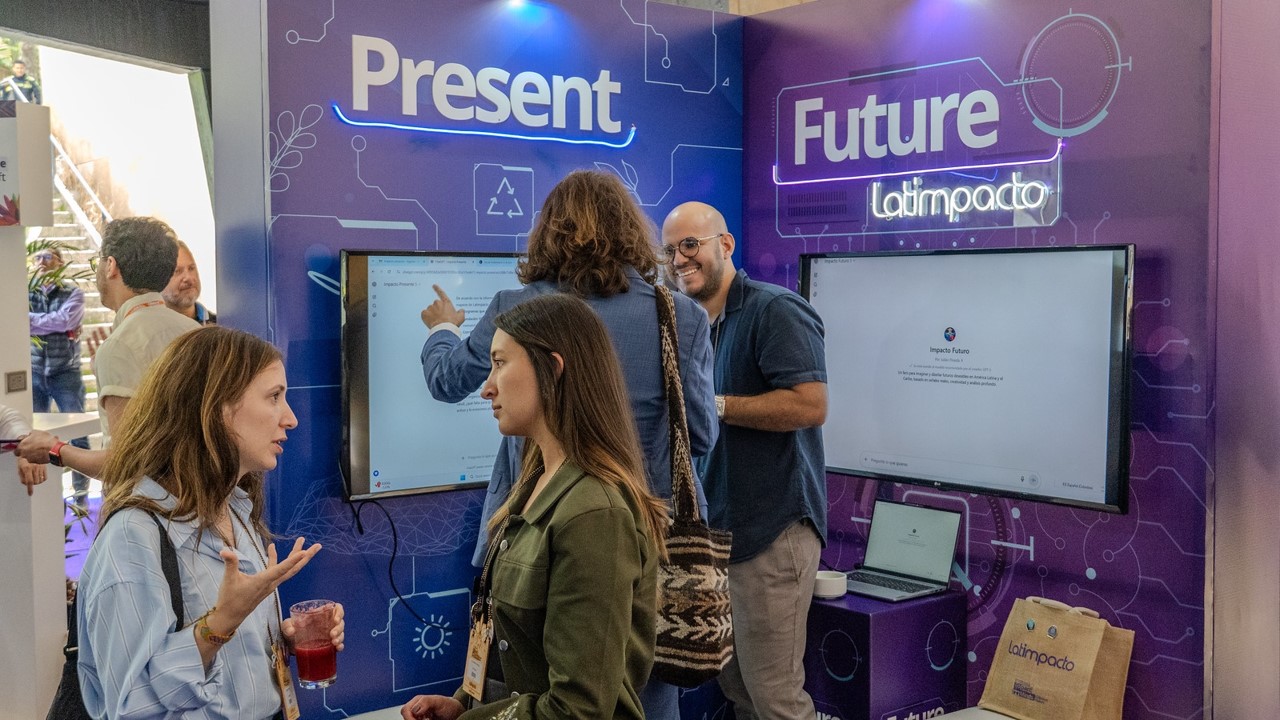
Medellín, Colombia, the city of eternal spring, became the epicenter of Latin America’s impact ecosystem this year, as more than 780 investors, philanthropists, corporate leaders and ecosystem builders from 41 countries gathered for Latimpacto’s fourth Impact Minds Conference: Collective Makers. The event showcased how collaboration across the Continuum of Capital, from philanthropy to impact investing, is shaping a new era of systemic, locally grounded impact in the region.
From collaboration to transformation
Latimpacto’s CEO María Carolina Suárez set the tone, saying, “Resilience flourishes when it is nourished by the diversity of voices, trust and the conviction that another future is possible.” That conviction permeated the three-day event, as participants shared examples of blended finance, regenerative development, gender-lens investing and AI for social good, all under the banner of collective transformation.
The 2025 edition stood out not only for its scale but also for the quality of its content. A crowdsourced academic agenda emerged from more than 200 proposals, resulting in 68 sessions and 246 speakers representing global leaders such as the Rockefeller Foundation, Citi Foundation, Bayer, Visa, UNICEF and Roots of Impact.
Panels explored the region’s most pressing questions, including how to finance systemic change, measure what matters and build local capabilities in a world of uncertainty and technological disruption.
Capital with purpose
The event’s core message was clear: Latin America’s future impact will be built on capital that collaborates. Discussions on the Continuum of Capital, from catalytic philanthropy to commercial investment with purpose, underscored the need for trust, flexibility and multi-stakeholder partnerships.
Leaders such as Kristen Molyneaux of Lever for Change and Daniela Konietzko of WWB Foundation shared frameworks for blended finance that move beyond risk mitigation to ecosystem transformation. The “ALMA” model — Align, Leverage, Mobilize, Amplify — captured the spirit of collaboration, emphasizing the creation of shared value and trust across public, private and philanthropic actors.
At the same time, impact investors like Patricia Sáenz of Ewa Capital and Raúl Pomares of Sonen Capital highlighted the importance of rigorous impact measurement to counter “impact washing.” Their call: Understand, measure and communicate impact as the region’s new competitive advantage.
New frontiers: AI, regeneration and gender equity
Technology and regeneration emerged as transversal themes. A session moderated by Latimpacto’s Carolina Suárez brought together IBM, Lenovo, and grassroots educators to address Latin America’s STEM and AI skills gap. With 63% of employers citing lack of skills as the top barrier to transformation, speakers argued for a human-centered approach to AI, one that empowers rather than excludes.
The climate and biodiversity agenda went beyond sustainability toward regeneration, as Dr. Eduard Müller from the University for International Cooperation urged the region to “not only reduce harm but restore life.” Universities like EAN and organizations like CAF and Fundación Neotrópica presented models linking regenerative business, ancestral knowledge and territorial innovation.
Equity also remained central. Sessions on gender-lens investing emphasized both the barriers women entrepreneurs face and the growing pool of women investors eager to channel capital into female-led enterprises, provided they receive technical support and access to networks.
Impact through democracy, culture and health
In a year marked by political uncertainty, democracy and civic engagement took the stage. Foundations such as SURA, Ford, Corona, and Gaia Amazonas framed democracy not just as governance, but as the right to listen, co-design and coexist with diversity. From land titling for 25 million hectares of Indigenous territories to participatory grantmaking, these initiatives reflect an expanded definition of impact, one that integrates dignity, participation and rights.
Health innovation panels demonstrated how impact investing can strengthen fragmented public systems. Organizations like Artemisia, Fiocruz, and Bayer Foundation shared examples of AI-driven health management, early warning systems and public-private partnerships built on shared governance.
Culture, too, played a starring role. Over 600 organizations applied to the Culture Fund, a joint initiative by Latimpacto and Fundación SURA that seeks to strengthen creative ecosystems as engines of regeneration and inclusion.
An ecosystem maturing and connecting
Impact Minds wasn’t all panels. Sixteen field visits and three immersive journeys across Colombia, from Medellín’s Comuna 13 to Urabá’s collaborative agro-industrial projects, grounded theory in practice, connecting investors directly with communities driving change.
Latimpacto also launched tools to strengthen the ecosystem’s data infrastructure, including SIAL, an AI-powered mapping platform of impact capital flows across Latin America and the Caribbean, and new studies on corporate impact and bioeconomy in partnership with global players like AB InBev, Coca-Cola and Argidius Foundation.
From Medellín to Manaus: The next frontier
Next year’s conference will take place in Manaus, Brazil. Hosting the conference in the heart of the Amazon sends the powerful message that Latin America’s impact future will be rooted in regeneration, inclusion and collective leadership.
This year’s conversations proved that Latin America’s impact ecosystem has reached a new stage of maturity, one driven not by isolated projects but by collaborative efforts, weaving together capital, culture and communities to redefine what development looks like in the Global South.
Manuela Jiménez López is a knowledge coordinator at Latimpacto.
Guest posts on ImpactAlpha represent the opinions of their authors and do not necessarily reflect the views of ImpactAlpha.