
Greetings Agents of Impact! Please join us in giving a warm welcome to all of the new subscribers who responded to ImpactAlpha’s holiday offers. The ImpactAlpha team is geared up to bring you your daily dose of impact in what is sure to be an eventful year. Ready or not, here we go. – David Bank
ICYMI: Sweat equity and the 39th president. Now the head of impact investments at the Robert Wood Johnson Foundation, Kimberlee Cornett first met President Jimmy Carter at a Habitat for Humanity build in Houston more than 30 years ago. “POTUS had little appetite for breaks and photo ops. He was there to work, and he expected you were, too,” recalls Cornett, who now serves on Habitat’s board. Carter, who died last week at the age of 100, will be laid to rest this week. As important as the houses he helped build was the awareness that Carter brought to the human right to decent housing as a springboard for better health, wealth and livelihoods. “Jimmy Carter knew that America can’t be great if only some of us are doing great,” Cornett writes in a guest post on ImpactAlpha. “His legacy of service lives on in each person who picks up a hammer, makes a donation, uses the tools of impact investment, or votes for policies that promote inclusion and provide opportunity.”
- Keep reading, “Sweat equity and the 39th president,” by Kimberlee Cornett. (Disclosure: RWJF supports ImpactAlpha’s coverage of Muni Impact.)
In today’s Brief:
- Agricultural drones take off in India
- Critical minerals and metals
- Regenerative farming in Mexico
- Measuring what matters and other 2025 trends
Featured: Impact Tech
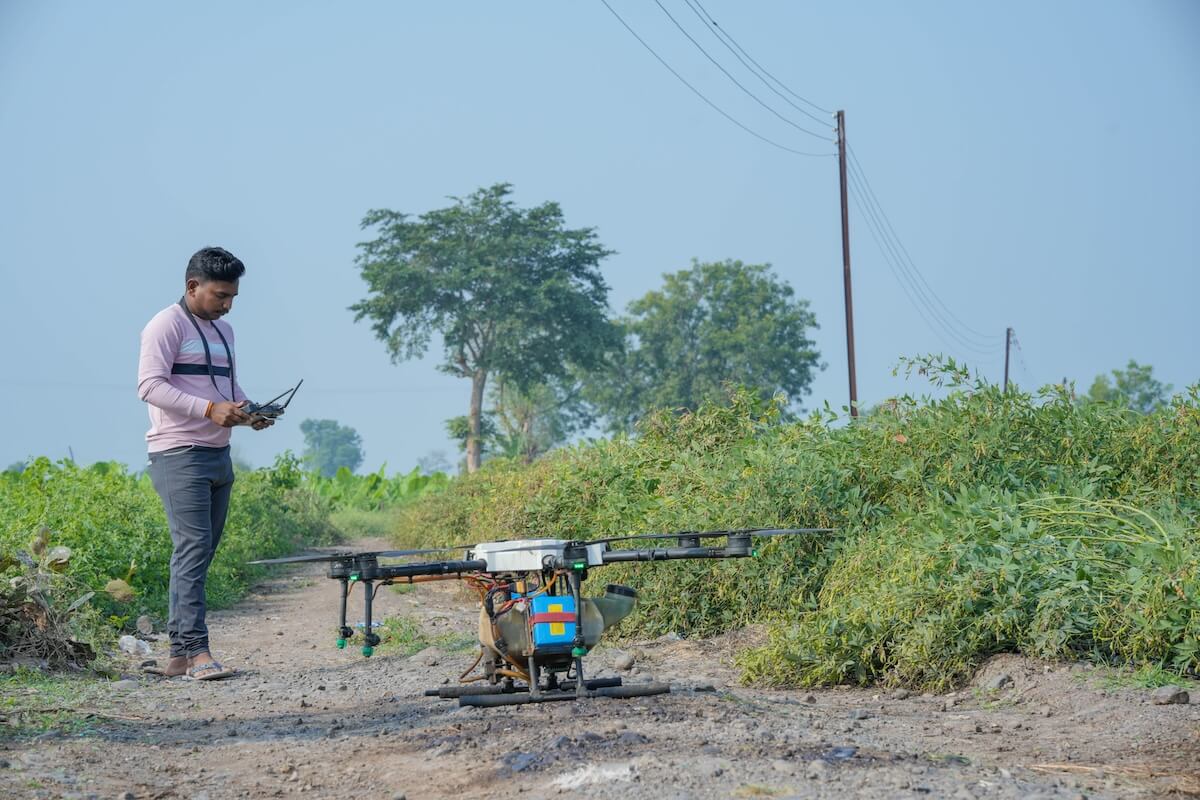
Investors bet on drones to lift agricultural productivity and women’s livelihoods in India. Aerial drones are raising alarms in national security circles as they are increasingly deployed for surveillance and warfare. In India, investors see a role for the technology in strengthening livelihoods and generating rural job opportunities. India’s drone startups are selling and deploying unmanned aerial vehicles across farms for seed planting, crop spraying and farm monitoring. Uptake of the technology represents a potential step-change for Indian agriculture, which is composed mostly of small farms with an average size of five acres. Efforts are being made to educate farmers on drones’ benefits and to train drone pilots. “There’s a lot of waiting to see evidence in your neighbor’s plot before you try it out yourself,” Lok Capital’s Ambika Narayanan tells ImpactAlpha. Lok has invested in agri-drone maker and training company Marut Drones. Gurgaon-based BharatRohan, which uses drones to collect intelligence for precision agriculture, has attracted financing from Villgro Innovation Foundation, Acumen and Upaya Social Ventures. India’s Prime Minister Narendra Modi believes drones have the potential to “revolutionize” farming in the country, along with employment for rural women and young people.
- Drone didis. To spur drone adoption and boost agricultural productivity, India is encouraging domestic manufacturing of drones and drone components. Its Drone Didi program, announced in 2023, promises to train women to acquire and pilot drones as “drone-as-a-service” providers. Another initiative is partnering with drone startups to help rural residents demarcate and secure titles to their land. Among the companies bringing drone-based services, data and insights to India’s traditional, tech-wary farmers are AVPL International, Dhaksha Unmanned Systems, Hubblefly Technologies and Flying Wedge Defense and Aerospace Technologies.
- Village entrepreneurs. The sector needs patient investors: real traction could be at least five years away, says Marut’s Prem Kumar Vislawath. Marut has hosted demonstrations in 14 of India’s states and trained 1,500 pilots through its drone academy. “We’re creating village-level entrepreneurs,” Vislawath says. “We ourselves have to create the market and provide (farmers) enough support mechanisms.”
- Keep reading, “Investors bet on drones to lift agricultural productivity and women’s livelihoods in India,” by Shefali Anand on ImpactAlpha.
Dealflow: Energy Transition
Financing for KoBold and Electra reflects global scramble for key minerals and metals. Climate tech dealmaking started the new year with a bang as KoBold Metals hauled in more than half of a billion dollars for its AI-powered technology to pinpoint critical mineral deposits. The deal spotlights two of the year’s hottest trends: AI and the competition for critical minerals. For Berkeley, Calif.-based KoBold, which is eyeing an IPO, the funding will help develop a massive copper deposit in Zambia, as well as dozens of other exploration projects in its pipeline (for context, see “Finding impact alpha in climate: Betting on the low-carbon transition, against the odds”). The Series C round was led by Durable Capital Partners and repeat investor T. Rowe Price. Also participating were early KoBold backers Breakthrough Energy Ventures and Andreessen Horowitz, as well as Earthshot VC, Equinor, Mitsubishi and others.
- Low carbon steel. Separately, low-carbon iron producer Electra Steel – another Breakthrough Energy-backed company – secured $180 million out of a planned $257 million raise. The Boulder, Colo.-based company uses an electrochemical process to extract iron from lower-grade ores, which can be turned into steel in electric arc furnaces. The process eliminates the most carbon-intensive emissions from steelmaking, which is responsible for 7% of the world’s carbon footprint. Steelmaking is also considered a matter of US national security: the Biden administration last week rejected Japanese steelmaker Nippon Steel’s bid to acquire US Steel.
- Mineral madness. Critical minerals such as copper, lithium, nickel and cobalt are essential for applications spanning construction, EV batteries, transmission lines and defense. President Biden has backed the Lobito railway connecting Zambia and the Democratic Republic of Congo with a port in Angola. The incoming Trump administration has signaled securing a supply of critical minerals is key to national security amid an intensifying competition with China. There is “very broad bipartisan support for diversifying [the] supply of critical minerals,” KoBold’s Kurt House told the Financial Times.
- More.
Regenera Ventures secures $9.3 million for regenerative farming in Mexico. Small farmers are collectively the largest landowners in Mexico. The founders of SVX Mexico two years ago set out to invest in agriculture in a way that nurtures climate-vulnerable food systems, farming communities and the planet. “There’s underlying wisdom that smallholder farmers have that we need to tap into,” said SVX Mexico’s Laura Ortiz (see, “Stewarding capital for Mexico’s regenerative economy”). Ortiz’s new firm, Regenera Ventures, makes equity investments in regenerative land projects using “trust-based finance” – investment terms that it co-creates with its investees. The goal is to help farmers shift to regenerative practices that will restore biodiversity and improve the health of their land, while also building new income streams, including new farm products and carbon credits.
- New backers. Regenera in December inked commitments of $5.3 million from the InterAmerican Development Bank, through its IDB Lab program, and the Green Climate Fund. The US International Development Finance Corp. already committed $4 million to the fund. Regenera aims to raise about $25 million to work with a dozen agriculture companies and support 18,000 farmers. The firm provides technical assistance via its partner Conservation International, which is funded by a portion of the new commitments and a grant from USAID.
- Share this post.
Dealflow overflow. Investment news crossing our desks:
- The US International Development Finance Corp. offered an $18 million loan to Delhi-based Mufin Green to expand from electric vehicle financing to solar financing. (YourStory)
- Baltimore-based Sunairio raised $6.4 million from Buoyant Ventures, MassMutual Venture’s Climate Tech Fund, Constellation Technology Ventures and others for its software that helps renewable energy investors, energy traders and utilities predict risks to the grid and energy infrastructure. (Sunairio)
- Singapore-based Tyme Group, a digital bank for small- and mid-sized businesses in Asia and Africa, raised $250 million in a round led by Brazilian digital bank Nubank. British International Investment, Norrsken 22, M&G Catalyst Fund, Tencent and others also invested. (Tyme Group)
- The International Finance Corp. invested $100 million in the Industrial Development Bank of Türkiye to increase its lending to women-led businesses and to businesses employing women in the southern part of the country devastated by an earthquake in 2023. (IFC)
Impact Voices: Looking Ahead in 2025
The ‘AI impact paradox’ and six other impact investing trends for the coming year. Trendspotting in impact investing is about seizing opportunities. “Those of us who have long been working in this space have always considered chronically underinvested spaces as unrealized alpha,” write Spectrum Impact’s Rehana Nathoo and Eric Stephenson of the Cordes Foundation in a guest post on ImpactAlpha. Among the opportunities they see for 2025: the quiet acceleration of assets into impact, a monumental capital shift toward climate goals, and mispriced risk in emerging markets. “The evidence shows we’re moving beyond impact investing 1.0’s mandate of ‘Do good and make money’,” write the authors. In 2025, impact investors must “build impact measurement systems that actually measure what matters, and continue to add to a growing repository that shows what works and why.”
- AI and impact. Artificial intelligence is revolutionizing every sector of the economy – including impact measurement, thanks to its ability to combine data analysis, predictive modelling and performance reporting. Progress with AI “comes at a cost,” write Nathoo and Stephenson, citing energy use, job security and equitable access. They mention the increased emissions of Microsoft and Google due to AI-related data center expansion, even as the tech giants commit to 100% clean energy goals. “It’s like trying to solve a puzzle while the pieces keep changing shape,” the authors write.
- Keep reading, “The ‘AI impact paradox’ and six other impact investing trends for 2025,” by Rehana Nathoo and Eric Stephenson on ImpactAlpha.
Agents of Impact: Follow the Talent
BlackRock promotes Nicoline Good to corporate sustainability vice president… Emily Thaden will replace Paul Bradley as CEO of Roc USA. Bradley will become CEO of Integrity Community Solutions… Catalyze taps Regina Green, previously head of Goldman Sachs’ Launch with GS, as managing director of investments… Closed Loop Partners is hiring a partnerships associate in New York… OFN seeks a senior vice president in Washington, DC, to focus on environmental, climate and green investment programs.
Community Investment Management is on the hunt for an investment director and investment analyst… Village Capital is looking for a contract-based investment analyst in Mexico… DeepMind is recruiting a sustainability portfolio lead in London… Finance in Motion has an opening for a renewables investment officer in Frankfurt… The nonprofit Catalyze will accept applications for its six-month fellowship for first-time fund managers through Saturday, Feb. 15.
Tensie Whelan and Chisara Ehiemere of NYU’s Stern Center for Sustainable Business will lead a research study with the Multifamily Impact Council to quantify the financial benefits and value drivers of impact-oriented multifamily real estate investments… ImpactAssets is hosting “Transforming capital access for women entrepreneurs,” with Grameen America’s Andrea Jung and SoGal Ventures’ Pocket Sun, in conversation with ImpactAssets’ Sandra Osborne Kartt, Wednesday, Jan. 22.
👉 View (or post) impact investing jobs on ImpactAlpha’s Career Hub.
Thank you for your impact!
– Jan. 6, 2024