
A tricky tech play for the agriculture sector is finding a place among India’s millions of small-scale farms to strengthen livelihoods and generate new rural employment opportunities.
India’s drone startups are selling and deploying their unmanned aerial vehicles across farms for everything from surveillance to seed planting to crop spraying. Hyderabad-based Marut Drones, which is backed by impact investor Lok Capital, manufactures drones and trains drone-operators, mainly for agricultural use. Gurgaon-based BharatRohan, with support from Villgro Innovation Foundation, Acumen and Upaya Social Ventures, uses drones to collect intelligence for precision agriculture.
A raft of other drone manufacturers including AVPL International, Dhaksha Unmanned Systems, Drone Destination’s sister company Hubblefly Technologies, and Flying Wedge Defense and Aerospace Technologies are also bringing services, data and insights to India’s largely traditional, tech-wary farmers.
The proliferation of drone startups operating in agriculture represents a noticeable shift from just a few years ago, when the technology was virtually nonexistent in the sector, observes Lok’s Ambika Narayanan.
“There’s a lot of waiting to see evidence in your neighbor’s plot before you try it out yourself,” she tells ImpactAlpha. But the firm’s backing of Marut Drones in November signals that Lok sees the potential for broader-scale adoption.
Farming with drones
India needs mechanization to improve the productivity and efficiency of its agriculture sector, which is composed mostly of small farms with an average size of five acres. For example, the amount of rice produced per unit of land in India is one third of that in China and half of that in Vietnam and Indonesia.
Land inheritance traditions exacerbate the problem: India’s average farm size has shrunk over time, as land is divided among children and grandchildren each time it passes on to a new generation.
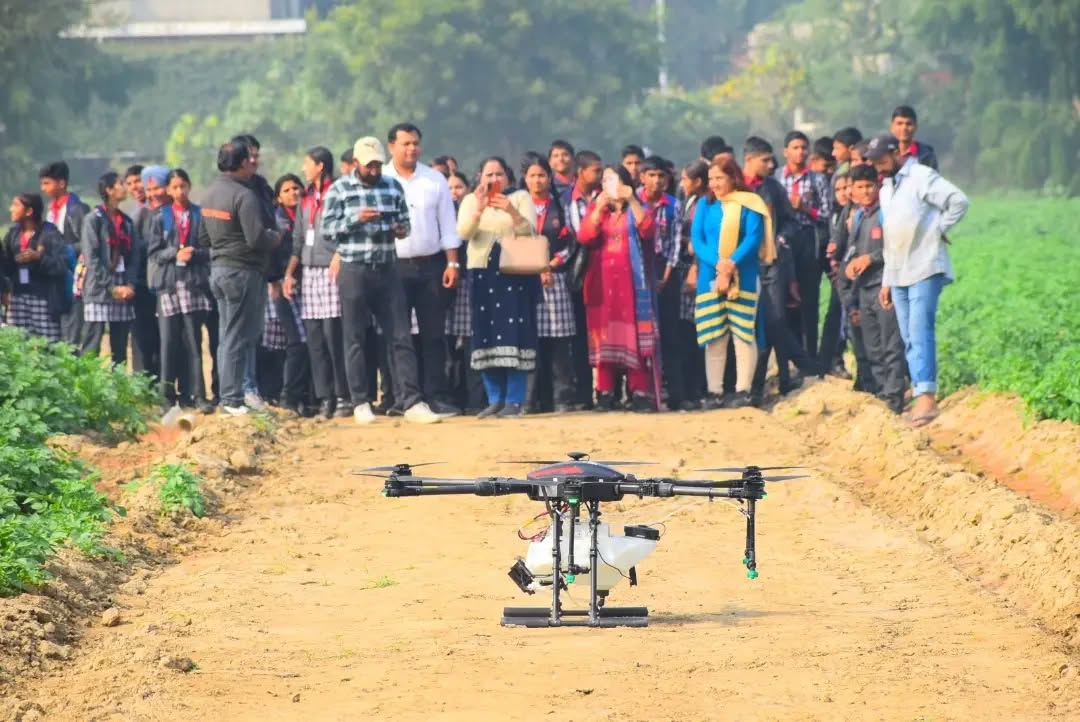
These small farm sizes make India’s agriculture sector well suited for disruption through technology, however. Drones work well in small areas for aerial surveying, in order to monitor crop health and scan for pests and disease. They can also be used to spray pesticides and fertilizers; they do so more uniformly than laborers, and they also reduce chemical health hazards to people.
Drones can also help alleviate a shrinking labor force: many young people are leaving rural areas and agriculture livelihoods to move to cities to earn better incomes.
Policy push
Recently, India’s government has been pushing for the use of drones in agriculture as part of a broader set of policy measures aimed at boosting India’s drone manufacturing and deployment capacity. Prime Minister Narendra Modi, who called drones a “revolution” for farming in India, announced the Drone Didi program in 2023 to train women to acquire and pilot drones in order to boost rural women’s economic opportunities. The program will support 15,000 women’s self-help groups with financial assistance and loans to buy drones. One woman in each group will be trained through the program to become a drone pilot. The groups will then offer their drone surveillance and field assistance services to nearby farms.
Drone Didi is just one program in the government’s drone agenda. It has also announced a scheme to incentivize the manufacture of drones and drone components in an effort to position the country as a “global drone hub.” Domestic interest and adoption has taken off since India’s aviation ministry issued guidelines in 2021 about drone use and licensing of drone pilots.
The policies are impacting fundraising in India’s drone startup scene, where applications range from defense, mining, delivery of pharmaceuticals in remote areas, and grocery delivery in urban areas. Airbound, which seeks to speed up deliveries using drones, recently raised $1.7 million from investors including Lightspeed and Peter Thiel-backed 1517 Fund. Skye Air, a drone delivery services-provider, got $ 4 million. Drone software-maker Aereo has raised nearly $17 million in two rounds this year, while IG Drones, which works in the defense industry, raised a seed round of $1 million.
“A lot more capital would be required in this space to develop both the drone manufacturing capabilities and the drone service-provider ecosystem,” observes Hari Krishnan of Lok Capital.
Drones-as-a-service
Agriculture has been a tough space for drone providers to crack, globally. Drone startups were on a funding tear in the US years ago for their potential in the sector. They didn’t take off as expected.
This was partly because they were being used for monitoring crops over large tracts of land, and companies weren’t willing to pay the high cost of those services, says Mark Kahn of agtech-focused impact investment firm Omnivore. They were also ill-suited for other applications, like crop spraying, on commercial farms.
“The average US farm is too big to be sprayed by little drones,” says Kahn.
In India, the proposed uses of drones for crop monitoring and spraying has better potential for success, he explains. “The average Indian farm is exactly the right size. It’s a much more interesting piece of hardware for India than it is for the US.”
Omnivore hasn’t yet invested in any of India’s drone businesses. “We have stood on the sidelines, trying to see how the space evolves, to see which business model we think makes the most sense,” says Kahn.
Drones-as-a-service seems to have potential, says Lok’s Krishnan. Given the high cost of drones and low farmer incomes, not many farmers would buy drones outright. However, a company or an individual could own one or many drones and rent them out for spraying, seeding and other uses.
“The service-provider play – that is something where we see that adoption could be even faster,” says Krishnan.
Market building
Investors will need to be patient, as it is early days in the market and there are few skilled operators. Efforts are being made to educate farmers on drones’ benefits and to train drone pilots.
Lok’s portfolio company Marut works actively in 14 Indian states to help build this network. It organizes monthly drone yatras, or journeys, in which a vehicle with a drone pilot goes from village to village to demonstrate the use and benefits of drones.
Marut also runs a drone training academy where it has trained 1,500 drone pilots so far. It hopes to use the funds raised from Lok Capital to open more training centers and step up its drone production, says Marut co-founder Prem Kumar Vislawath.
To speed adoption, the company works with anyone who wants to buy a drone, by helping them access government subsidies or connecting them with lenders. It partners with large seed companies to provide drone spraying, and then passes on that demand on to local village drone-owners.
“We’re creating village-level entrepreneurs,” says Vislawath.
He expects real traction could be five years away. “We ourselves have to create the market and provide (farmers) enough support mechanisms.”