
Greetings Agents of Impact!
📞 Get PluggedIn: Latin America is the climate market US investors can’t afford to ignore. From bio-based materials to urban mining and distributed energy, Latin America is a proving ground for bold climate innovation. For the next PluggedIn, Savia Ventures’ Andres Baehr joins Sherrell Dorsey to detail Savia’s investment thesis, as well as practical steps for US and European investors trying to maintain momentum in the face of climate headwinds. Get PluggedIn, Tuesday, Dec. 2, at 10am PT / 1pm ET. RSVP now.
☎️ Agents of Impact Call: Tackling advisor roadblocks. Your clients want to do more with their money. You want to do more with your clients. Financial advisors who engage their clients about their values and offer credible impact strategies can deepen their relationships, prepare for generational shifts and prosper through the Great Wealth Transfer. In this candid conversation, advisors can bring their real questions and concerns: How real is client demand? How do I talk about returns – and tradeoffs? What’s legit in the growing landscape of impact products? Join CapShift’s Liz Sessler, ImpactPHL’s Cory Donovan, Westfuller’s Randall Strickland, Glenmede’s Mark Hays, and ImpactAlpha’s David Bank for this interactive session, Thursday Dec. 11, at 10am PT / 1pm ET / 6pm London. RSVP today.
- Guidance for advisors. ImpactAlpha’s Advisors’ Corner, developed with CapShift, includes a series of “Getting Started” guides, as well as deep dives into natural capital, impact reporting and the coming Great Wealth Transfer.
In today’s Brief:
- Solar installers race deadline for expiring tax credits
- AI-enabled wildfire prediction and prevention
- How the impact investing job market has fared since 2024
Featured: Deploy!
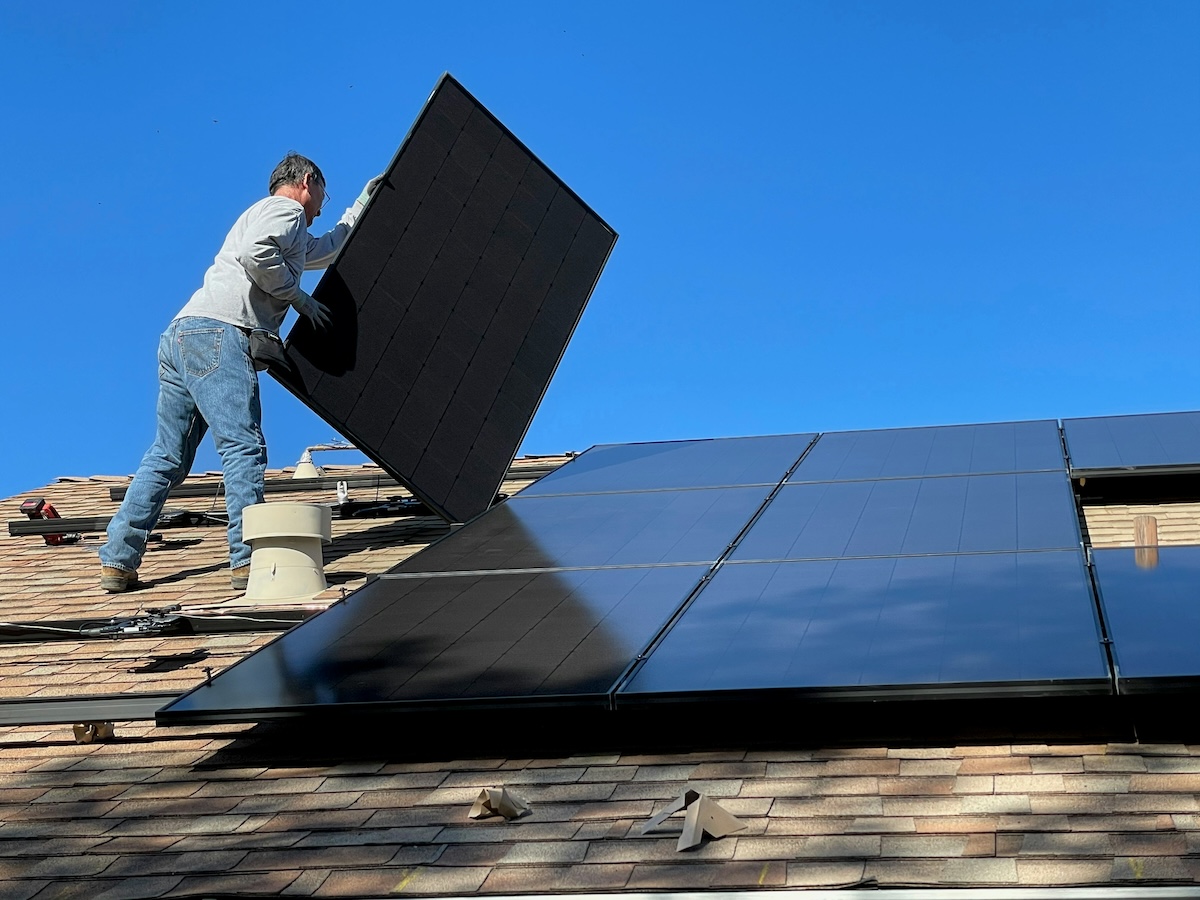
With tax credits expiring, cutting ‘dealer fees’ could keep solar affordable. The holiday season could be a busy one for contractors and installers of solar panels, battery storage and heat pumps. Home and business owners are racing a Dec. 31 deadline to complete such projects in order to be eligible for generous federal tax credits (the deadlines for electric vehicle tax credits have already passed). Many of the incentives for renewable energy and home upgrades were phased out under the Republicans’ One Big Beautiful Bill legislation that President Donald Trump signed in July. Clean energy advocates are not throwing in the towel. “We could cry. Or we could electrify,” the nonprofit Rewiring America says on its website, which includes a handy list of the expiring subsidies, as well as a tool to calculate potential savings. The falling cost of photovoltaic panels can make residential solar systems a financial win for homeowners even without the federal subsidies (many states offer their own incentives). In the US, the median installation cost per watt of residential solar panels, before incentives, fell from $3.80 per watt in 2014 to $2.53 last year, according to EnergySage. The 30% hit from the investment tax credit’s expiration could be largely offset by eliminating “dealer fees” that fintech middlemen charge for point-of-sale financing for solar customers.
- Hidden fees. Dealer fees, sometimes called program fees, lending fees, finance fees, platform fees or original issue discounts, generally get added to the cash price of the system and rolled into the principal of the loan. That can make a seemingly low interest rate deceptive because the principal amount is inflated by the hidden fee. The Consumer Financial Protection Board, before it was gutted under the Trump administration, spotlighted “markups and fees that can increase the loan principal by 30% or more above the cash price.” A $30,000 system with a $9,000 dealer fee, for example, would require a $39,000 loan. “The downside of the investment tax credit is that there’s been extra fat available, and so that’s how these dealer fees have been able to survive so long, in such magnitudes,” says Bill Paulen of Seattle-based LoanTERRA, which launched last month to help credit unions and other lenders originate renewable energy loans.
- Customer demand. Paulen spent a decade developing solar loan products for credit unions, first with Generations Credit Union and then at Community 1st Credit Union. LoanTERRA is a platform that lets any credit union, or other community lender, make direct-to-consumer solar loans, cutting out the fintech middlemen and eliminating the dealer fees (LoanTERRA takes a 2% fee, paid by the lender). LoanTERRA’s first group of lenders is going through due diligence. Paulen thinks that saving customers money by cutting out dealer fees could save the solar industry. “Everyone’s expecting an anvil to fall on their head,” with the loss of the tax credits next year. “If the public believes that solar has become 30% more expensive, it’s going to be harder for sales people to overcome that,” he said. The winners may be companies that can keep reducing solar prices without subsidies, Paulen says. “Even as the pie shrinks, we’re going to get a bigger slice of the pie because we’re the solution that makes it easier for people.”
- Keep reading, “With tax credits expiring, cutting ‘dealer fees’ could keep solar affordable,” by David Bank.
Dealflow: Climate Tech
Overstory secures $43 million to predict and prevent utility-sparked fires. Vegetation management is critical for utilities to ensure trees, branches and other plants avoid contact with powerlines. Overstory, based in Amsterdam and Somerville, Mass., uses satellite imagery and artificial intelligence to map vegetation near electricity infrastructure. Its data helps utilities optimize infrastructure maintenance and respond to wildfire risks. Women-led climate tech investor Blume Equity led Overstory’s $43 million Series B financing round. Energy Impact Partners, B Capital, Semapa Next, Convective Capital, Bentley Systems and others also participated. Overstory said the funding will support development of AI-based risk modelling and its new “fuel detection model,” which identifies high-risk wildfire areas and advises on “exact actions” that can reduce the risk. “Wildfires will continue to occur, but we can get much smarter about how to prevent the worst from happening,” Overstory’s Fiona Spruill told ImpactAlpha. “Investors are keenly aware of the billions of dollars at stake and the urgent need to bolster the resilience of our grid.”
- Climate AI. This summer was the worst wildfire season in Europe in more than two decades. Such fires pose a climate and environmental danger; they’re also expensive. In the US, PacifiCorp, a utility owned by Warren Buffet’s Berkshire Hathaway, was hit with $30 billion in claims last year for the 2020 Oregon wildfires. In California, PG&E paid $13.5 billion into a trust for victims of wildfires in 2015, 2017 and 2018. “Satellite data, AI and the vegetation-management intelligence we get from companies like Overstory are transforming how utilities think about wildfire prevention,” said Andy Abranches of PG&E, an Overstory client. “The details are in the data, and that precision allows us to deploy our crews where wildfire risk is greatest.”
Impact investors back Nest Health to improve healthcare for families on Medicaid. Steep cuts to Medicaid by Republican lawmakers are spurring nonprofits and social enterprises to help enrolled patients and their families stretch benefits and care access. Impact investors are rallying behind Nest Health, a New Orleans-based startup that offers in-home and virtual care for Medicaid families, as well as care coordination with specialists and assistance in securing housing and registering for utilities. “Now is the time for investors to double down on solutions for working-class Americans, not shy away from them,” said Yusill Scribner of Impact America Fund, which invested in Nest’s Series A round alongside Hopelab, Luminary Impact Fund and Socium Ventures, an impact venture fund owned by Cox Enterprises. “We’re excited to invest in a company that has unicorn-sized ambitions by serving families on Medicaid,” Scribner said. “By meeting people at home and treating the whole family, Nest is bringing healthcare into the context of everyday life, where it can have the greatest impact.” Nest’s Series A round has reached $22.5 million after a $12.5 million first close in August.
- Family-centered care. Through partnerships with AmeriHealth Caritas in Louisiana and Blue Cross Blue Shield in Arizona, Nest Health says it has reduced emergency room visits and increased vaccination rates. “Our partnership with Nest Health is bringing a proven, whole-family model into homes across Maricopa County and rural Mohave County [in Arizona], where limited provider access makes this care especially impactful,” said Blue Cross Blue Shield’s Heather Carter.
- Check it out.
Ceniarth and A to Z Impact invest in Fòs Feminista to meet contraceptive needs in the Global South. Family offices Ceniarth and A to Z Impact invested $1.8 million in INNOVA Health Supplies, a procurement service created by Fòs Feminista, an international alliance of nearly 200 reproductive health organizations. INNOVA aggregates orders from alliance organizations and purchases contraceptives on their behalf. It buys directly from companies like Pfizer and Bayer, eliminating middlemen, securing bulk pricing and cutting delivery times from 13 months to as little as three. INNOVA “speaks to the power of economies of scale and the ability to negotiate,” Fòs Feminista’s Meradith Leebrick told ImpactAlpha.
- Preserving grant capital. Major donors have cut at least $600 million from global reproductive health budgets in the past year. That includes losses from the gutting of USAID and to the UN Population Fund. Nonprofits that once relied almost entirely on grants are rethinking how to cover the costs of operating clinics and delivering care. “Every dollar of philanthropy right now is super precious,” A to Z’s Alex Evangelides said. Structured as patient debt, the new investment gives INNOVA time to distribute the stockpiled products and collect revenue before repayments begin. “It lets them avoid choosing between using a couple million dollars of grant money to buy inventory, or using it to hire staff or test a new initiative,” Evangelides said.
- More.
Dealflow overflow. Investment news crossing our desks:
- Indiana-based Sortera secured $45 million from T. Rowe Price Associates, VXI Capital, Yamaha Motor Ventures for its AI-enabled process of extracting aluminum from metal scrap. (Canary Media)
- Education-focused impact investment firm Educapital led a €4 million funding round for French startup MuchBetter.ai, which provides AI-based workforce training and professional development to sales and customer service workers. (Tech.EU)
- X-Energy raised $700 million in a Series D funding round to commercialize its small nuclear reactors. Jane Street Group, ARK Invest, Corner Capital, Ares Management and Emerson Collective backed the round. (Bloomberg)
- Just Climate led a $30 million equity round for India-based AgroStar, which provides agronomic support to millions of farmers and connects them with retailers. (YourStory)
- Colombian startup Unergy closed a $4 million pre-Series A round to deploy mini solar farms in. (Startup Researcher)
Impact Voices: Impact Careers
How has the impact investing job market changed since 2024? Rumors of the demise of impact-related jobs have been greatly exaggerated, say Shawn Cole, Jonah Zahnd and Anushka Kataruka of Harvard Business School’s Project on Impact Investment. The political backlash to ESG and DEI began almost as soon as President Joe Biden took office. It reached a fever pitch last year, and spread to Europe and global finance broadly. This year, the Trump administration has pummeled inclusion initiatives along with foreign aid and clean energy. The HBS trio are out with an analysis of hiring for impact-related roles in what is euphemistically being called “the current environment.” They find that, despite headline-grabbing layoffs, the impact investing job market contracted only modestly – about 2.2% – for the period from May 2024 to May 2025. Overall employment at the major banks, asset managers and consulting firms included in the analysis grew by about 2.3% over the same period.
- Behind the numbers. While total impact-related headcount fell only slightly, the authors note anecdotal evidence that some firms are relabeling or absorbing former ESG and impact roles into other teams. That shift risks reducing impact functions to something closer to rote compliance, rather than the strategic, alpha-generating priorities that until recently commanded C-suite attention. The study follows the researchers’ recent look at who lands jobs in impact investing. Both studies used a large dataset of roughly 1.6 million workers across 40 major financial and consulting firms. The findings do not capture information regarding a large number of smaller impact investing firms.
- Social and environmental. Cole, Zahnd and Kataruka grouped impact investing roles into two categories: “Environmental and climate,” which includes jobs tied to sustainability, climate, clean energy and most ESG functions, and “Social impact.” They found that jobs in the former category declined by 2.9%, whereas limited data suggested that social impact roles actually grew. “A key trend was an uptick in roles focused on philanthropy, social impact and inclusion,” they write. The largest employers of environmental/climate talent were JPMorganChase, Bank of America and CitiGroup. JPMorgan also was among the group with the largest reductions in the category, along with Northern Trust, Jefferies, Goldman Sachs and UBS. The biggest overall swings – across legacy and impact roles – occurred at Credit Suisse (now part of UBS), Evercore and Amundi.
- Keep reading, “How has the impact investing job market changed since 2024?” by HBS’ Shawn Cole, Jonah Zahnd and Anushka Kataruka.
Agents of Impact: Follow the Talent
Rachel Korberg will step down as executive director of The Families and Workers Fund in January 2026 (listen to, “Solving for both unemployment and labor shortages with high-quality jobs”). The New York-based multi-donor fund recruiting for her replacement… National Cooperative Bank welcomes David Ramos, previously with the FDIC, as vice president of community association banking… Harper Lawson, previously with the NASA Goddard Space Flight Center, joins the Social Finance Institute as a special projects coordinator.
Sonen Capital taps Giselle Mendoza, previously with Full Spectrum Capital, as a research associate on its private markets team… Asset Funders Network is recruiting a program officer for the Carolinas… Arnold Ventures seeks a mission-aligned investing director in New York… ROC USA has an opening for a governance and business advisor… In California, the Governor’s Office of Land Use and Climate Innovation is hiring an enterprise business analyst and a policy innovation team lead.
Philadelphia Industrial Development Corp. is on the hunt for a senior business partner for its human resources team… The New York State Insurance Fund is looking for a sustainable investing manager… CareQuest Innovation Partners seeks an impact investing director… Self-Help is recruiting a real estate project manager in Oakland, Calif.
👉 View (or post) impact investing jobs on ImpactAlpha’s Career Hub.
Thank you for your impact!
– Nov. 25, 2025