
Greetings Agents of Impact!
In today’s Brief:
- Climate adaptation moves from hedging to preventing
- Afrishela’s flexible financing with a gender lens
- Wastewater monitoring to detect bird flu
Featured: Deploy!
Rising risks and returns on resilience are the push and pull for climate adaptation. Climate-induced economic damages ticked down slightly last year from 2024’s record $1.4 trillion, as fewer major hurricanes made landfall. Notwithstanding that minor blip, the cascading effects of climate-related damages are starting to show up across the US. Insurance premiums are rising in higher-risk regions; three-quarters of the country’s hottest real estate markets are in low-risk areas. “There’s your chain of dominoes,” says BloombergNEF’s Danya Liu. “Climate risk pushing up insurance prices, which then pushes down property values, which then could destabilize local government finance” (for background see, “LA wildfires spur a climate-risk reckoning in the $4 trillion muni market”). At last week’s BloombergNEF Summit in San Francisco, Liu presented a county-level map of risk and resilience that could guide home buyers and businesses considering a move, or help assess the stability and yield of local municipal bonds. Liu said adaptation solutions represent “sponges” to help the economy absorb climate shocks. “Adaptation is not just policy,” Liu says. “It is balance sheet protection helping us turn more systems of dominoes into sponges.”
- Beyond hedging. Portfolio managers have primarily responded to climate risk with financial solutions, such as insurance and catastrophe bonds that can spread risk but not reduce it (see, “Innovations in ‘risk transfer’ for climate-vulnerable communities”). “I don’t think most of them are investing in hard adaptations right now,” Liu tells ImpactAlpha. As insurance becomes unaffordable, momentum will grow for the next tier of solutions, such as sensors, early-warning systems and other predictive technologies. The bankability of engineering and infrastructure adaption projects that actually reduce physical risk remains a challenge, even when broad economic benefits are clear. “There’s no good, established methodology for showing payback for these hard adaptations,” Liu says.
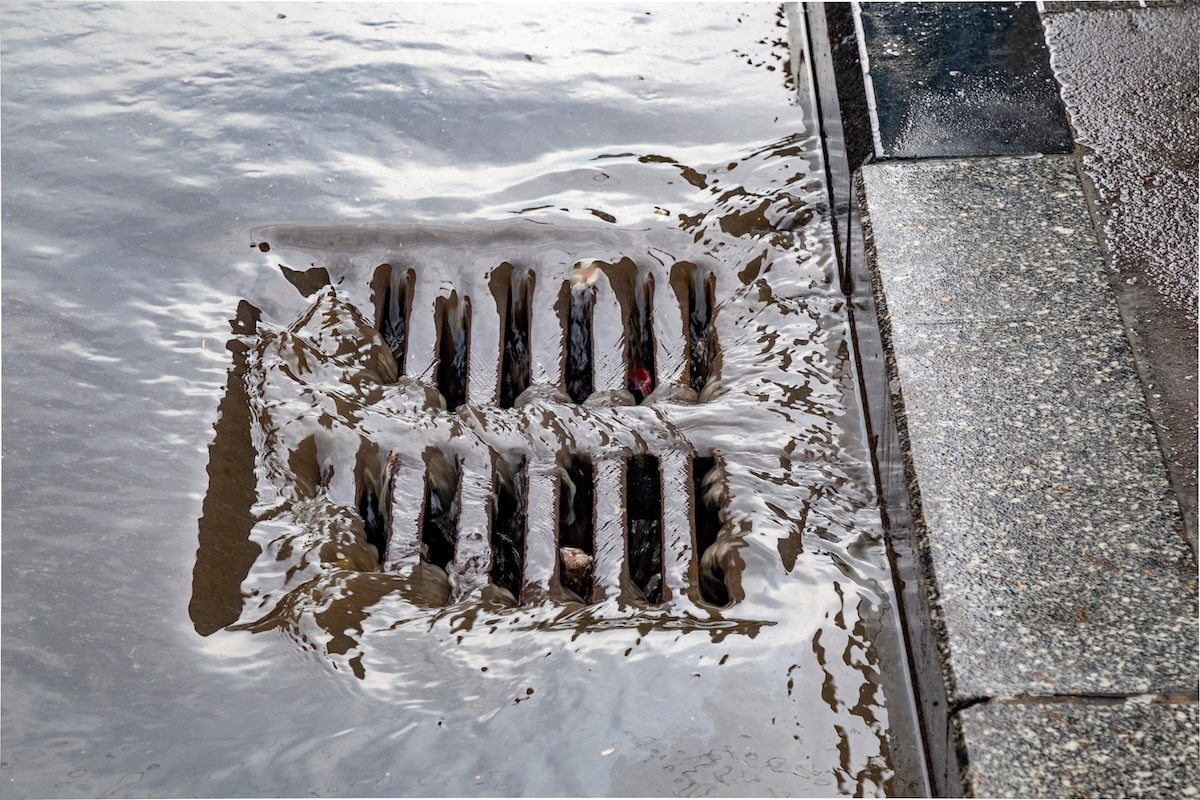
- Pay for success. Milwaukee is tapping private credit to build green stormwater infrastructure, reports HIP Investor’s Nick Gower in his latest Resilient Capital Stacks column on ImpactAlpha. Last summer, a massive storm caused the release of more than five billion gallons of sewage into the local watershed. The Milwaukee Metropolitan Sewerage District has set a 2035 goal of capturing 740 million gallons of stormwater each time it rains. The sewer district partnered in 2020 with Corvias Infrastructure Solutions to develop pay-for-success stormwater capture projects in partnership with private landowners, using a revolving private credit facility backed by Goldman Sachs’ Urban Investment Group. Corvias takes on the early development and construction risk, and is repaid by the sewer district based on gallons captured. Property owners can also contribute through “gallon purchase agreements,” blending private matches with public payments. The financing structure “better matches the reality of distributed green infrastructure,” Gower says, “in which dozens of mid-sized projects come online over several years rather than all at once.” Read his full post.
- Keep reading, “Rising risks and returns on resilience are the push and pull for climate adaptation,” by David Bank.
Dealflow: Gender Smart
Afrishela provides revenue-based and impact-linked financing with a gender lens. Johannesburg-based Afrishela provides impact-linked loans and revenue-based financing to women-led businesses in East and southern Africa (see, “Underwriting with a gender lens in Africa“). Its first investments include South Africa-based Welo Health, a health concierge service for corporate employees. The company connects workers to nurses and doctors for in-person and virtual visits, designs employee wellness programs, and offers mental health counseling. Welo Health secured an undisclosed amount of revenue-based financing to offer its health services to employees of small and medium-sized businesses “typically left out of traditional healthcare arrangements,” said Welo Health’s Zanele Abraham-Matome.
- Better logistics. Afrishela also provided an impact-linked loan to Kenya-based TrackRight, a logistics management software that helps companies optimize routes. Better route planning not only improves business efficiency and cuts cost, it reduces transport-related carbon emissions. Afrishela is a new fund manager that is being incubated by Graça Machel Trust, an advocacy group focused on women and children in Africa. It is aiming to raise $30 million for its first fund to provide flexible financing, underwritten with non-traditional forms of collateral.
Barnwell Bio lands $6 million to detect bird flu and other poultry threats. The team behind one of the first Covid-19 wastewater monitoring systems is turning its attention to the global poultry market, which faces an urgent threat from avian influenza, or bird flu. New York-based Barnwell Bio offers a “metagenomic” biosurveillance system to detect and track viruses, bacteria and parasites before they can devastate entire flocks. “Consumers have higher demands for animal welfare, there is regulatory pressure, and there are more disease challenges than ever before,” Barnwell Bio’s Michael Rhys told ImpactAlpha. He said the company gives customers “a tool to help them navigate all of those different constraints and still maintain their livelihoods and businesses.”
- Agrifood partners. The seed financing, backed by Twelve Below, Planeteer Capital, AgVentures Alliance and other investors, will help Barnwell expand in the Midwest and Southeast US. “For vets managing dozens of barns, getting to the bottom of a disease issue can be a process of trial and error,” said Liz Beilke of West Liberty Foods, a farmer-owned poultry processing company in Iowa. “We’re guessing. That’s the frustrating part.” Barnwell has secured partnerships with Austin-based Vital Farms, one of the largest “pasture-raised” egg producers in the US. Vital Farms is facing consumer scrutiny and social-media backlash over accusations that it misrepresents how its hens are raised and fed.
- Share this post.
Dealflow overflow. Investment news crossing our desks:
- Tokyo-based GLIN Impact Capital launched a 20 billion yen ($130 million) fund to invest in startups in healthcare, climate, fintech, education and other impact sectors. MUFG, Japan Post Insurance, Sophia University, Sumitomo Mitsui Trust Bank and SBI Investment Group are early investors. (GLIN Impact Capital)
- Seattle-based Mast Reforestation made its first sale of biomass-based carbon removal credits to the Royal Bank of Canada, CNaught and others. The credits, calculated from 10 million pounds of wildfire-killed trees, will help restore the burnzone in Montana. (Mast Reforestation)
- Yosemite, a biotech venture fund that focuses on new cancer treatments, raised $200 million. The firm is run by Reede Jobs, son of Steve Jobs, who died of pancreatic cancer. Reede’s mother, Laurene Powell Jobs, invested in the fund via Emerson Collective, alongside Amgen, Memorial Sloan Kettering, MIT and others. (Forbes)
Agents of Impact: Follow the Talent
Fabiola Greenawalt of The Russell Family Foundation joins the Sustainable Agriculture and Food Systems Funders’ board of directors… Cynthia Wong, formerly with Chan Zuckerberg Initiative, joins the San Francisco Mayor’s office as director of strategic partnerships…TPG’s impact-focused Y Analytics measurement group is hiring an associate of credit data and analytics… Capricorn Investment Group seeks an investment analyst in New York… Social Finance is recruiting a head of communications in Boston.
The Washington Area Community Investment Fund has an opening for a social impact consultant in Washington, DC… Spring Point Partners is hiring an investment associate in Philadelphia… The Nature Conservancy is looking for an impact investing associate in Brazil… Citi Foundation is accepting proposals for its 2026 Community Finance Initiative for projects supporting financial resilience in American communities.
👉 View (or post) impact investing jobs on ImpactAlpha’s Career Hub.
Thank you for your impact!
– Feb. 2, 2026