
Greetings Agents of Impact!
Meet up. The ImpactAlpha team is out and about as conference season gears up. This week, Jessica Pothering is in Hong Kong for AVPN’s global conference. Next week, Jessica and Dennis Price will be in Singapore for Impact Week. From there, Dennis heads to London for Venture ESG’s FRAME confab. Amy Cortese will be chronicling the sustainable side of this week’s New York Fashion Week. Amy and Erik Stein will be taking the pulse of Climate Week NYC, Sept. 21-28. Find David Bank at the Neighborhood Economics conference in Chicago, Sept. 29-Oct. 1. Say hello!
In today’s Brief:
- Acumen’s blend of capital (podcast)
- Enduring Planet’s first-loss guarantee
- Kin’s direct-to-consumer homeowners insurance
- Sustainable forestry in Africa
- Community-owned “DePIN” networks lower the costs of connectivity
Featured: Catalytic Capital
How Acumen’s Jacqueline Novogratz is blending capital to bring electricity to the hardest to reach (podcast). There are nearly two dozen investors in Acumen’s $250 million Hardest-to-Reach Fund to bring clean energy to some of the world’s 700 million people still living without electricity. The entities include philanthropic funders seeking to encourage companies to enter markets like Chad, Malawi and Burundi; catalytic investors like the Green Climate Fund, whose first-loss reserve is meant to crowd in commercial investors; Shinhan Bank, South Korea’s largest commercial bank; and a $20 million sleeve of “impact alignment” incentives to reduce interest payments for portfolio companies that beat their energy-access targets. “It’s essentially a rebate,” Acumen’s Jacqueline Novogratz explains on ImpactAlpha’s latest Agents of Impact podcast. “At the end of the day, there’s a blueprint for what the private sector can do with the right incentives.” The Hardest-to-Reach Fund focuses on 17 countries where electrification rates remain shockingly low. Some 85% of people living without electricity are located in about two dozen African nations. Says Novogratz: “This is the biggest planetary market failure of our lifetime.”
- Growth stage. After 24 years, the nonprofit Acumen is on pace to more than triple its assets under management. In addition to the Hardest-to-Reach energy access fund, the Acumen Resilient Agriculture Fund is one of the world’s largest climate adaptation strategies, raising up to $300 million to help smallholder farmers upgrade their irrigation, crop selection and market strategies. All told, Acumen is raising as much as $750 million and has recently recruited as president and chief investment officer Carsten Stendevad from Bridgewater Associates, Ray Dalio’s $92 billion hedge fund. Novogratz says hope is a responsibility. “I feel like I’m just starting, and Acumen is just starting,” she says on the podcast. “We’re living proof that if you dare to try and you stick with it – you will fall down, you will fail and so will your companies – but those that stay in the game end up winning the game, and change happens.”
- Risk, adjusted. As Novogratz likes to say, “Climate finance is not scarce. It’s scared.” Acumen’s next frontier is changing systems – and perceptions of risk. “Risk is not just a financial concept. It’s a social concept, an environmental concept, and it is a moral concept,” she says. “And we have to ask ourselves as well, ‘What’s the risk of not daring?’” Acumen aims to be at the vanguard of “building systems that show what it looks like to put our shared humanity and the earth at the center.” That’s particularly important as innovators and investors adapt to the dramatic decline in traditional foreign aid. “What we want is a world of dignity,” Novogratz says. “You feel it in young African entrepreneurs who want to build systems of, by and for Africans. And so it behooves us to then match their desire with systems of capital, markets and management support that helps them do that.”
- Read on and listen to the podcast, “How Acumen’s Jacqueline Novogratz is blending capital to bring electricity to the hardest to reach.” Stay up to date with all of our podcasts by subscribing on Apple, Spotify, or YouTube.
Dealflow: Climate Finance
Enduring Planet secures catalytic guarantee from Locus to derisk its second climate fund. When Silicon Valley Bank went bust, the Portland, Ore.-based lender Enduring Planet stepped into the breach for climate tech startups left in the lurch. Enduring Planet has since 2021 made flexible, non-dilutive bridge loans to small climate-tech companies to tide them over while they wait for government grants, commercial payments and other unexpected delays. As the firm looks to raise its second fund in a challenging fundraising environment, it is receiving a helping hand from Locus. The nonprofit is extending a catalytic guarantee from its Community Investment Guarantee Pool that will cover 10% of any investor losses on up to $20 million of Enduring Planet’s second fund. “The guarantee plays a critical role in derisking and enhancing the capital structure of Climate Fund II, especially during this volatile economy,” Enduring Planet’s Erin Davis told ImpactAlpha.
- Unlocking capital. Enduring Planet has made nearly $25 million in loans to climate tech firms working in clean transportation, renewable energy and the circular economy. Last May, it reached a first close of $4.1 million on its second fund, which aims to raise $20 million to $40 million. Early investors include Greenspark Ventures, donor-advised funds managed by ImpactAssets, members of Toniic, and clients of Figure 8 Investment Strategies. “Enduring Planet exists to make sure that all climate entrepreneurs have access to the capital they need to address the climate crisis,” said the firm’s Dimitriy Gershenson. Locus’s guarantee pool has issued more than $40 million in guarantees to date, unlocking some $307 million for community projects (for background see, “How loan guarantees and catalytic capital can amplify federal ‘green bank’ funds”). The partnership with Enduring Planet, said Locus’s Jim Baek, “is a prime example of how guarantees can strengthen investment ecosystems and drive capital towards urgent needs like the climate crisis.”
- More.
Kin raises $250 million in equity and debt for direct-to-consumer homeowners insurance. Insured losses from wildfires, hurricanes and other climate-induced natural disasters reached $137 billion in the US last year, and are projected to climb even higher. Many insurers are declining to offer or renew coverage in high-risk areas, such as Florida and California (see, “LA wildfires push California’s insurance market to the brink”). “Insurance is a critical safety net, but it’s disappearing just when people need it most,” said Sean Harper of Kin, which has designed a direct-to-consumer insurance model for underserved homeowners. The model uses data and expert analysis to assess risk profiles of specific homes and offer customized coverage. By eliminating the need for external agents, the Chicago-based company is able to reduce insurance premiums for homeowners.
- Insurance tech. Kin says its policyholders in 13 states pay over $600 million to insure more $100 billion of home assets. A $50 million Series E equity round, co-led by QED Investors and Activate Capital, will help the company “expand in markets most affected by natural disasters in a way that’s sustainable, scalable and customer-focused,” said Harper. A $200 million line of credit led by Wellington Management will help pay off $145 million of existing debt. Kin is “not just writing policies,” said Activate’s Eric Meyer, “they’re offering a vital financial service [to those] who need it most.”
- Share this post.
New Forests’ African forestry fund acquires South Africa’s Rance Timber. The Sydney-based investment firm New Forests invests in forests, agriculture and land with region-specific funds in Africa, Southeast Asia, Australia and New Zealand. Its African Forestry Impact Platform, or AFIP, has acquired Rance Timber, a family-owned forestry and pine sawmilling company based in Stutterheim in South Africa’s Eastern Cape province.
- Community benefits. The deal is the second since New Forests launched AFIP in 2022 with $200 million from British International Investment, Norfund and Finnfund. It follows AFIP’s buyout in 2022 of Norwegian company Green Resources, which manages forest plantations and wood processing facilities in Mozambique, Uganda and Tanzania. New Forests is looking to raise $500 million for the open-ended vehicle from investors in Europe and the US.
- More.
Dealflow overflow. Investment news crossing our desks:
- MassMutual Catalyst Fund, Boston Impact Initiative and Raven Indigenous Capital Partners are among the investors in the $9.5 million seed round of Florrent, which improves power quality and grid reliability using supercapacitors, or short-term energy storage devices. (Florrent)
- Dallas-based MCatalysis secured seed financing, in a round led by HL Energy Ventures, to upcycle waste resources, such as plastic and agricultural waste, into low-cost and clean synthetic fuels and chemicals. (MCatalysis)
- The Asc Impact Forestry Fund, an investor in sustainable land and forestry management in Africa, secured an undisclosed investment from K+S, a German chemical company. (Asc)
Impact Voices: Community Finance
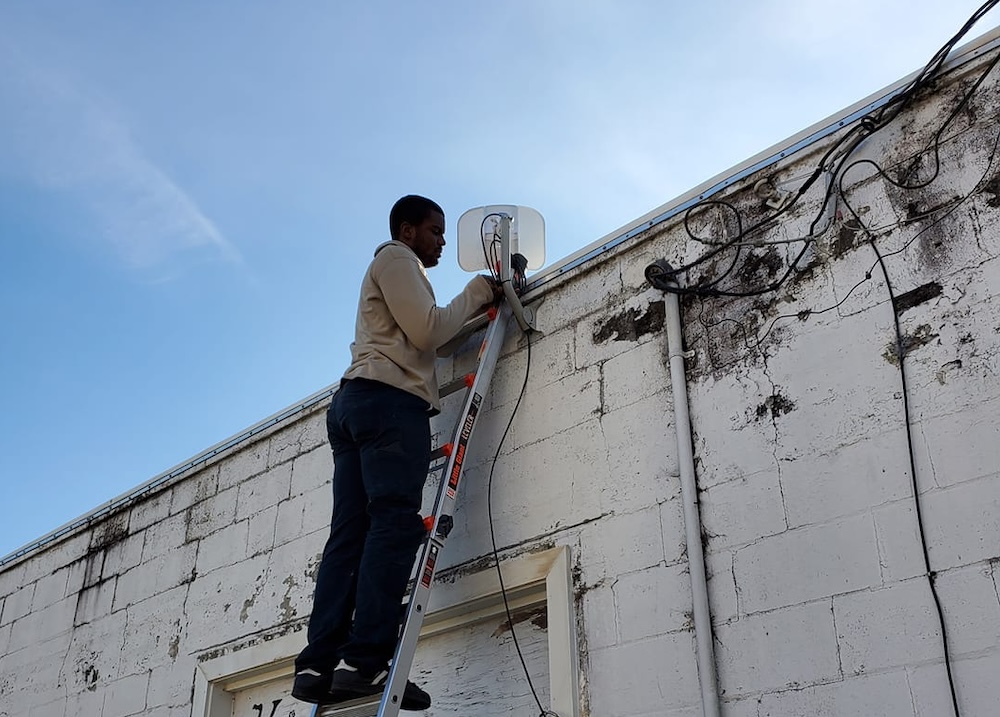
The DePIN model for digital infrastructure: Decentralized and community owned. When a tornado knocked out internet service in rural Enfield, NC, LaShawn Williamson and her husband didn’t wait for big commercial providers to step in. They launched Wave7, a mom-and-pop internet service provider that has connected more than 2,000 neighbors at a fraction of the cost of conventional ISPs. The company runs on Althea, a decentralized internet protocol that lets residents pool resources and build wireless networks where fiber providers won’t invest (see, “Private equity won’t close the digital divide – I know, I’ve tried”). Wave7 is an example of a broader shift in how internet access, energy and other critical services are leveraging “decentralized physical infrastructure networks,” or DePIN. “DePIN represents the next frontier for impact investors,” Renee Pinto da Silva Barton of the Crypto Council for Innovation writes in a guest post.
- Scaling across sectors. Althea-based networks in North Carolina, Arizona, Alaska and California offer internet service for as little as $40 a month. In other sectors, decentralized networks like Geodnet, with 11,000 geospatial sensors, and WeatherXM, with 7,000 weather stations, are making information accessible and affordable. Insurers like Lemonade are piloting climate insurance for smallholder farmers in East Africa using DePIN-enabled data, while local governments are tapping decentralized sensors to improve planning and climate resilience. Companies such as Fuse and Via reward households for shifting energy usage to off-peak hours. Distributed systems can lower capital costs, expand access, and create new streams of community income, da Silva Barton says. For investors, they’re an opportunity “to fund models that not only close access gaps, but create affordable and resilient systems that communities themselves can sustain.”
- Keep reading, “A new model for digital infrastructure: Decentralized and community owned,” by Crypto Council for Innovation’s Renee Pinto da Silva Barton. With the W.K. Kellogg Foundation, ImpactAlpha is spotlighting investment strategies expanding opportunity in today’s complex environment.
Agents of Impact: Follow the Talent
Aisha Weeks of Dearfield Fund, Megan Parrish of Heart Lake Committed Capital, Foundation Fund’s Lev Freedman, and New Rising Ventures’ Phil Sanders are among the Just Economy Institute’s new fellows… 100x Impact welcomes Nelson Ng, previously an impact investing partner at New York-based family office Acuie, as its Southeast Asia lead.
Sustainable Capital Advisors adds Grace Coombs as a research and analyst fellow… KawiSafi promotes Angela Muraguri to associate director… Liberty Mutual Investments is looking for an impact investing senior analyst in New York and Boston… Capital Impact Partners seeks a fund analyst… The Colorado Health Foundation has an opening for an impact investing senior officer… Builders Vision is hiring a data and applications project manager.
US SIF is kicking off its Financial Advisor Roadmap Series, designed to help advisors integrate sustainable investing strategies into their practice, with a webinar on Thursday, Sept. 11… Black Squirrel is accepting applications for the 2025 cohort of its RISE Real Estate Accelerator for emerging developers. The deadline to apply is Thursday, Sept. 18… Also on Sept. 18, ImpactPHL is hosting a fall social in Philadelphia… Impact Frontiers will host a webinar on systems thinking for impact investing, Monday, Sep. 22.
👉 View (or post) impact investing jobs on ImpactAlpha’s Career Hub.
Thank you for your impact!
– Sept. 10, 2025