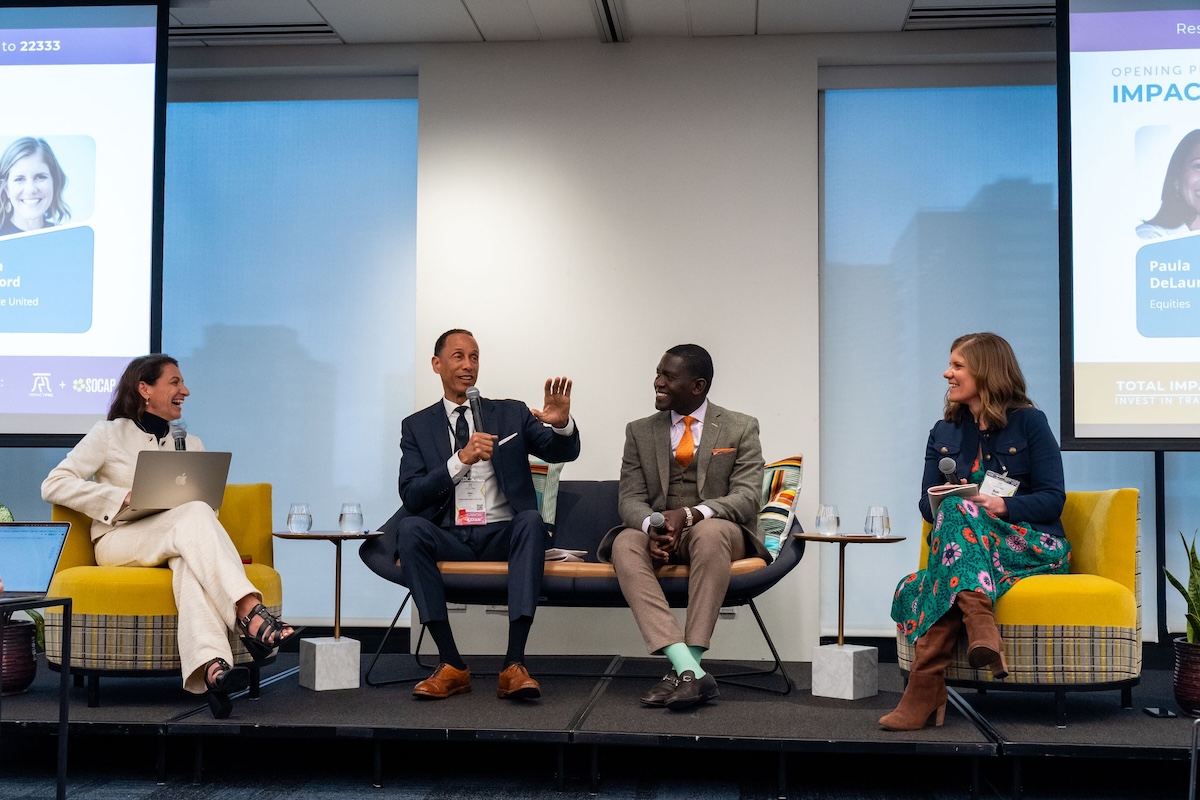
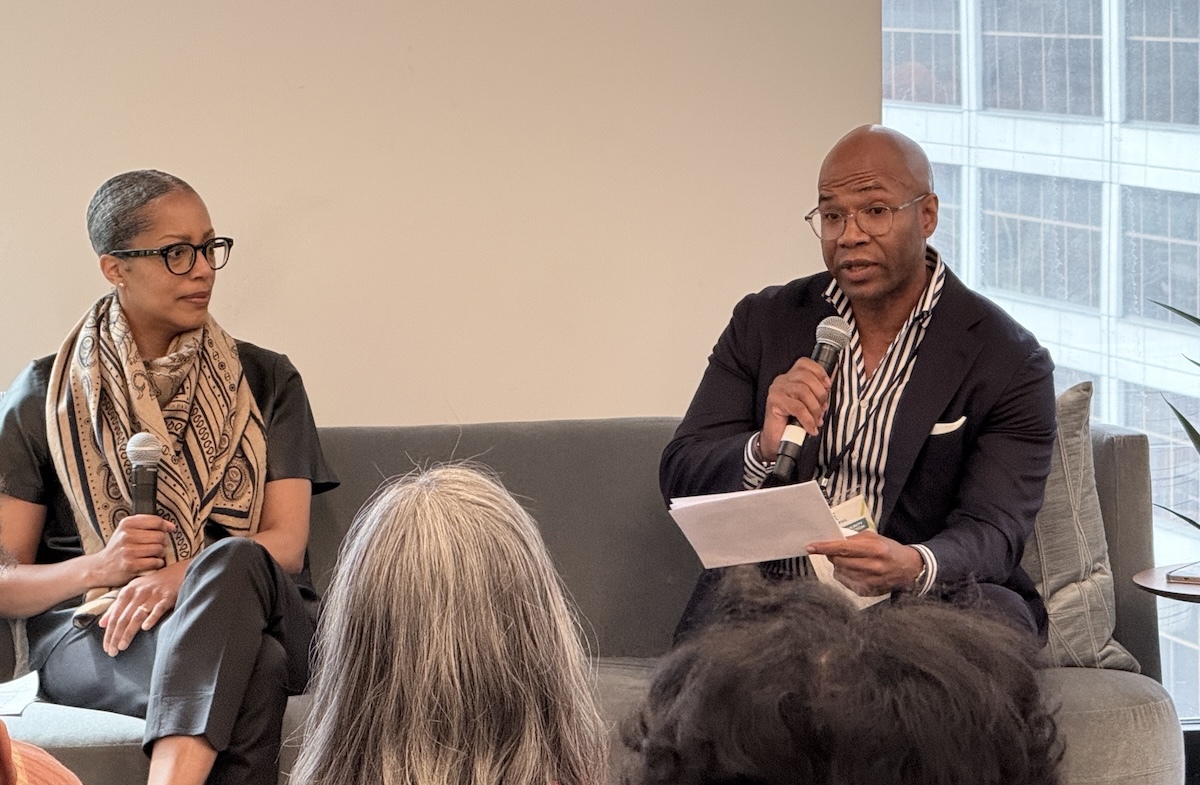
As some 450 local impact leaders gathered last week in Philadelphia for ImpactPHL’s Total Impact Summit, developments in the nation’s capital a short Amtrak ride away hung over the proceedings. “I think we’re all coming here right now a little bit shaken, if not stirred,” said Jonathan Tower of Artaris Impact Investors, “with the withdrawal of federal funding for a lot of the programs that enable the great work that everybody in this room does.”
Still, the gathering, ImpactPHL’s largest to date, focused on solutions from new opportunity zone legislation to sustainable agriculture, and attendees vowed to continue the work of inclusive wealth-building in low-wealth communities.
ImpactPHL’s Kafi Lindsay, who took the helm of ImpactPHL last year (see “Agent of Impact”) announced a new initiative to mobilize a billion dollars of impact capital for equitable economic growth development in Philadelphia. “Please bring your vision, bring your capital, bring your partners and bring your urgency.”
ImpactAlpha’s Roodgally Senatus and Erik Stein were on the scene.
Community ownership
Ownership was a recurring theme at Total Impact, as more place-based investing strategies give communities a stake in the projects taking shape in their backyards.
“We are identifying strategies to give folks community wealth by ownership,” Otho Kerr of the Federal Reserve Bank of New York declared during a plenary session.
Kerr invited impact investors to join the New York Fed on diving deeper on community ownership, which he says can address deep underlying economic inequality in underserved communities. “We want more investors to come to the table,” said Kerr.
The bank has formed design teams made up of investors, policymakers and community leaders working to better coordinate public and private investment for community economic development. A community ownership design team, led by Nonprofit Finance Fund’s Aisha Benson, “will support the intersection of community ownership and community resiliency, where community-led vision, racial equity, and climate justice are prioritized,” reads the Fed’s “Making Missing Markets Initiative” report.
In Atlanta, Nikishka Iyengar of The Guild has been working with communities of color to build community ownership of land, housing and real estate since 2015. During an ImpactPHL panel discussion, she kicked off a $30 million fundraise to build out a community shared ownership portfolio.
The Guild works with two models: community land trusts and local, shared ownership and stewardship of local assets such as grocery stores, community day care centers and small business spaces. The Guild is bringing capital to neighborhoods “where land has been systematically devalued,” said Iyengar. “It’s not just a question of exclusion for these communities, it’s a question of extraction.”
Employee ownership
Policies that support private investment in the ownership economy are also making strides in Washington, DC, John Cochrane of the US Impact Investing Alliance shared during another session.
“We’re hearing a lot more about how can we invest in an ownership economy?,” he said. In addition to homeownership and business ownership, Cochrane said there is interest in “how we make retirement investment accessible to more people.” He added, “There’s been a lot of interesting work happening across the country.”
The Alliance has endorsed the American Ownership and Resilience Act, a new bipartisan bill introduced in Congress to expand employee ownership through employee stock ownership plans, or ESOPs. The legislation aims to create a federal investment facility to finance employee ownership transition deals.
“We’re hoping that we can scale this new investment class to make more employees owners of their own workplace, and in doing so, keep those businesses rooted in the communities where they were built in the first place,” Cochrane said.
Opportunity Zone 2.0
Despite the chaos that might be stirring up at the federal level, the work of community revitalization will fall on the shoulders of local actors, said Tower of Arctaris. The Boston-based impact investor partners with local governments and community foundations to launch place-based investment initiatives that support affordable and workforce housing, broadband infrastructure and small businesses.
“You have to think local,” Towers said. “It’s not like a federal program is going to come down and figure out what to do in something that’s hyper-local.”
Arctaris, which has carved out a specialty for investing in Opportunity Zones, has been raising capital in anticipation of an extension for OZs, through the reconciliation bill making its way through Congress (see, “Investors look for Opportunity Zones to get an extension and a fresh dose of tax-advantaged capital”).
Towers is excited about the new legislation’s impact reporting requirements. Another neat feature, he says: a provision that allows individuals that invest in Opportunity Zones to defer taxes on up to $10,000 of ordinary income, not just on capital gains. In OZ 1.0, Towers said, “There wasn’t a path for low-income people to invest in their own communities and get tax benefits. The new feature brings OZ to the masses.”
Collective action
Many attendees at the conference have been affected by the Trump administration’s attacks on diversity, equity and inclusion and climate action. Beth Bafford has been in the hot seat.
As the head of Climate United, a Calvert Impact-led coalition that was awarded $7 billion under the Greenhouse Gas Reduction Fund to make green loans in underserved communities, Bafford and her fellow GGRF awardees have been locked in a legal battle with the Environmental Protection Agency to preserve the Congressionally approved program and the clean air, green jobs and other benefits it will bring to US communities (see, “Climate United carries legal banner in battle for the green bank”).
During a panel discussion, Bafford urged attendees to step up when policy threats and market gaps put high-impact projects at risk.
“We are in a collective action challenge where it is scary to speak up and speak out, but the more we do that, the more it reduces the risk for everyone else,” Bafford said. “This field is built to do the hard stuff and solve hard problems.”
Some $20 billion of $27 billion GGRF remains frozen in a custodial account at Citibank following legal threats from the Trump administration. At a hearing earlier this week that could decide whether the funds are unfrozen, federal judges appeared skeptical of EPA lawyers’ arguments.
Climate United was rolling out financing for projects including solar power in Arkansas and electric drayage trucks in Southern California before the funds were frozen. The GGRF program was designed to spur lending for the types of green projects that otherwise would go unfunded. The electric drayage trucks, for example, clean the air for frontline communities, but carry no clear resale value since they are so new.
“No one will finance the trucks… no one knows the residual value of the trucks in the future.” Bafford pointed out. “There are projects in every corner of this country that need help.”