
A long-standing fault line once again cracked this year, splitting investors in the impact community. On one side are “impact-first” investors who accept higher risk and lower returns. On the other: investors who believe that impact and market-rate returns are compatible and mutually reinforcing.
This binary isn’t serving us well. Both sides are arguing on financial terms, debating how much return investors should be willing to give up.
Instead, we should be debating how to maximize impact across the full spectrum of capital. Given the state of the world and the urgent need for bold, full-scale solutions, we need to leverage the entire range of effective strategies to drive meaningful change.
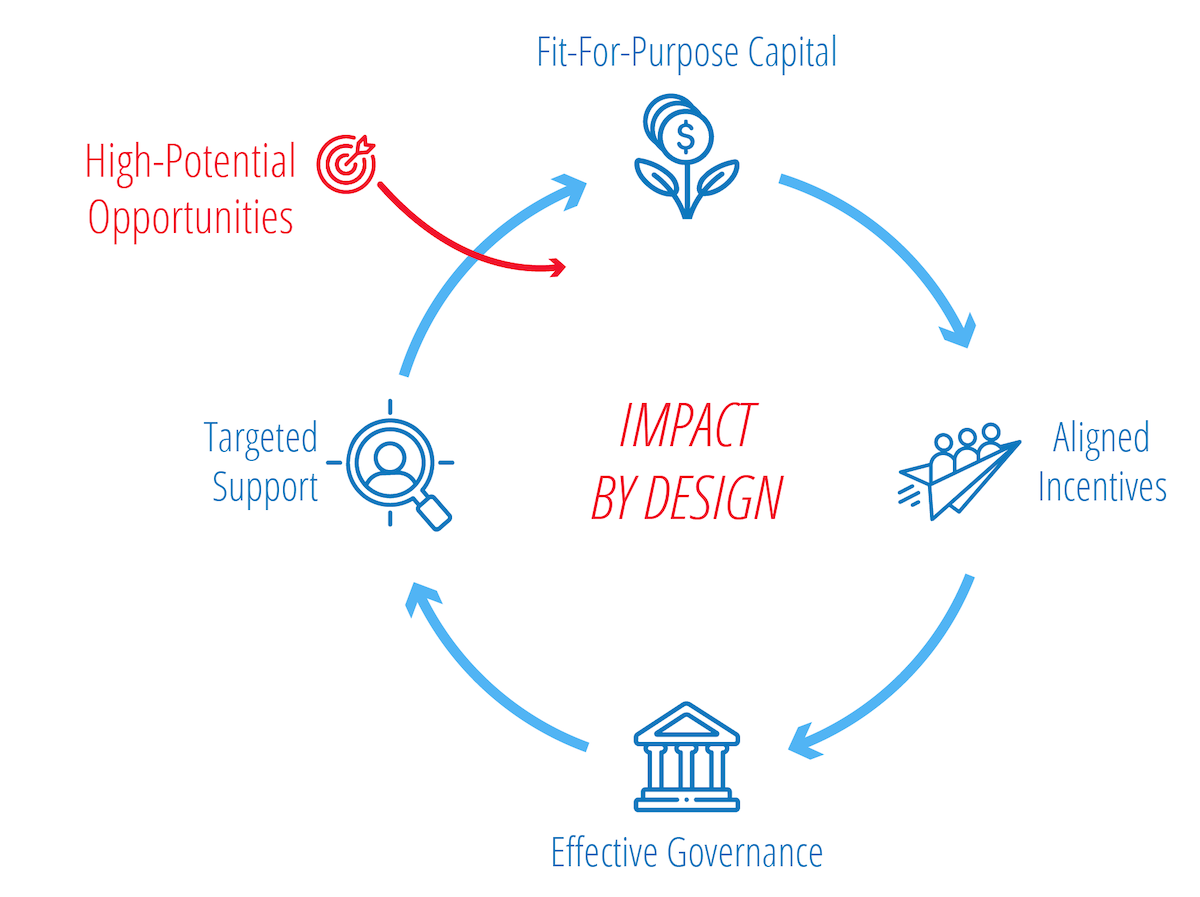
Many know Roots of Impact for our work in impact-linked finance, and we continue to believe that embedding impact incentives into financial structures is a powerful tool. Our work has evolved, and now impact-linked finance is just one tool in a broader set of approaches, all sharing a single core principle: deploying capital so that it delivers the greatest possible impact in line with the priorities of those who provide this capital. This has led us to a new set of actionable strategies we call “impact by design.”
Intentional impact design
The “impact by design” approach embeds impact creation into capital use from the outset, generating positive outcomes through intentional design. It seeks to advance direct, indirect and systemic outcomes across the entire spectrum of capital. It differs from traditional impact finance in a few important ways:
| Traditional impact finance | Impact by design approach |
| Many impact investments focus on “safe bets” that scale what already works, leaving truly disruptive, high-impact innovations underfunded. | Back what can change the system, not merely what feels safe. Dedicate capital to seed and scale disruptive innovations with outsized impact potential, guided by active stewardship to ensure long-term mission alignment and impact integrity. |
| The majority of impact funds are forced to exit their investments after 5–7 years, regardless of whether impact has fully matured or systems have truly changed. | Design capital for the time horizons impact actually needs. Use permanent capital vehicles or self-liquidating instruments, paired with strong governance and incentive mechanisms, to align investment terms with the achievement of real, durable, and systemic impact. |
| Philanthropic funding is spent within narrow criteria, supporting non-profits that meet eligibility requirements and present a plausible theory of change. | Turn philanthropy into a multiplier. Deploy parts of philanthropic capital as catalytic investment in high-impact enterprises that generate sustainable impact, recycle returns, and continuously fuel new rounds of value creation. |
| In blended finance, first-loss capital and guarantees often protect fund-level returns without translating into higher risk-taking or more flexible capital for investees. | Use de-risking to unlock true additionality. Deploy first-loss capital and guarantees as catalytic tools to take disproportionate risk, provide fit-for-purpose financing, and support investee impact creation with technical assistance and incentives. |
| Success is measured by the volume of capital deployed into investments that appear impactful, with limited transparency on the impact actually achieved. | Scale impact, not just financing volume. Maximize impact per dollar invested or spent – and then scale that efficiency with additional financing. |
Putting concepts into practice
Alongside an incredible network of partners and continually inspired by our friends at the Innovative Finance Initiative, we have designed blended funds and evergreen philanthropic investment vehicles that mobilize resources, align incentives and accelerate impact. We have developed capacity-building approaches that turn traditional technical assistance on its head by rewarding enterprises for achievements rather than reimbursing costs for activities. And we have advised organizations exploring innovative and blended finance and introduced new ways to make these approaches more effective. Across all this work, our solutions have been designed to integrate impact from the outset. This evolution unfolded naturally as we responded to diverse needs and remained focused on delivering fit-for-purpose solutions. We call this “impact by design,” as it goes beyond a choice about financial returns or risk.
What drives us is the commitment to make finance work for positive impact by refining and reshaping it so that it becomes truly fit for purpose. Sometimes this means introducing small tweaks, other times it calls for more fundamental redesigns. Finance can deliver better outcomes – across the capital spectrum – when it is intentionally designed to do so.
Bjoern Struewer and Natasha Dinham are co-CEOs of impact advisory firm Roots of Impact.
Guest posts on ImpactAlpha represent the opinions of their authors and do not necessarily reflect the views of ImpactAlpha.