
It’s the financing, stupid.
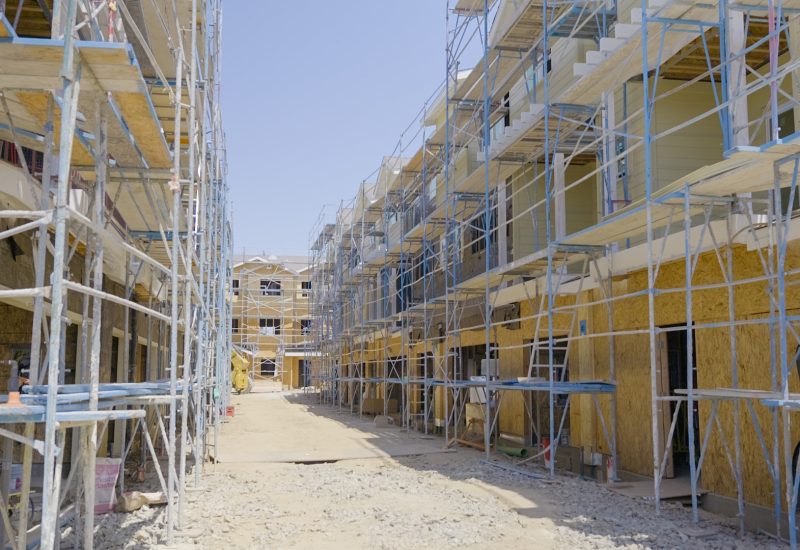
In Los Angeles, a novel mechanism that is expected to finance the construction of more than 1,500 units of new housing may suggest a way for the rest of the state, and the country, to get more housing built more quickly and cheaply.
Local officials on the board of the LA County Affordable Housing Solutions Agency, the area’s three-year-old regional housing authority, on Wednesday approved the issuance of a $204 million social bond to back 20 housing projects.
Instead of relying primarily on federal low-income housing tax credits, or LIHTC, the new approach leverages the $4 trillion municipal bond market to make low-cost capital available to mostly nonprofit housing developers. The key: A layer of catalytic capital that mitigates the risk of losses for institutional bond buyers.
“There’s a new source of construction financing in the state of California, especially in LA County,” Ryan Johnson, interim director of the regional agency, known as LACAHSA, told ImpactAlpha. “It’s cheaper than LIHTC and it’s less complex.”
In essence, Los Angeles’ approach treats affordable housing as civic infrastructure, much like roads, schools and parks. A corollary: The biggest obstacle to housing construction is not local opposition or environmental regulation, it’s financing.
Capital stack
A one-stop shop for housing developers, LACAHSA covers about 20% of the cost of projects and requires developers to break ground within 12 months. The agency offers construction loans, rental subsidies and operating support in addition to permanent financing.
“LACAHSA is going to give you a note at a below-market interest rate for 25 years, and it’s 20% of your capital stack,” Johnson said.
The 40-year-old LIHTC (pronounced “lie-tech”) program is credited with originally bringing institutional capital to affordable housing projects. Last year’s One Big Beautiful Bill Act expanded the program and made it permanent. But the complex requirements to qualify for the credits are now blamed for increasing the number of layers of financing and the time developers need to assemble them, raising the costs and undermining the economics of affordable housing.
Each layer of financing on an affordable housing development adds 3% to the project’s total costs, according to the Terner Center for Housing Innovation at UC Berkeley.
“That’s not much, but when you have five sources of financing, all of a sudden that’s a lot of extra cost to carry and complication and time,” the Terner Center’s Carol Galante said on an Agents of Impact podcast in March. Each additional public funding source delays a project by four months, on average, the center found, and increases costs by more than $20,000 per unit, or more than $2 million on a 100-unit project.
Los Angeles’ bond financing will set up a comparison between projects financed with, and without, the tax credits. At its meeting, the LACAHSA board approved $155 million in financing for a slate of 10 projects that do include low-income housing tax credits. That follows the board’s approval last month of an initial package of $100 million for 10 other projects that do not rely on LIHTC. Johnson said LACAHSA’s analysis suggests that non-LIHTC projects can be built for at least 12% less than LIHTC projects.
In LA County, three-quarters of proposed affordable housing projects fail to receive the tax credit equity. Even those that do grapple with long delays, high transaction costs and added complexity.
“It’s a natural experiment,” said Johnson. “This has never been tried in state history before. No government has tried this in California – a LIHTC alternative.”
Risk mitigation
The approach is not so novel globally: Paris, Vienna, Singapore and other cities use low-cost public financing or publicly-managed private savings to build affordable, or “social,” housing for the majorities of their populations.
LACAHSA, along with regional housing agencies in the San Francisco Bay Area and San Diego, was created by state legislation in 2022. What sets Los Angeles apart is a countywide half-cent sales tax, approved by voters that provides LACAHSA about $385 million a year (see, “Building regional engines for affordable housing in California”).
Most of that funding goes to housing and services for the area’s large population of unhoused residents. But a portion of the capital will be used to provide a junior, risk-mitigating layer for the social bond. That will reduce the risk, and thus the return expectations, for institutional bond buyers to buy the senior layer.
The difference could amount to 400 basis points, or four percentage points, reducing the cost of capital from more than 7% to under 4%. Many projects that don’t pencil out at 7% interest might well be viable at 3.5%, he said.
“This is true catalytic capital that’s trying to change policy and induce the private sector to come in and do this at scale,” Johnson says.
There’s appetite for more where that came from. Developers had submitted a total of 127 applications totaling $1.5 billion and representing 11,625 units. Mayor Rex Richardson of Long Beach, chair of LACAHSA’s board, said the response challenges long-standing assumptions about the obstacles to affordable housing. “The challenge isn’t a lack of sites, developers, or community will,” he said in a statement. “The challenge is financing and operational support.”