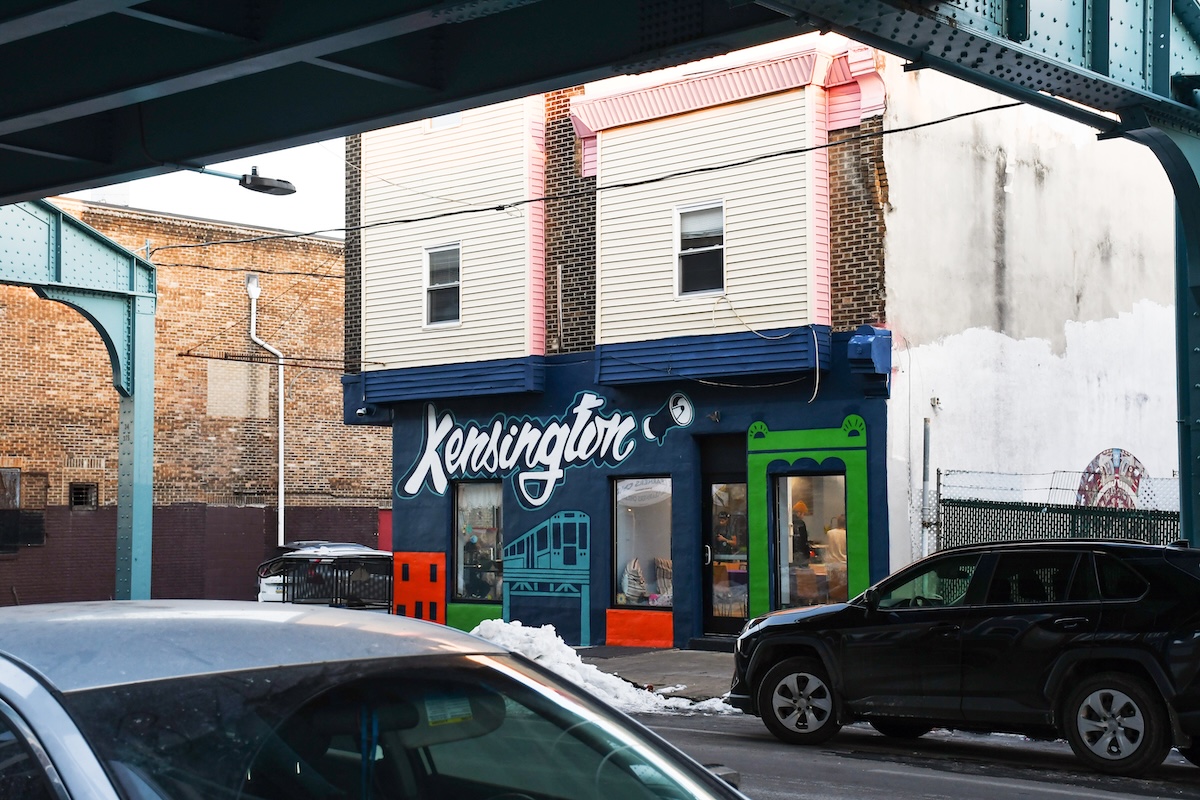

On a commercial corridor northeast of downtown Philadelphia, a diner, a hair-braiding shop and a photography studio, along with murals and a community garden, are tangible markers of a neighborhood reclaiming power over its real estate and its future.
Coming soon to Kensington Ave.: A solar-powered community grocery store with a shared commercial kitchen.
The storefronts between East Allegheny Ave. and East Atlantic St. are among more than 30 properties held by the Kensington Corridor Trust, an ambitious effort to, at once, revitalize a disinvested neighborhood and protect local residents and small business owners from gentrification and displacement.
Under the perpetual purpose trust, which is ultimately governed by the roughly 32,000 residents in Kensington’s 19134 zip code, the properties have been effectively removed from the speculative market in an effort to ensure long-term affordability, collective ownership and community power.
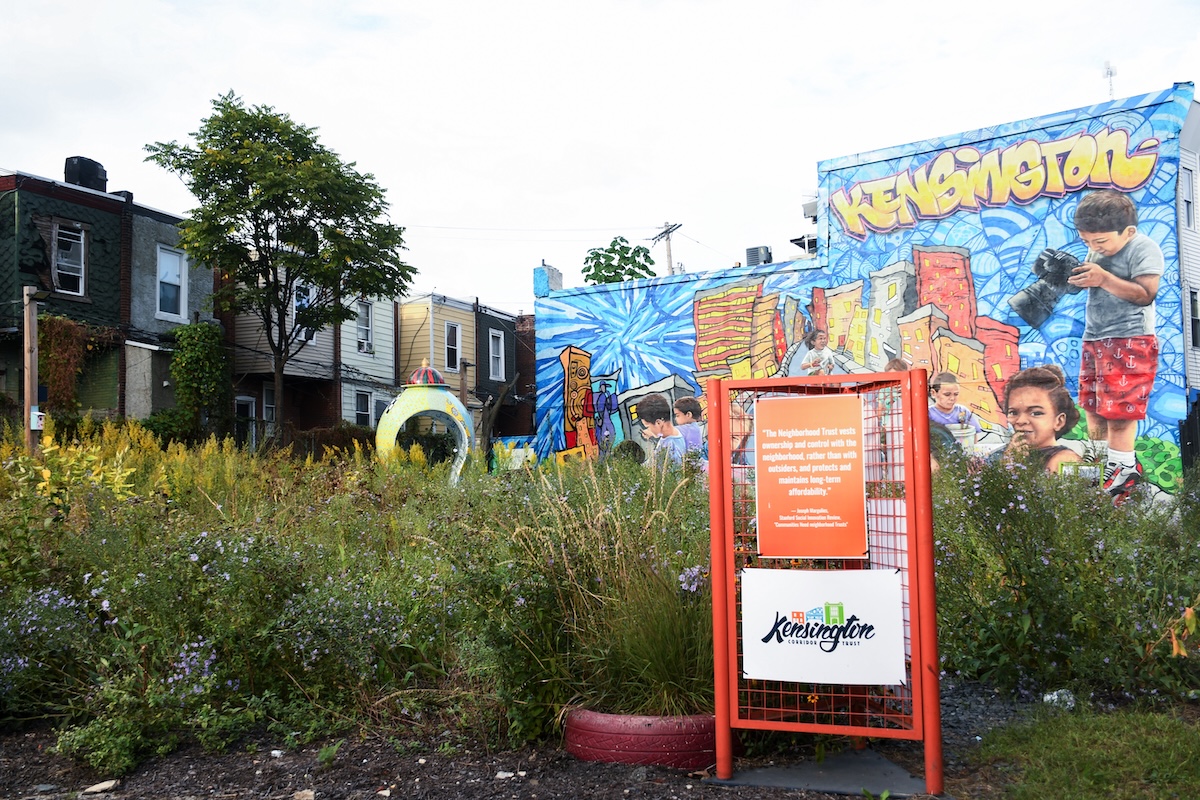
Similar models of community ownership and “decommodification” are emerging across the US, as community leaders adopt strategies to give local residents and business owners a say in their neighborhood’s development and a stake in its rising value. In Philadelphia, the Kensington commercial district has long registered high rates of crime, visible drug markets and some of the city’s lowest outcomes in education, employment and health.
“We got here because policies failed this neighborhood on purpose,” says Adriana Abizadeh-Barbour, who has led Kensington Corridor Trust as executive director for six years. “We’re designing our way out. We’re designing our way past redlining and insurance hikes and intentional speculation and crime.”
In its next phase, Kensington Corridor Trust is launching a community stewardship trust to allow neighborhood residents to buy property shares for as little as $10 a month and receive dividends.
“We were hearing from folks, ‘Hey, I have $100. I have $1,000, I would love to invest in that,’” Abizadeh-Barbour tells ImpactAlpha.
Community stewardship
To set up the community stewardship trust, the Kensington trust teamed up with The Guild, based in Atlanta, which has worked with neighborhoods of color in Atlanta since 2015 to build community ownership of local wealth-building assets. The Guild created and incubated the community stewardship trust model to give residents a stake in the upside of developments in their neighborhoods.
The model is similar to that used by Community Investment Trust, which has spun out of Mercy Corps Ventures to help neighborhoods gain stakes in their local commercial corridors. Community Investment Trust helped hundreds of residents of southeast Portland, Ore., buy into a local strip mall to a small slice of the upside appreciation as well as regular dividends (see, “This strip mall in Portland is helping neighborhood families build wealth and community ownership”). Nearly 350 lower-middle-class residents in southeast Portland have a small slice of the upside appreciation of a well-kept strip mall. Many have already taken distributions, totaling more than $300,000, a 2X return.

Other models include Local Code, which is expanding from Kansas City, Mo. where it helped a local developer acquire properties in the city’s Oak Park neighborhood with the goal of converting them to community ownership (see, “LocalCode adds community ownership to the real estate toolkit”). The real estate investment firm Chicago TREND last year netted hundreds of neighbor-investors a five-fold return on their investments of between $100 and $5,000 in a small shopping center in Chicago’s Chatham neighborhood.
“Community ownership models could deliver a new wave of community wealth generation,” Grounded Solutions Network’s Devin Culbertson and Devin Murphy of Integrated Purpose wrote in ImpactAlpha last year.
Across the Delaware River from Philadelphia in Trenton, New Jersey, April De Simone is taking a page from Kensington’s playbook.
De Simone has stood up nonprofit Vesi through a perpetual purpose trust with a $500,000 grant from the Robert Wood Johnson Foundation. The trust’s first asset is a six-bedroom, single-family Queen Anne–style Victorian home that she and her husband, Marcus, purchased in 2022 and are renovating. They plan to sell the home to the trust at below-market value, and incorporate a kind of renter-equity structure that allows future occupants to walk away with a share of the upside of the home.
De Simone and her husband plan to sell the home for $390,000, even though the house is currently worth about $500,000. “We’re selling it at a reduced amount and activating it so that it stays in the trust in perpetuity,” she told ImpactAlpha.
De Simone says the home could be worth $1.5 million in a decade. The Trust will retain 55% of the ownership shares, the occupant will get 45% of the shares, with an option to sell the shares after 15 years if they vacate the home.
Unlike the hyper-local focus of the Kensington Corridor Trust, De Simone is looking to acquire residential, commercial and cultural assets in blighted commercial corridors all over the US.

“We created a structure that allows us to work across the nation,” she says. “We’re really trying to formulate how do we create thriving neighborhoods for everyone, not just if you can afford to pay.” Such neighborhood development trusts, De Simone says, can help build communities where land and assets are protected for long-term public benefit, rather than speculative gain, and where ownership is broadly accessible.
Kensington Corridor Trust had similarly small beginnings. “All of this started with two condemned properties that were side by side, with bricks that were actively falling on the sidewalk,” says Abizadeh-Barbour. “Now we have our 32nd property under agreement.”
She says she has discouraged leaders in other communities from replicating Kensington’s model. “‘We don’t know if we’re sustainable,’” Abizadeh-Barbour says she told them. Now, her tune has changed.
“We firmly believe that this is a sustainable model that can advance collective ownership, and decommodification,” she says. “We’re very actively moving to replicate.”
Local groceries
Before it gained its reputation as “ground zero” of the US’ opioid crisis, Kensington was a 19th-century industrial engine, with steam-powered textile mills and brick factories with thriving working-class neighborhoods of European immigrants. The Market-Frankford train slicing through the neighborhood offered a direct line to other jobs in Philly’s central city.
The corridor’s decline started with post-war deindustrialization, followed by decades of disinvestment, redlining and speculative activity. Today, Kensington is a majority-Latino neighborhood with a large Puerto Rican population.
“This corridor’s very high crime, very high drug trade, very high sex trade, so it’s not the most appealing corridor across the city of Philadelphia,” says Abizadeh-Barbour. “But the folks who already live here, they feel safe here. This is home. This is their neighborhood.”

Kensington Corridor Trust was created in 2019 by a local consortium led by social impact-focused real estate development firm Shift Capital and including community development nonprofit Impact Services, entrepreneurship incubator IF Lab and the Philadelphia Industrial Development Corp. The consortium funded the acquisition of its first two properties.
With backing from local philanthropies and lenders, the trust has become the largest acquirer of commercial and mixed-used assets on Kensington Ave, according to Abizadeh-Barbour, with 31 properties valued at about $10 million. A Philadelphia Magazine feature names the people behind Kensington Avenue’s storefronts, including Yolanda Del Valle, who runs Sherry’s Restaurant on East Ontario Street.
Shift has sold one of its properties in the area to the trust under an agreement to give the trust right of first refusal. The mixed-use property has 16 residential units and a nonprofit food pantry, the Sunday Love Project. “We’re really excited to take anything that they’re trying to sell and bring it into community control all day, every day,” Abizadeh-Barbour says. “We want to buy all their stuff.”
Under the Kensington Corridor Trust’s ownership structure, anyone in the 19134 ZIP code can formally raise concerns about how a property is being used. Any Kensington resident can trigger a community discussion and, if needed, a vote on the matter. In a food desert, one of the things residents have been calling for is a community grocery store.

“When you’re part of a collective ownership structure, you do own it, and you do have control, and you do have a say — along with all your neighbors, along with all the small businesses that are around you,” Abizadeh-Barbour says. “It produces a vastly different outcome when we’re all collectively making decisions together, versus a single person governing something that directly impacts others.”
By removing local assets from the speculative market, the Kensington neighborhood get to collectively “decide what happens to the land and the real estate, what types of small businesses are brought into those spaces, how we develop the built environment, and how we think about climate resiliency and energy efficiency,” she told ImpactAlpha.
“When I first started and was going around the neighborhood getting to know folks, the number one thing everybody kept telling me was to bring in a grocery store,” she says.
The 800-square-foot grocery store will open this spring. The Kensington Food Company, owned by veteran and Kensington native Thomas Sheridan, will occupy the space and sell fresh produce, baked goods, meats and imported goods. The second floor will have a shared commercial kitchen for local food entrepreneurs. The trust has secured a grant from a regional foundation, the Green Family Foundation, to put solar panels on top of the community grocery store and commercial kitchen.
Ownership shares
The decision to launch the community stewardship trust came out of conversations with residents who wanted to put their capital towards decommodifying more assets in the neighborhood. Neighborhood residents are able to buy property shares for as little as $10 a month and to receive dividends.
The community stewardship trust provides an individual ownership opportunity, whereas the umbrella Kensington Corridor Trust enables community governance. The community stewardship trust allows Kensington residents to build wealth by investing in the commercial and mixed-use assets transforming their neighborhood.

“You’re investing in bringing small businesses, grocery stores, childcare centers,” The Guild’s Nikishka Iyengar tells ImpactAlpha. You’re meeting a real commercial need for the community.”
The stewardship trust will allow residents to buy into only revenue-generating assets in the portfolio that already have tenants. Assets that have not yet stabilized will be excluded. “What we don’t want to do is ask low- and moderate-income people to put $100 a month at a high financial risk,” Abizadeh-Barbour says.
Kensington Corridor Trust is looking to raise $25 million in low-interest, unsecured debt to break ground on new projects and others currently in development, establish its community stewardship trust and support new neighborhood trusts in other cities.
“We have a lot of projects in construction at different stages in the pipeline,” says Abizadeh-Barbour. “We need capital and it needs to be integrated and blended capital.”