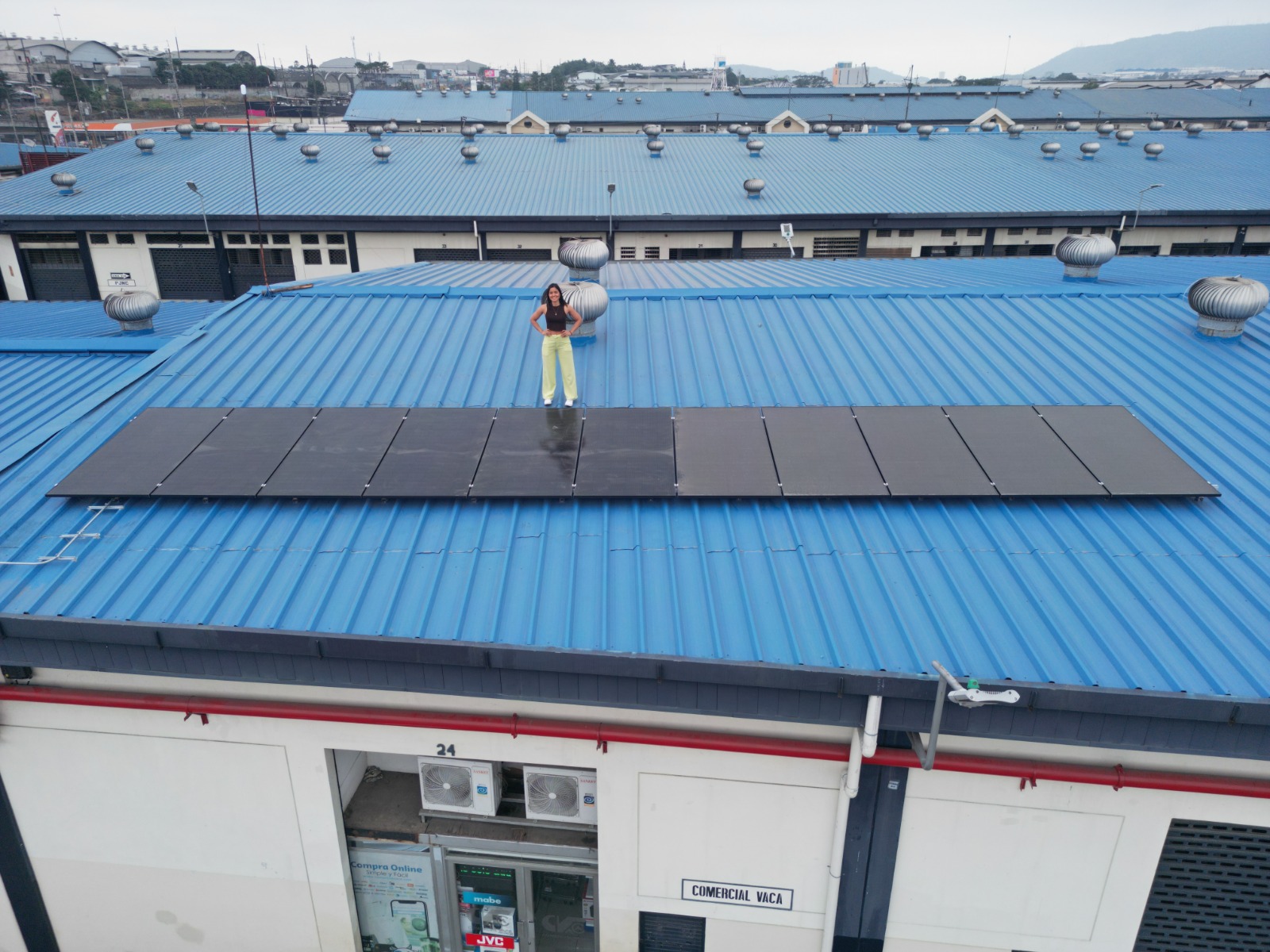
DREX, an Ecuadorian solar developer focused on medium sized commercial projects, has secured financing from Exagon Impact Capital for a six-megawatt solar installation at one of the country’s largest shrimp exporters, Grupo Almar.
The deal marks DREX’s first project to receive financing and Exagon’s first investment in Ecuador since commencing operations six years ago. The New York-based firm invests in energy and infrastructure projects in Latin American and the Caribbean.
“These middle market companies don’t want to put their capital towards the energy part,” Exagon’s Marc Frishman told ImpactAlpha “They want to focus their capital on their core business — sign a contract with us for 15 or 20 years, we’ll sell you energy, and we’re responsible for everything else.”
Missing middle
DREX founder Joselyne Del Rosario spent years confronting the “missing middle” in the region’s solar energy market. In her previous role at Nextergy, an energy solutions provider, she structured solar installations for commercial offtakers in Ecuador.
Roughly 90% of the projects she originated never secured financing.
Most fell into a financing blind spot in Latin America’s energy market. Projects between 0.5 and 10 megawatts are typically too small for development finance institutions such as the Inter-American Development Bank, but too large for local lenders. Del Rosario founded DREX in 2024 to close that gap.
In addition to its role as a developer, the company is building a digital platform designed to standardize how these mid-sized solar projects are presented to investors, hoping to create a clearer pipeline of investment-ready opportunities.
Overlooked founder
Del Rosario grew up in Guayaquil, a port city on Ecuador’s Pacific coast, competing in math tournaments as a kid and eventually earning a place at Escuela Superior Politécnica del Litoral, one of the city’s top engineering universities.
A university-sponsored trip to Europe landed her at European Utility Week in the Netherlands, where she connected with clean energy startups eyeing Latin America. She came home and founded Nextergy, an engineering and procurement firm, to help bring them into the region.
“I didn’t have a background, I didn’t have connections, no money, nothing,” Del Rosario said. “And I’m really proud, because today, if I go and compare my company to others that are in space, these are companies that are led by the sons of corporations — but I have built all of this.”
Del Rosario is currently raising a $1.2 million seed round for DREX. She said finding investors who trust women to deliver remains one of the harder parts of the job in Latin America. Most of the investors who have backed her companies so far have been men. “I just want to grow with good partners — aligned partners that trust in the capacity of women to deliver.”
Solar in Ecuador
The investment case for solar in Ecuador is strong.
The country relies heavily on hydropower, making its electricity supply vulnerable to rainfall patterns that are growing less predictable as climate change grows more severe. Drought conditions in recent years have strained generation capacity, producing recurring outages and price volatility.
Solar offers a stable and cheaper alternative: Long-term offtake contracts can stabilize electricity costs while reducing exposure to grid disruptions. They also help exporters respond to growing pressure from international buyers to lower the carbon footprint of their supply chains.
“It’s a perfect storm — price, quality and stability of the system, and then that sustainability component. That’s all come together,” Frishman said.