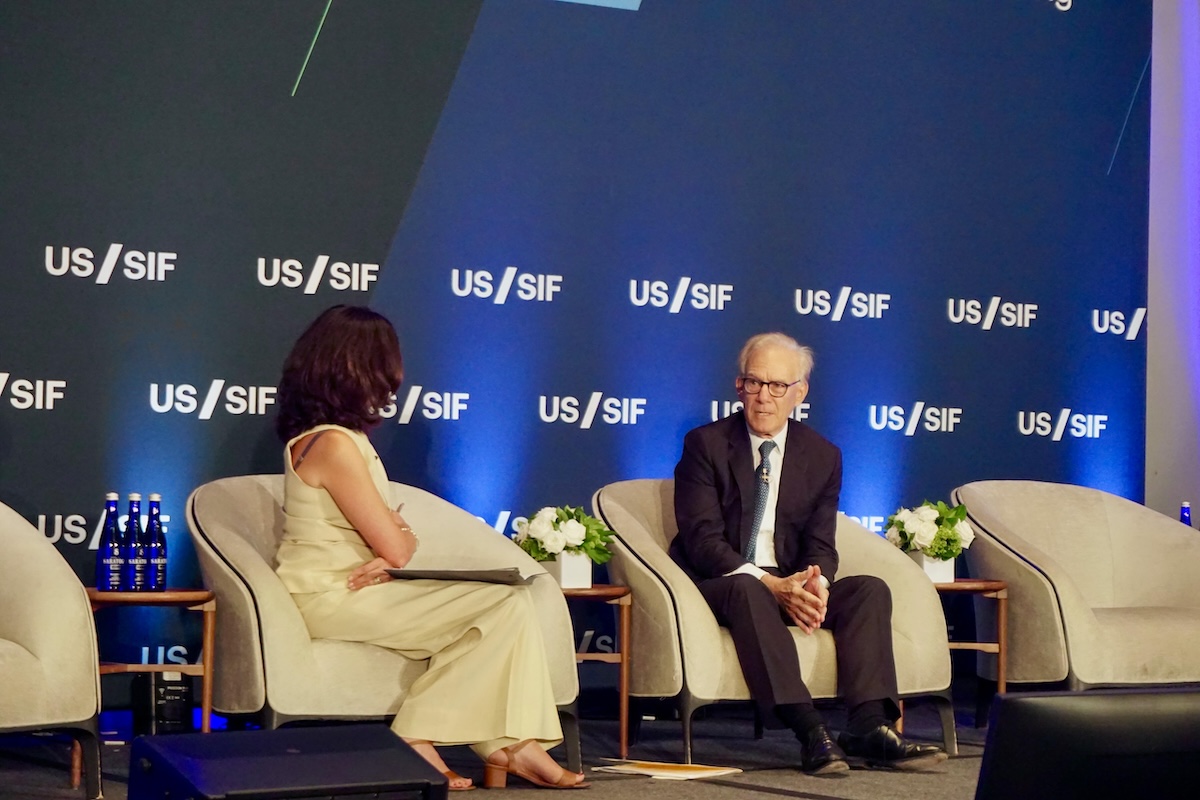

Sustainable investors had a lot to chew on at US SIF’s annual gathering in Washington, DC, last week, as across town senators took aim at some of their biggest priorities.
Republicans’ tax cut and health care bill, which could be voted on as soon as today, threatens to punish solar and wind developers with a tax that could add 20% to project costs on top of slashing Biden-era tax credits and incentives. The so-called “One Big Beautiful Bill” also takes an ax to social safety net programs like Medicaid and food stamps to pay for tax cuts for the wealthy.
Speakers at the US SIF gathering urged participants to protect decades of progress and double down on long-term solutions that center climate, inclusion, and financial accountability.
“We know that the current political climate has led some institutions to step back — from conferences, from networks, from public engagement and commitments to sustainable investing,” said Stephanie Cohn Rupp, who chairs US SIF’s board of directors, commending attendees for staying the course.
“As investment professionals, we are stewards of capital. That now includes offering clients the freedom to invest not just in the world as it is—but in the world as it could be.”
Proxy power under pressure
Shareholder rights are also under attack. Republican-led states have filed dozens of anti-ESG bills, although relatively few have passed, and the Trump administration is rolling back climate and social disclosure rules.
The administration has also gone after the proxy advisors like ISS and Glass Lewis that CalPERS and other large asset owners rely on to vote effectively across thousands of holdings.
“I think the thing that concerns me the most right now, and you may have heard our CEO, Marci Frost talk about this last week, is the attack on the proxy advisory firms and their recommendations.” said Drew Hambly of CalPERS during a panel about the future of stewardship, referencing the growing pressure on these firms.
On May 20th, three GOP senators sent a letter to ISS and Glass Lewis raising concerns about their influence, which followed a house hearing where Republicans pushed Congress and the SEC for stricter regulation on these firms.
“I would characterize this as an all-out assault on proxy rights,” Hambly added.
Efforts to undermine those firms could cripple shareholder engagement on climate, governance, and social issues (though some say such advisors have abandoned their principles in the changed political environment).
That has sparked a move on the part of asset managers like BlackRock to shift more proxy voting to shareholders, taking themselves off the hot seat. That extends to retail investors. Vanguard is piloting pass-through voting for retirement accounts. State Street is piloting its Proxy Voting Choice Program that allows investors to align their votes with specific values, such as climate or faith based through selecting from ISS voting policy templates. Neuberger Berman, through its NB Votes initiative, publicly declares how it will vote ahead of annual meetings, aiming to influence outcomes in real time. These initiatives were discussed among several panelists as examples of how proxy voting is becoming more personalized and transparent. Retail investors can use new tools, such as one from proxy voting platform Iconik.
Hundreds of investors and business leaders, state financial officers, labor unions, and faith leaders have rallied around a “Freedom to Invest” campaign that defends the right of shareholders to consider material financial risks – from extreme weather to labor shortages — and business opportunities, including the benefits of clean energy investments, into decision-making.
Centering Indigenous finance
US SIF’s new Sustainable Indigenous Finance Initiative offers tools and research to guide indigenous led investing. The initiative aims to highlight effective investor engagement, analyze legal and financial risk affecting indigenous communities, and explore opportunities to integrate indigenous knowledge into conservation strategies.
Indigenous communities have long been overlooked by capital markets, despite their stewardship of most of the world’s remaining biodiversity. “We’re outperforming everyone else by 400% with little to no resources. Imagine what indigenous peoples could do if we were fully resourced,” said Fawn Sharp of the Quinault Indian Nations
That exclusion carries a cost. Wharton research shows that foreign direct investment near Indigenous lands often triggers violence and protest. “Grievances lead to protests, which could lead to violence, actually—and that is the cost that you all absorb,” said Rebecca Adamson of First Peoples Worldwide. She pointed to Shell’s $4.1 billion write-down on an Arctic drilling project following Indigenous opposition as a preventable loss.
“The world is going to be desperate for a gold standard of investment. Where can we invest dollars and take that to the bank? You can invest with indigenous peoples around clean water and know we’re going to value it as a sacred resource.” said Sharp. “You can invest in all these natural systems, whether it’s ocean water, salmon, and we have centuries of knowledge that we bring to bear in valuation”
Local capital for local needs
With global aid in retreat, local institutions are stepping up. “A healthy outcome of this moment is more deals that start locally,” sai Joan Larrea of Convergence Blended Finance.
The dramatic pullback of global development assistance, led by the Trump administration’s shuttering of USAID, has led to a $70 billion annual gap in concessional finance, according to Boston Consulting Group (BCG). One study estimates that 340,000 deaths can be attributed to USAID’s recent budget cuts.
Convergence recently provided design-stage grant funding and technical assistance to the Development Bank of Rwanda’s sustainability-linked bond — the first of its kind issued by a development bank in Africa. The bond directs capital into affordable housing, green projects, and women-led businesses. “They are now in the driver’s seat,” said Larrea, pointing to the bank’s ability to steer capital on its own terms, without the rigid conditions set by global development funders like USAID.
Accessing donor capital remains a challenge for blended finance funds that don’t fit neatly into traditional thematic buckets.
“If I have a near-investable proposition and it needs a little bit of help,” Larrea explained, “I have to go knock on the door of SIDA in Sweden, Proparco in France, Rockefeller in New York, MacArthur in Chicago. Each of them says, ‘I only do youth,’ ‘I only do Africa,’ ‘I only do gender.’ You end up with a null set.”
Larrea highlighted the Investment Mobilization Collaboration Arrangement, launched by Nordic donor countries. The platform pools concessional funding through a single “front door,” simplifying access for investment managers and reducing transaction time. “No private equity fund is going to wait two years to get a deal done,” she said. “The clock is ticking.”