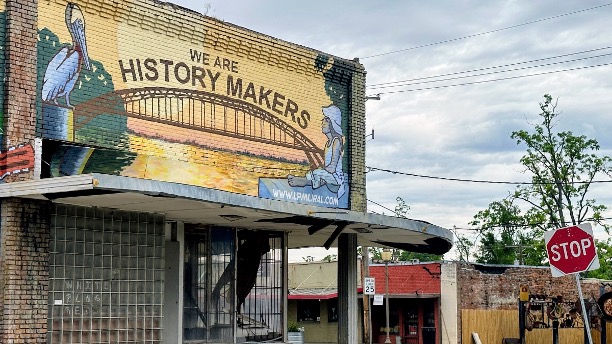

Residents of East Carroll Parish, Louisiana did everything they could. For six years, a coalition of faith leaders and local organizers ran door-to-door surveys, mapped unserved homes, and built partnerships in an effort to bring better internet to the parish, one of the poorest in the country and, until recently, one of the worst connected.
That organizing paid off when the state awarded funds to bring fiber internet to the most rural parts of their parish. Today, rural East Carroll has high-speed connectivity and is already seeing economic green shoots as residents who left decades ago to find work have started to return, bringing remote jobs and full-time salaries with them.
But that’s only half the story. The town of Lake Providence — where most of East Carroll’s Black population lives, where earnings are low and job options are few — is stuck on slow, expensive service. The town had been in line for Broadband Equity, Access and Deployment, or BEAD, funding until the Trump Administration reengineered the program and a $6 million award for fiber became $150,000 for Starlink’s satellite service. Today, fiber stops at the edge of Lake Providence.
BEAD is falling short
There are versions of what happened to East Carroll across the country. One hundred billion dollars in federal funding between 2010-2020 closed the digital divide by less than 1 percent. Reasonable estimates suggest that 26 million Americans still have no access to home broadband.
BEAD was supposed to be the program that finally closed that gap. Instead, the program has been halved, with substantial funding redirected to satellite services that don’t deliver the durable infrastructure communities need. Even in places that haven’t lost awards, contract renegotiations and delays are causing operators to walk away.
In my five years working to close the digital divide at Connect Humanity, a non-profit impact fund, I’ve spoken to many funders who believed BEAD would be sufficient. It will not. Analysts have long warned that BEAD’s $42 billion wouldn’t be enough to deliver high-speed internet to everyone. And now that the program has been weakened; many more communities will be left wanting and waiting. These will disproportionately be the same rural areas, low-income households and communities of color passed over in previous funding cycles. A different approach is long overdue.
A problem made for community development finance
Digital infrastructure is no different from other public goods that we deem essential but that aren’t universally provided by the market. Some of the most effective tools for closing these gaps over the long term come from community finance, not one-off federal grants.
Affordable housing isn’t getting built because the federal government decided to solve housing on its own. It is getting built because decades of community finance infrastructure — CDFIs, CRA-motivated banks, tax credit structures — created a market around an asset class that private capital alone wouldn’t touch. The same story is true of rural healthcare and clean energy. It’s time to build this market for community broadband.
There is a growing movement of community-centered providers that are well-positioned to connect the hardest-to-serve areas. These are small- to medium-sized outfits, based locally, and purpose-driven to close connectivity gaps. But they struggle with access to capital. They are too small for large infrastructure investors and too large to rely on foundation grants. And private equity investors come with return expectations that don’t pencil out for low-income communities. This work needs lenders that can structure financing around the realities of each place, with flexible terms, patient capital and covenants that hold providers accountable. It screams community development finance.
What we’ve learned from community broadband investing
Connect Humanity was created for this purpose. Our pilot fund has deployed over $3 million, catalyzing a further $47 million in public and private capital, supporting five projects in a range of communities.
In Plumas County, California, our investment in Peak to Peak Communications has helped bring fiber to towers in the Sierra Nevada, boosting public safety communications and connecting remote mountain communities. In Macon County, Alabama, a $500,000 loan unlocked a $3.9 million fiber build that has attracted $183 million in further investment and will create an estimated 2,000 jobs. It also provided the infrastructure Tuskegee University needed to set up Alabama’s first OnMed telehealth station, reducing healthcare barriers for 3,000 students and staff. This is what broadband can do when communities are backed with the capital they need.
Connect Humanity is building a community development loan fund to scale this lending — one where funds revolve and repayments from one project fund the next so the same dollars serve community after community. A portion of the interest income generated is used to fund digital skills and device programs, ensuring residents can make the most of connectivity when it arrives. These digital adoption programs de-risk the initial investment. This is capital with inclusion built into the fund structure.
Building the ecosystem
While we are now on track to become the first CDFI dedicated to digital infrastructure, our bigger goal is to catalyze an ecosystem that sustains broadband lending perpetually so communities aren’t forever exposed to the boom-and-bust cycle of public grants.
I often say that broadband infrastructure is a forever problem. Funding the expansions and upgrades needed to close the digital divide and keep it closed takes more than a handful of funders. Affordable housing scaled because a market formed and CDFIs, banks, and investors all learned to underwrite the asset class with confidence.
Similarly, this is a job for the whole capital continuum. Grants build the technical assistance and underwriting tools that make these deals bankable. Recoverable grants and PRIs absorb early risk and lend patiently where banks won’t. MRIs and market-rate debt bring the scale that makes a market. Every one of these has a distinct role in moving community broadband from one-off deals to a financing system. Connect Humanity is looking for partners across that spectrum to build it.
The future of Lake Providence and the hundreds of towns across America still unconnected rests on whether we build the community development ecosystem that can do what BEAD won’t and private equity can’t.
Brian Vo is Chief Executive Officer at Connect Humanity.
Guest posts on ImpactAlpha represent the opinions of their authors and do not necessarily reflect the views of ImpactAlpha.