The “Resilient Capital Stacks” series has highlighted how local leaders blend public, private and philanthropic dollars to build climate infrastructure rooted in specific places. Farmland may not look like a transit line or a microgrid, but it is just as place-based – tied to soils, water, communities and local economies – and it requires equally durable capital to weather climate and market shocks. As a financial advisor, HIP Investor encounters managers like Farmland LP in our research on climate-aligned real assets, and we view their evolving capital stack as one example of how investors can support regenerative land management.
Since 2009, the sustainable agriculture fund Farmland LP has shown how an evolving investor base and diversified revenues can turn working lands into a resilient real-asset investment for impact-minded limited partners. Farmland LP’s model offers a practical playbook: Farmland LP’s approach is straightforward: design a resilient capital stack, broaden the investor base over time, layer in revenue streams linked to ecological performance, and bring in climate buyers who pay for verified impact.
As an anchor investor in Farmland LP’s third fund, Microsoft’s Climate Innovation Fund helps de-risk early soil-carbon projects, sets a high bar for measurement and verification, and signals durable corporate demand for verified carbon credits – turning a traditional farmland vehicle into a testbed for data-driven climate finance that remains grounded in specific landscapes and communities.
The state of farmland
U.S. agriculture is entering a historic transition. An estimated 70% of U.S. farmland will change hands over the next 20 years as aging farmers retire and many families lack a skilled or willing next-generation operator. Almost $1 trillion worth of farmland is expected to come to market in the next decade, creating a rare window to influence how these acres are farmed for climate and community outcomes.
At the same time, the base of farmland itself is shrinking, driven by urbanization, consolidation and economic pressures on smaller farms. The US has lost roughly 66 million acres of farmland since 2000, an area the size of Florida. The total US farmland market is valued at about $3.8 trillion, similar in size to the U.S. muni-bond market, yet only 2% is institutionally owned, leaving most acres in fragmented ownership structures that can struggle to finance transitions to regenerative management at scale. For investors, this creates a decision point opportunity to build more resilient food and climate systems.
Farmland LP’s model and resilient capital stack
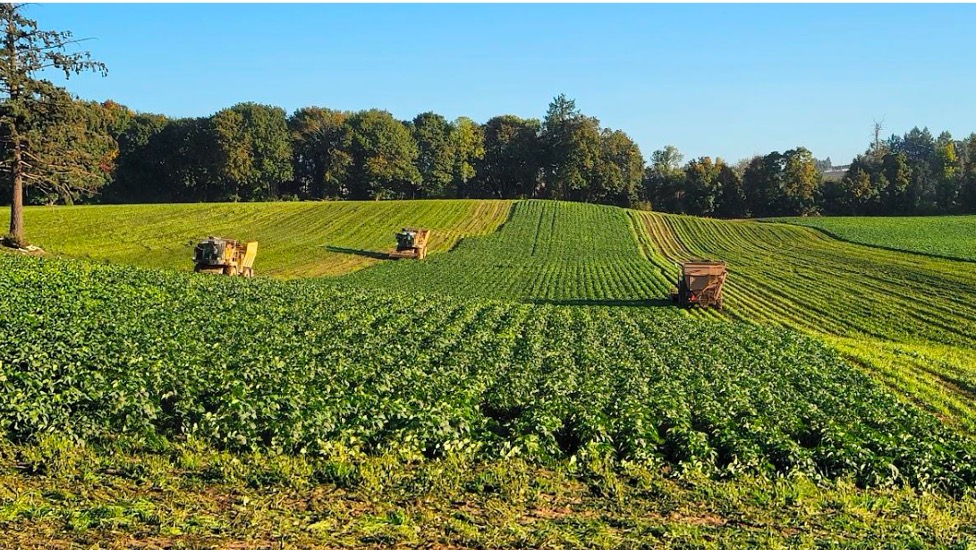
Founded in 2009, Farmland LP is one of the largest US fund managers focused solely on organic and regenerative farmland, with roughly $350 million across three funds and more than 19,200 acres across California, Oregon and Washington. Farmland LP acquires high-quality land with secure, strong, senior water rights, transitions the land to organic and regenerative practices, and captures higher value by selling organic and permanent crops like almonds, blueberries and apples. These high-value products can support higher rents to farmers, stronger operating margins and ongoing land appreciation, plus, an “ecosystem-service revenue,” such as selling carbon credits.
Farmland LP’s capital stack is intentionally conservative. As of year-end 2024, Fund III’s loan-to-value is below 10%, providing a substantial buffer against interest-rate increases or commodity pricing downturns. Modest mortgage and equipment debt finances land acquisitions and technology and infrastructure investments (such as field satellite imaging, GPS-driven tractors and farm management software). In addition, ongoing government grants from USDA programs have supported beneficial, organic-friendly practices such as drip irrigation, pollinator hedge-rows and energy-efficiency improvements. This structure prioritizes staying power over maximum leverage, reducing refinancing risk and preserving flexibility to invest through cycles.
Evolution of fund participants
The evolution of Farmland LP’s investor base mirrors the broader mainstreaming of climate-aligned real assets.
- Fund I (2009): Backed primarily by direct investors, including accredited individuals and family offices, who acted as catalytic early capital, proving that large-scale conversion from conventional to organic and regenerative systems could deliver compelling returns.
- Fund II (2014): Added registered investment advisors, or RIAs, to the mix, reflecting growing acceptance of farmland as a diversifying, inflation-hedging asset class with impact credentials.
- Fund III (2023): Brings institutional capital into the stack, including Microsoft’s Climate Innovation Fund as a prominent anchor investor, alongside continued commitments from direct investors and RIAs.
Today, about 68% of Fund III capital flows through direct investors, 21% from institutional investors and 11% from RIAs. This diversified investor mix – individuals, advisors, family offices and institutions – supports scale while maintaining the low-leverage profile that underpins the fund’s resilience.
Diversified revenue model
Farmland LP’s resilience is reinforced by a five-bucket revenue model, with each bucket reacting differently to market and climate conditions.
- Base rents and lease income: After organic conversion, land rents can double, rising from roughly $300 per acre to $775 or more. By leasing to specialist organic growers or farming directly, the fund turns long-term leases into stable, “utility-style” payments comparable to power purchase agreements in renewable energy.
- Operating margin from direct farming: Through Farmland’s Green Spring Farms operating company, a 55-person team manages permanent and specialty crops such as blueberries, wine grapes, almonds, hazelnuts, apples and cherries. At Burns Farm in California, a 4,200-acre property, transitioning to 80% certified organic and permanent crops increased gross margins 2.3 times while appraised value tripled, illustrating how regenerative practices can enhance both operating performance and land values on a specific place-based asset.
- Land value appreciation: U.S. farmland has historically appreciated at about 6.2% annually above inflation, and Farmland LP seeks to enhance that baseline by improving soils, biodiversity, water infrastructure and certifications.
- Soil carbon credits and ecosystem services: In partnership with Carbon Friendly, Farmland LP has submitted the first regenerative farming carbon credits in the U.S. to Verra, which administers the world’s most widely used voluntary carbon credit program. The partners expect to generate two to five million verified, high-quality, nature-based, carbon-removal credits over the coming decade, backed by rigorous soil sampling, management-practice tracking and third-party verification.
- Impact premiums and certifications: Certifications – including USDA Organic and other regional and global standards – support price premiums, preferred supplier status and access to impact-oriented capital.
This blend gives the fund both stability and upside: Base rents and appreciation stabilize returns, while operations, credits and impact premiums add growth linked directly to climate and ecological performance.
Microsoft as institutional investor and catalytic climate capital provider
“Farmland LP’s use of regenerative agriculture practices to ensure healthy soils, and therefore high-quality soil carbon credits, is a critical element of advancing nature-based carbon removal solutions,” said Erika Basham, director of Microsoft’s Climate Innovation Fund. “We’re excited to invest in their fund and work with them to create a more sustainable agriculture sector.”
Microsoft’s $1 billion Climate Innovation Fund, established in 2020 to accelerate the development and deployment of new climate technologies, plays three catalytic roles in Farmland’s Fund III resilient capital stack.
- First, Microsoft’s anchor commitment validates the manager and strategy for other LPs, demonstrating that regenerative farmland and soil carbon sequestration can meet higher institutional standards for climate impact and risk.
- Second, Microsoft helps underwrite early-stage carbon-credit development risk, enabling Farmland LP to build projects that comply with Microsoft’s criteria for high-quality carbon dioxide removal and register through Verra.
- Third, this partnership signals long-term corporate demand for high-integrity, nature-based carbon removals, encouraging sustained investment in measurement, reporting and verification infrastructure.
In effect, the Microsoft partnership links capital access to data quality, pushing the fund toward the frontier of resilient, evidence-based climate finance.
Resilient capital stacks in action
For investors and local leaders Farmland LP offers a tangible playbook: build a diversified, resilient capital stack; grow a broader investor base; stack multiple revenues; and attract climate buyers who pay for verified impact. Farmland is inherently place-based, and resilient capital stacks like Farmland LP’s can help ensure that the transition to climate-smart agriculture keeps working lands in production, supports rural communities and delivers real, measurable climate benefits over time.
HIP Investor’s role is to analyze such models, understand their strengths and limitations and help clients integrate lessons into broader strategies for climate-aligned, place-based portfolios – rather than to promote any single fund.
Nick Gower is a senior vice president at HIP Investor.
The “Resilient Capital Stacks” series is a partnership between ImpactAlpha and HIP Investor, which explores how communities and climate leaders are mobilizing diverse funding sources to implement critical climate infrastructure, actions and initiatives.
Guest posts on ImpactAlpha represent the opinions of their authors and do not necessarily reflect the views of ImpactAlpha.
Disclosure: HIP Investor is a registered investment advisor, and has previously created an impact report for Farmland LP’s use with investors. The content above is for your education, and not an investment recommendation. All investing risks capital.