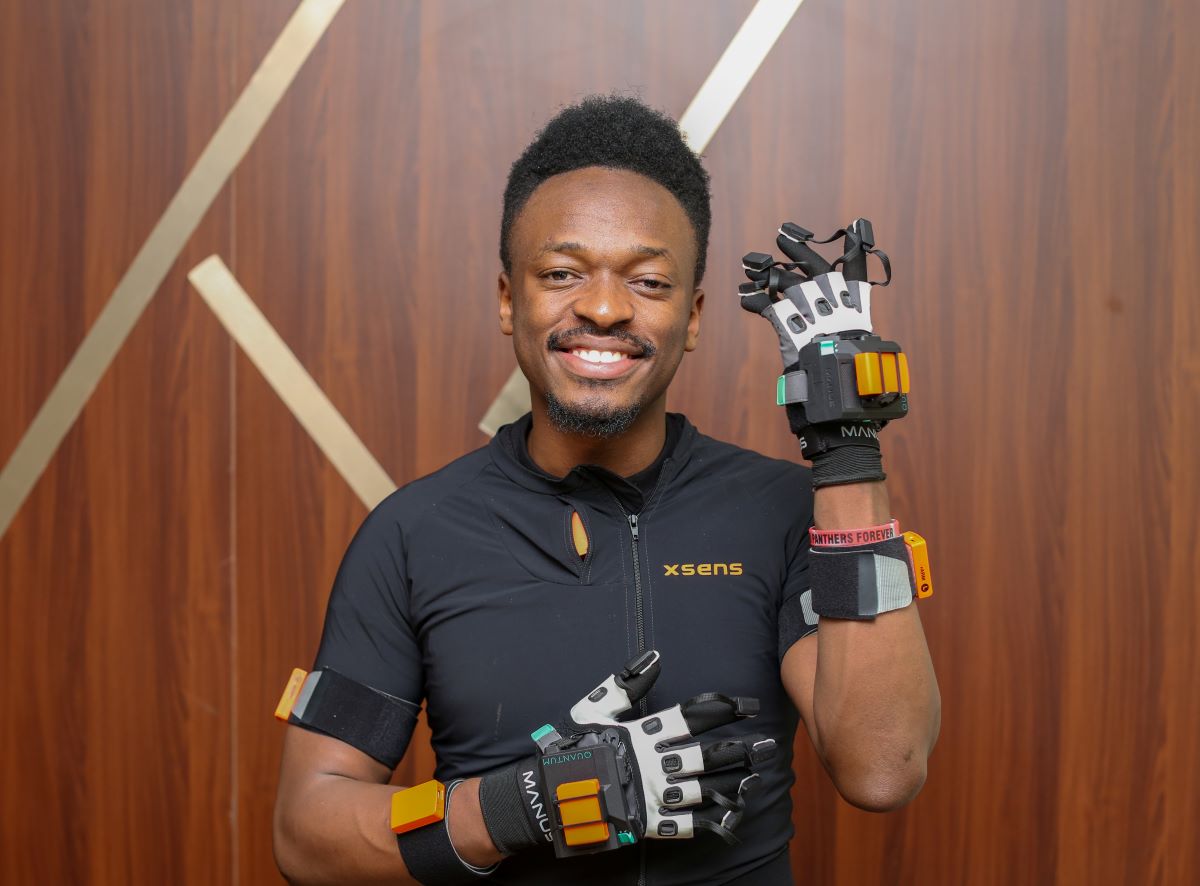

Africans with disabilities confront major hurdles in navigating day to day life with ease. Solutions haven’t attracted much attention or capital from private investors. That’s because technologies, infrastructure and services designed for people with disabilities are largely lumped in with humanitarian issues.
“It’s very charity oriented,” says Bernard Chiira of Kenya-based impact investor Assistive Technologies for Disability Trust, or AT4D.
Chiira and his team are out to convince investors that investing in Africa with a disability lens is not only a viable fund strategy, it’s a way to improve infrastructure, products and services for the broader population. AT4D is part of a consortium led by the Kenya’s Ministry of Information, Communications and the Digital Economy, in partnership with the Kenya Institute of Special Education, assistive computer technology provider inABLE, Huawei Kenya and healthcare-focused research and data analytics firm Qhala. The consortium launched the AI for Disability Project which will launch digital hubs to support the development and deployment of assistive technologies.
“When you include or you solve for accessibility, it’s not just for a small group of people, you’re benefiting everyone,” Chiira tells ImpactAlpha. AT4D is testing the thesis with its Momentous Fund, its inaugural fund for early-stage disability tech. “We hope this fund will encourage people to see the value chain at the industry level,” Chiira says.
Curb cut effect
AT4D is looking for tech solutions that are being deployed in mobility, logistics, customer services and other sectors that ease these challenges for Africans with disabilities, and in the process, also benefit the general population.
The prime example is curb cuts, or dips in sidewalks made to help wheelchair users to navigate and cross the street but which also benefit parents with strollers and delivery workers with dollies. Another example of the so-called “curb cut effect” is the improved accessibility and hygiene that come with portable and automatic toilets that were initially designed for individuals with limited mobility. Also: voice-to-text and predictive texting, which started out as ways to make tech more inclusive for differently-abled people.
The “curb cut effect” is lauded by other disability-lens investment firms, like Enable Ventures in the US, as evidence the seemingly niche solutions have broader beneficial uses.
AT4D was developed as an accelerator program within the Global Disability Innovation Hub at the University College London Engineering using funding from UK Aid. It was spun out in order to help fill a resources and funding gap for disability tech ventures: venture capital investors often write them off as too niche or nascent, while many grant funders see them as “too commercial” and try forcing them to register as nonprofits. That “goes against the idea of building sustainability,” says Chiira. “The fund was inspired by understanding the needs of early stage innovators, and also the need to change the mindset that it’s charity.”
Flexible finance
AT4D’s acceleration cohort included Kenya-based Signvrse, which is enabling real-time digital sign language translation using AI in making interpretation avatars. Signvrse received a grant from Google to develop country-specific sign language. AT4D helped South Africa-based HearX secure a £200,000 grant to manufacture hearing aids and diagnostic devices, which are available in more than 40 countries.
Hope Tech makes wearables for blind individuals that use haptics to enable independent mobility and navigation. Lincell Technologies repurposes laptop batteries and motorcycle shock absorbers to make electric tricycles for people with disabilities. Syna Consultancy makes odorless portable and automatic toilets.
AT4D’s Momentus Fund has secured $650,000 from the Judith Neilson Foundation to begin investing in such companies. The fund offers flexible financing, including SAFE notes and convertible debt, depending on founders’ needs. Chiira says he hopes that over time the pilot fund will attract a range of investors and evolve into a blended finance facility.
AI’s impact
As with every sector, opportunities in the disability tech space are evolving quickly because of artificial intelligence, says Chiira. AI is also making it easier and faster to test and iterate on products and services.
Signvrse, for example, is using AI for real-time interaction with users and guidance.
To ensure that African users are fairly represented in the AI models startups are leveraging, AT4D is launching an AI and disability inclusion hub in partnership with Nairobi-based Next Step Foundation, Kwame Nkrumah University in Ghana, Canada’s International Development Research Centre, and the UK’s Foreign, Commonwealth and Development Office. The hub will support development of African datasets to support startups building inclusive AI applications, and it advocates for “frugal” AI models, like Google’s Gemma, which can function without internet connectivity.
“If AI developers do not train their models on data sets that represent disability,” Chiira warns, “there’s a high risk of another layer of digital discrimination of people with disabilities.”