
I recently watched the new Marvel movie, “Thunderbolts*,” and it was everything a superhero-obsessed mass audience could have asked for. Well-choreographed action scenes. Relatable characters with real depth. A healthy dose of mystery and suspense. Thunderbolts* had it all – even a unique spin on the mental health epidemic.
But if superheroes are all about saving the world, why not put them to work saving the current world? Why is every high-stakes battle about malevolent aliens or rogue technology, rather than about the real-world battles that impact investors and civil-society organizations are trying to fight?
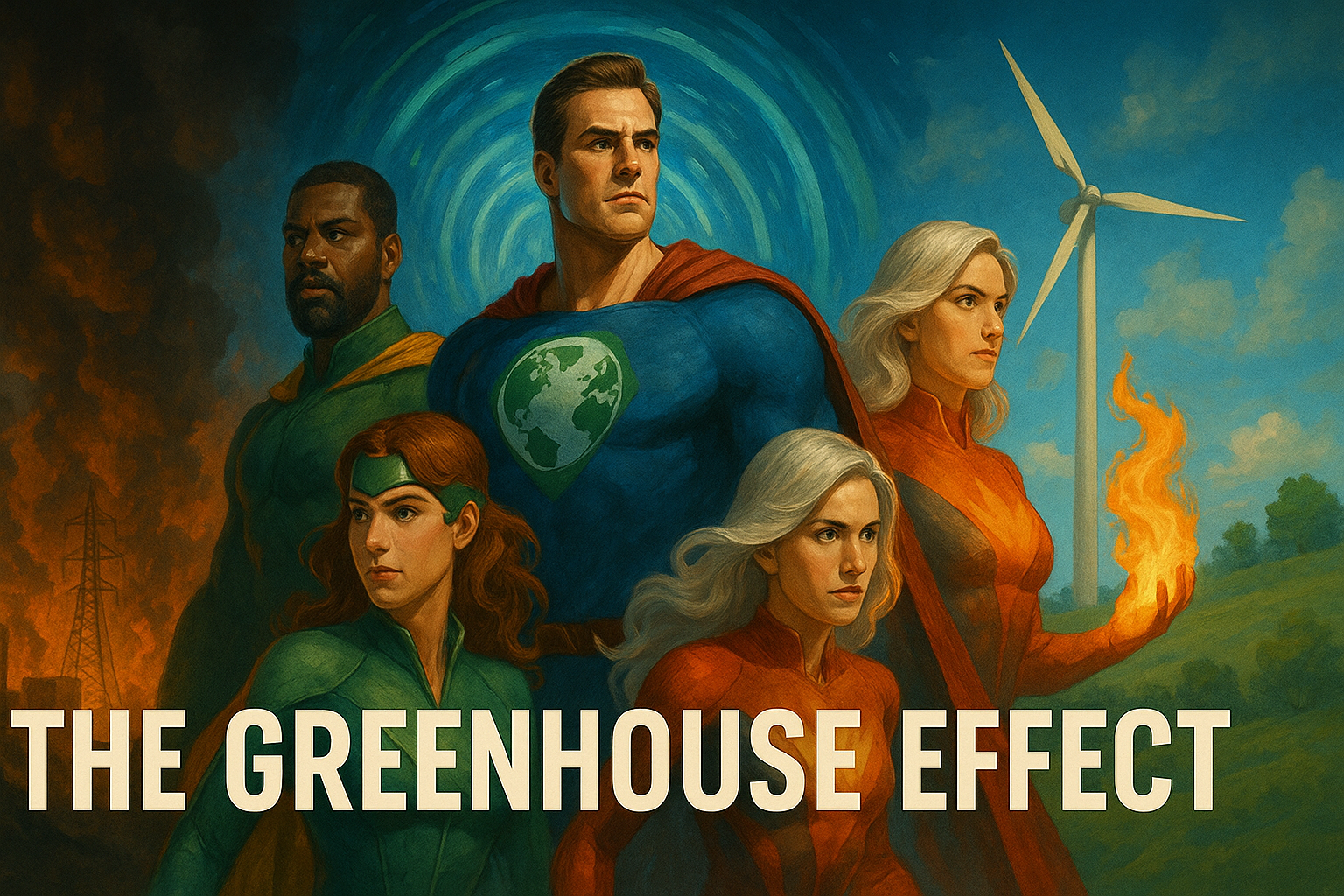
I think Marvel can do better. Here’s my pitch for a climate-themed film, which I’m calling “Avengers: The Greenhouse Effect.”
The Greenhouse Effect
It’s 2030 and the Avengers are gathered for an emergency meeting. A historic heat wave is decimating much of Europe. The power grid has failed, and the public cooling centers can only hold so many people. What food had been saved for such emergencies is now quickly spoiling. Hospitals are running out of room, and most reservoirs have run dry.
The UN has called on the Avengers for aid. But even with all their resources, the Avengers could only save so few.
So Morgan Stark, daughter of Iron Man, pays homage to her father’s plan to defeat Thanos by coming up with a plan to defeat an enemy just as ruthless: climate change.
Using the Pym Particles to enter the quantum realm, a group of Avengers will go back in time to 1988. That’s the year Dr. James Hansen, director of NASA’s Institute for Space Studies, first testified to Congress about the greenhouse effect and the 99% certainty that human activity was causing global warming.
The Avengers’ mission is to do a 3-month publicity blitz, making sure that everyone in the world is aware of the horrors that await humanity if world leaders don’t leap into action. At the end of the 3 months, the Avengers will have run out of Pym Particles and will need to return to their timeline.
Peter Parker, aka Spider-Man, and Bruce Banner, aka The Hulk, will work with the period’s best scientists to share cutting-edge research on solar panels and battery technology, allowing them to make decades of advancements in just weeks.
Bucky Barnes, aka Winter Soldier, and Sam Wilson, aka Captain America, will lead outreach to the world’s government and military leaders, telling them about how the combination of increasingly severe natural disasters and a global scarcity of resources will lead to endless conflict and more than 1 billion refugees.
Matt Murdock, aka Daredevil, and Yelena Belova, aka Black Widow, will team up to hit all the news shows and radio programs as the trusting public faces for a world about to undergo a difficult transition. They’ll go on the Tonight Show with Johnny Carson, appear on-stage with Sting during his inaugural Rainforest Benefit concert, and light the flame at the 1988 Summer Olympics in Seoul. They’ll do photo ops with U.S. President Ronald Reagan and Soviet leader Mikhail Gorbachev to signal the easing of Cold War tensions. They’ll also attend the G7 Summit in Canada, where they’ll be accompanied by an enthusiastic 40-year-old Al Gore, the Senator from Tennessee.
The Wakandans will sign a treaty with the biggest fossil fuel companies, agreeing to give them access to vibranium (aka “the strongest metal known“) in exchange for a rapid phase down of fossil fuel production. The fossil fuel companies – and their shareholders – will be richer than ever.
It’s a high stakes race against the clock. The Avengers won’t know if their efforts work until they get back to modern times.
As the end of the 3 months nears, the Climate Avengers make an impossible choice. Instead of going back home to their loved ones, they stay in the past to make sure that humanity stays on the right path.
Cut back to 2030 and the world is completely transformed. Everyone has access to clean and affordable energy. Food and water are plentiful. The average lifespan is 150 years. Humans are building high-speed underground trains on Mars. At the signing ceremony for the new train hub, the UN Secretary General thanks Earth’s “real heroes” for this important milestone – “the scientists and the engineers, the teachers and the artists, the mothers and the fathers.”
The Avengers that stayed behind in 1988 are, now more than 40 years later, leading a peacekeeping mission to the stars, promoting Earth as the cultural and spiritual center of the galaxy.
The Avengers of 2030 watch a public broadcast of their old friends about to meet an intelligent, interplanetary species for the first time. On the ticker at the bottom of the screen, the stock markets roar in approval. And at the top of the screen, a global happiness index ticks steadily upward.
Dmitriy Ioselevich is the founder of 17 Communications