
Greetings Agents of Impact!
In today’s Brief:
- This climate investor’s emissions may go up before they go down
- Sustainable salmon farming in Japan
- Tikehau and Amova team up in Singapore
- Aqua-Spark’s founders on the eFishery scandal
Featured: LP = Leadership Potential
On the ‘right path’ to net zero, portfolio emissions may go up before they go down. Some investors have abandoned net-zero goals. Those still trying to meet their targets are divesting from high-emitting sectors, purchasing carbon credits, or funneling capital into low-carbon companies that are already on track. A better strategy: Taking on major sources of emissions to help transition them to lower carbon footprints. “The most effective investments may increase a portfolio’s reported emissions in the short term but are intentionally chosen for their capacity to reduce real-world emissions over time,” Kathleen Simpson of The Russell Family Foundation writes in a guest post. “These are the investments that finance the hardest work of climate action – retrofitting industrial systems, scaling frontier technologies that may have high initial carbon footprints, and supporting transitions in carbon-heavy regions and sectors.” The foundation, based in Gig Harbor, Wash., calls this “the right path.” With about $100 million in assets, the foundation (ImpactAlpha Edge) is small compared to some of its peers, but Simpson hopes to nudge the field by sharing TRFF’s impact-first strategy (listen to, “This family foundation is ‘meeting the moment’ with all of its $100 million in assets”).
- Hard to abate. Simpson points to a recent investment in Galvanize Global Equities, the public equities strategy of Tom Steyer-founded climate investment firm Galvanize. The portfolio includes low-carbon solutions, such as green hydrogen producer Bloom Energy, alongside emissions-heavy companies that could be key to decarbonizing industry, such as internal combustion engine maker Cummins. The global equities fund is “investing in hard-to-abate sectors that have often been overlooked by investors in environmental solutions,” explains Simpson. That may increase the emissions intensity of Russell Family’s portfolio, “yet accelerate real decarbonization where it matters most,” says Simpson. “That’s a tradeoff we’re willing to make.” The fund is targeting a 50% reduction in Scope 1 and 2 emissions across the portfolio by 2030.
- Climate and food investments. TRFF today announced a new round of grants and investments totaling $2.3 million, in line with a decision to increase annual outlays to 10% of assets, roughly double the level of most foundations. To support its Food for Climate Solutions programs, which aims to cut food-sector emissions and boost access to locally produced healthy food, the foundation is investing $250,000 in the Native Nation Development Fund, an Indigenous-led community development financial institution that lends to Native-led food and agriculture enterprises. Around 75% of the foundation’s assets under management are already in climate solutions, including its private asset portfolio, with investments in BTG Pactual Timberland Investment Group, for example, and sustainable energy investor and operator Greenbacker. The foundation is “activating every tool at our disposal – investments, grants, convenings and advocacy – to advance climate solutions that are both impactful and just,” Simpson and colleague Sarah Cleveland wrote in a recent climate progress report. More.
- Keep reading, “On the ‘right path’ to net zero, portfolio emissions may go up before they go down,” by TRFF’s Kathleen Simpson.
Dealflow: Financing Fish
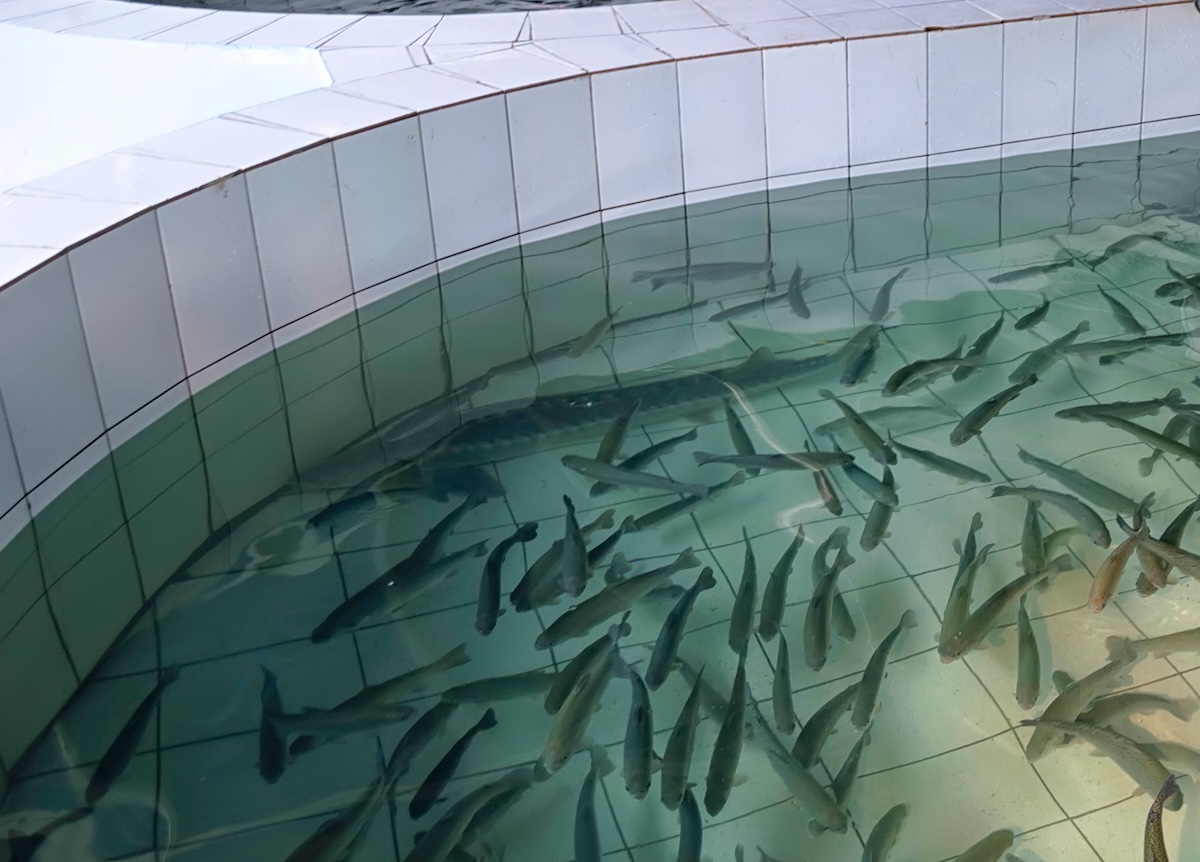
Pure Salmon lands $180 million in financing for sustainable salmon farming in Japan. Abu Dhabi-based Pure Salmon develops and operates high-tech facilities for farming salmon on land. The company raised $180 million from New York-based Fortress Investment Group and Hong Kong-based Tor Investment Management to develop its first farm in Japan and fourth globally. The farm will be spread over 34 acres of land and have a production capacity of 11,000 tons per year. The technology Pure Salmon has designed – a recirculating aquaculture system, or RAS – offers a sustainable alternative to open-pen salmon farming in the ocean. With sea-based farms, antibiotics, chemicals and parasites can leach into the surrounding marine ecosystem. “Once completed, the facility is expected to be one of the most advanced land-based salmon farms in the world,” Fortress wrote in a statement. Pure Salmon also operates farms in France, the US and Brunei.
- Localizing food systems. Pure Salmon was launched and is owned by 8F Asset Management, a Singapore-based impact private equity firm that focuses on aquaculture. (Pure Salmon appears to be the 8F’s only portfolio company.) The company aims to “produce high-quality salmon close to end consumers,” said founder Stephane Farouze. Most of Asia’s farmed salmon is imported from Norway and Chile. “Japan is a strategically important market, and this project reflects our long-term commitment to developing resilient, local food production systems,” said Farouze. 8F last year raised $460 million in a mix of debt and equity for the facility in Japan and for Pure Salmon Technology, a subsidiary in Norway that sells its farming systems.
- Share this post.
Tikehau Capital teams up with Japan’s Amova for decarbonization investments in Asia. Tikehau Capital is taking its European decarbonization strategy to Asia. The French asset manager is teaming up with Japan’s Amova Asset Management to launch Tikehau Amova Investment Management in Singapore to back decarbonization solutions. The announcement coincided with French President Emmanuel Macron’s state visit to Tokyo last week. “We want to see more Japanese investors in France,” Macron told reporters during a press conference with Japan’s Prime Minister Sanae Takaichi. Amova, a subsidiary of Sumitomo Mitsui Trust, manages $274 billion across its global strategies. “Investors in Asia and around the world are looking for investment opportunities related to decarbonization,” said Amova’s Stefanie Drews. The partnership builds on a 2024 agreement in which Amova took an equity stake in Tikehau and began marketing its strategies to investors in Asia.
- Cross continental alliance. Japan has been actively courting foreign asset managers. Its Promoting Japan as a Leading Asset Management Center initiative has registered 48 firms since 2023. Ares Management expanded into Japan in 2024 through its acquisition of GLP Capital Partners’ international business. Warburg Pincus opened a Tokyo office in November 2025. Jolt Capital announced plans to expand at a government-backed startup expo in Osaka in September 2025. The government-led initiative offers regulatory streamlining, English-language administrative support and special business zones in Tokyo, Osaka, Sapporo and Fukuoka. “It makes business sense capturing investor demand and is a seamless cultural fit for both of us,” said Drews.
- More.
Dealflow overflow. Investment news crossing our desks:
- Acumen provided an impact-linked convertible note to Omia Agribusiness Development Group, a Ugandan agribusiness serving smallholder and refugee farmers. (Acumen)
- Greenoaks Capital led a $200 million Series C equity round for Also, a Rivian spinoff developing autonomous electric delivery vehicles. DoorDash also participated in the round. (TechCrunch)
- Novastar Ventures reached a $147 million final close for its third People and Planet Fund for climate and consumer startups in Africa. (Novastar)
Impact Voices: G is for Governance
Aqua-Spark’s founders share lessons learned and the path forward after eFishery scandal. Financial fraud probably isn’t more common in ostensibly social-impact enterprises than business generally (see, FTX, Theranos, Ozy and Wirecard). But such enterprises aren’t immune from the pressure to inflate revenues, fake profits and intermingle accounts. From Abraaj to Bitwise to AllHere, impact investors have missed signals and been overly credulous of charismatic founders and appealing pitch decks. The damage is compounded by the reputational hit to impact investing generally, and by the lost impact of what may well have been solid and high-impact business models. “eFishery did not need to go in this direction,” Aqua-Spark’s Amy Novogratz and Mike Velings write in a guest post, publicly sharing their reflections on the scandal at the Indonesian company for the first time. “It was a real company with real technology and a genuinely important vision, connecting smallholder fish farmers to markets, financing and better inputs, and empowering them with the tools to lift their practices and their livelihoods. It should have become an enduring, impactful business. It should have spawned others like it. The tragedy is not just what was lost. It is what was possible, and what was thrown away.”
- Due diligence. Back in 2024, Bandung-based eFishery was heralded as the first aquaculture unicorn, with a $1.4 billion valuation and investors that included SoftBank and Temasek, as well as Aqua-Spark, the Netherlands-based impact investor for sustainable fish farming ventures. That came crashing down last year when investigators found that eFishery had for years inflated its revenues numbers. In 2024, the company reported a $16 million profit when in reality it had suffered a $35 million loss. At least $300 million in investors’ money is unaccounted for and the company’s collapse caused Aqua-Spark to mark down its own asset valuation by nearly half, to about $300 million. “We have asked ourselves hard questions about what we missed and why,” write Novogratz and Velings. “And it has changed us. We are more rigorous, more disciplined investors because of it.”
- Impact thesis. eFishery had represented an inflection point in sustainable aquaculture’s maturity into an investable sector (see Dealflow, above). “When the fraud came to light, that pipeline didn’t just slow. It closed,” the authors write. “Rebuilding confidence with investors who took a chance and got burned is hard, slow work. That too is what was stolen.” Aqua-Spark is rebuilding both its investor base and its operations (see, “Aqua-Spark aims to build an African value chain around ‘aquatic chicken’”). Fish farming remains one of the most promising paths to meeting the global protein demand, requiring new feed feed ingredients, farming systems and production technology, say Novogratz and Velings. “We know what is being built here. We know why it matters. And we are not going anywhere.”
- Keep reading, “Aqua-Spark’s founders on lessons learned and the path forward after eFishery scandal,” by Aqua-Spark’s Amy Novogratz and Mike Velings.
Agents of Impact: Follow the Talent
Don’t miss these upcoming ImpactAlpha partner events:
- April 7-8: GIIN West Coast Impact Forum & Investor Training, San Francisco.
- April 27-29: Mission Investors Exchange, Atlanta.
- May 12-14: Latin American Regenerative Investment Summit, Bogotá, Colombia. Use code ImpactAlpha for 10% off.
- May 13-14: Total Impact Summit, Philadelphia. Save $600 with code IMPACTALPHA.
- May 19-21: ReFed Food Waste Solutions Summit, Charlotte, NC.
- May 26-29: GLI Forum Latam, Lima, Peru. Save 15% on a Horizonte Global ticket with code IMPACTALPHAGLI26.
- May 27-29: Katapult Future Fest, Amsterdam.
- June 1-5: Sustainable Finance Initiative’s Impact Week, Hong Kong.
- June 8-9: SuperReturn Energy Transition, Berlin. Take 10% off using code FKR3665ALPHA.
NESsT promotes Mariana Paulino Lima to associate director of the Lirio Fund Brazil… Sustainability consulting firm ERM is hiring a private markets ESG consultant in the United States… JPMorgan Chase seeks a carbon transition analyst in New York…. GSG partner Aliados de Impacto is hiring a project and operations analyst in Lima… MCE Social Capital seeks an associate investment manager in Colombia… The Boston Impact Initiative is looking for a director of development and investor relations.
The New York Green Bank is searching for a managing director of community development investment in New York City… The Inter-American Development Bank opens a Miami office… The Aspen Network of Development Entrepreneurs and the Development Bank of Latin America and the Caribbean, or CAF, are surveying impact investors across Latin America to size and map the ecosystem.
👉 View (or post) impact investing jobs on ImpactAlpha’s Career Hub.
Thank you for your impact!
– April 6, 2026