
Greetings Agents of Impact!
In today’s Brief:
- Aircapture bends the direct air capture learning curve
- Policy support for carbon removal
- Emergency response tech
- PCV’s Bulbul Gupta on AI for an inclusive economy
Featured: Carbon Removal
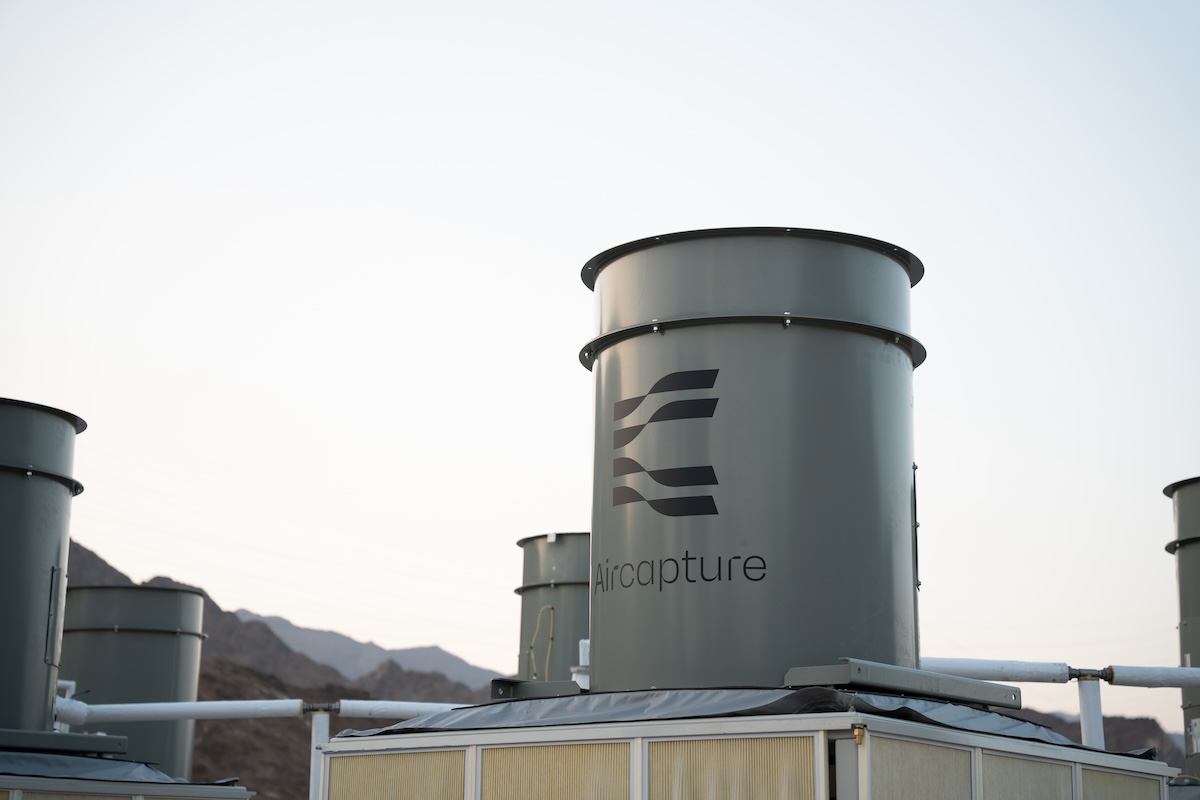
Capturing the market for carbon by removing it from the air more cheaply. Hanging from a scale mounted on a steel beam in an industrial space in Berkeley, Calif., is a large plastic bag filled with a ton of carbon. The colorless, odorless gas, extracted from the air outside, will be refined and sold to beverage makers, meat processors, hospitals and even laser manufacturers. A ton of carbon dioxide can fetch anywhere from $300 to $2,500 from such commercial customers. Aircapture, the six-year-old startup that is capturing and selling those tons of carbon, is aiming to become a low-cost provider of carbon removal, with container-sized converters that can capture 500 tons of carbon per year. Aircapture recently won a contract to supply all the CO2 needed for AB InBev’s brewery in the Canary Islands, and in June raised $50 million in a Series A round led by Ripple founder Chris Larsen’s Larsen Lam Climate Change Foundation. “The global economy runs on carbon,” says Aircapture’s Matt Atwood at the Berkeley R&D facility, where one modular direct air capture, or DAC, unit was being readied for shipment to Japan. “We’re focusing on selling the carbon molecules themselves to customers in industry that need it.”
- Storage and sequestration. Carbon removal has moved up the agenda of climate investors, as it becomes clear that the decarbonization won’t happen fast enough to significantly reduce the carbon load in Earth’s atmosphere. Slow scale-up, along with high per-ton costs, has cooled enthusiasm for direct air capture technologies, however; nature-based approaches are gaining traction. In April, Houston-based Mati Carbon won the XPRIZE Carbon Removal competition, taking home the $50 million grand prize for its rock weathering technique that sequesters carbon and improves soil health. Aircapture itself won a $1 million XPRIZE for Project Hajar, a collaboration with the Oman-based carbon storage company 44.01 to capture and store carbon at a site in the United Arab Emirates. In just 17 days, the company deployed its modular DAC machines and integrated with 44.01’s technology to mineralize the carbon and convert it into rock within subsurface geological formations. The project was deemed to produce net carbon reductions, including when transportation logistics were factored in.
- Merchant market. If tomorrow’s market is carbon storage and sequestration, today’s business for Aircapture are the commercial and industrial customers that will pay good money for actual carbon. In recent years, the term “carbon market” has come to suggest the nascent, fragmented and sometimes suspect mechanisms for trading low-priced credits generated by avoided emissions or higher-quality credits for carbon capture and storage (see, “Corporate buyers nudge voluntary carbon markets toward higher-quality projects”). But there’s a much older “merchant” market for actual CO2, estimated at $70 billion in 2023. Atwood’s strategy slingshots off the merchant market to be ready to compete for carbon removal credits when they become bankable. Says Atwood, “We think our go to market approach is the right way to be the low cost provider of this technology at scale when the infrastructure is mature.”
- Keep reading, “Capturing the market for carbon by removing it from the air more and more cheaply,” by David Bank.
Corporate and policy support for durable carbon removal. New York-based Gigablue sequesters carbon on the ocean floor by harnessing the natural processes of photosynthetic plankton. It’s one of a new crop of durable carbon dioxide removal solutions that can sequester carbon for a century or more. Policy momentum, from the EU’s Carbon Border Adjustment Mechanism to bipartisan interest in US carbon tariffs, is translating into real market potential for such solutions and is pushing new buyers to place orders. “Market forces are now stronger than the industry’s critics,” Gigablue’s Ori Shaashua writes in a guest post on ImpactAlpha. “Supporting the carbon economy represents both a logical response to our climate crisis and a transformative economic opportunity.” Read on.
Dealflow: Impact Tech
Investments in drones and AI aim to reduce response times in emergencies. Thousands of emergency calls last month from Texas flood victims went unanswered because the federal government had laid off hundreds of call center workers. Cities and states are now bracing for the impacts of federal budget and staffing cuts on emergency response for the upcoming storm season. Tech startups are trying to help first responders use limited resources more efficiently. New York-based Carbyne is developing AI-based emergency response to assist 911 call centers during demand surges. The company says its software is in use in 300 call sites. “From dramatically reducing response times to alleviating frontline staffing pressures… it’s already delivering tangible outcomes in the field,” the company said. Carbyne has raised $100 million from AT&T Ventures, Axon Enterprise, Cox Enterprises, Global Medical Response and other investors. The company has a presence in the US and six other countries. It is focusing on expansion in the US, Latin America, Europe and the Middle East.
- Emergency drones. Versaterm, a Canadian software provider for first responders and public safety agencies, has acquired Austin-based DroneSense, which provides emergency response drones. Integrating drones into emergency response supports “faster response times, enhanced situational awareness and greater safety for first responders and the communities they serve,” Versaterm said in a statement.
- Share this post.
Raise Robotics raises $7.8 million to help construction companies with workplace safety and labor shortages. San Francisco-based Raise Robotics makes robots to automate high-risk construction jobs, improve workplace safety and cut construction costs. Founders Gary Chen and Conley Oster started the company in 2021, inspired by Chen’s research on autonomous cars and Oster’s work as a structural engineer for crane and rigging companies. Raises’s multi-tool bots can scan and drill, plot site layouts and handle installations. The bots perform jobs that often require workers to be in compromised and unsafe positions or require repetitive motions, which increase the odds of injury. “With mounting pressure from labor constraints, cost overruns, and safety risks, the need for adaptable, automation-ready solutions has never been greater,” said Vivin Hedge of Zacua Ventures, which backed Raise’s seed round alongside Undivided Ventures, Cybernetix Ventures and Union Labs. Leading the round was MaC Venture Capital, a Black-led venture fund focused on diverse founders, economic inclusion and environmental solutions.
- Climate and construction. Raise’s robots are designed to work in extreme temperatures, from 15 to 120 degrees Fahrenheit. As heat waves and other extreme weather-related events intensify because of climate change, such tech solutions will be crucial for construction and other industries that depend on large outdoor workforces. The robots also fill in skills gaps for specialized project needs. On the 15-story St. Jude Children’s Research Hospital in Memphis, Tenn., Raise’s robotics prevented a months-long delay when the project developer struggled to find a skilled crew to install glass panels.
- Share this post.
Dealflow overflow. Investment news crossing our desks:
- Off-grid solar provider Sun King closed a $156 million local currency securitized debt package to expand solar access to Kenyan households. Citi, Absa, Stanbic, the Co-operative Bank of Kenya and KCB Bank Kenya invested in the senior tranche, while three European development finance institutions invested in the subordinated mezzanine tranche. (Citi)
- LeapFrog Investments exited Kenyan pharmacy chain Goodlife, selling its remaining stake in the company to African drug distributor CFAO Healthcare. (LeapFrog Investments)
- The Emerging Africa and Asia Infrastructure Fund secured a $100 million debt facility from Export Finance Australia to ramp up infrastructure financing in Asia. (Export Finance Australia)
Impact Voices: AI for Shared Prosperity
Charting AI’s course to an inclusive economic future. Local grocers, bookshops and bakeries – long the backbone of communities – are struggling to compete with a few tech-driven and AI-enabled firms. “While this future is fast becoming our present, it does not have to be our destiny,” writes Bulbul Gupta of Pacific Community Ventures, a community development financial institution. “Technology, when harnessed with intention, can unleash the economic potential and innovation of our communities and small businesses,” she writes in the first piece of a three-part series on harnessing AI for an inclusive economy. “PCV envisions a vibrant future economy where this technology is in the hands of communities, workers, families and entrepreneurs.”
- AI for shared prosperity. With AIKKA, an AI-supported tool, PCV is collecting voice-based feedback from workers and communities to shape the design and delivery of its Good Jobs Initiative and other programs. PCV is part of a growing community of mission-driven leaders designing new underwriting and predictive models to deploy more loans to underserved communities. PCV’s data analytics team is drawing insights from its annual survey of small businesses and good jobs. The results? “More tailored solutions and restorative capital are deployed,” Gupta says, “leading to more small business entrepreneurs staying in the game of innovation and disruption, creating more jobs with dignity as more communities prosper.”
- Keep reading, “Charting AI’s course to an inclusive economic future,” by PCV’s Bulbul Gupta. Check out all of ImpactAlpha’s Responsible Tech coverage.
Agents of Impact: Follow the Talent
Locus appoints Pravina Raghavan, former director of the US Treasury Department’s CDFI Fund, as CEO… Federico Brusa is promoted to lead specialist of climate change at the Inter-American Development Bank… Joe Neri will step down as CEO of IFF, formerly known as the Illinois Facilities Fund, at the end of this year. He will be replaced by Kirby Burkholder, the CDFI’s current president of core business solutions… Borja Garcia Fernandez, former head of structuring and LATAM at Citi Social Finance, joins the IFC as inclusive capital lead.
Federated Hermes seeks a fixed-income sustainability analyst in Pittsburgh… The Greenlining Institute is recruiting a president and CEO, a senior program manager for climate equity, and a senior program manager for tech equity in Oakland, Calif… Impact Capital Managers is hiring a manager of talent and leadership development in New York… Mission Driven Finance has an opening for a borrower services associate.
The Scottish National Investment Bank is recruiting an associate director for place-based economic development in Edinburgh… The Institutional Investors Group on Climate Change seeks a program director for investor strategies in London… Allianz Global Investors is looking for a “student worker” for sustainability and impact investing in Frankfurt… Kiva is on the hunt for an investment manager in Bangkok… Also in Bangkok, IIX has an opening for a senior analyst for its impact institute.
👉 View (or post) impact investing jobs on ImpactAlpha’s Career Hub.
Thank you for your impact!
– Aug. 4, 2025