
Greetings Agents of Impact!
In today’s Brief:
- Regenerative cotton in Peru and Indigenous fashion New York
- Gene editing for climate-resilient crops
- “Fair credit” access in Mexico
- Overheard at Latimpacto: New models for equitable ownership and informal workers
Featured: Sustainable Fashion
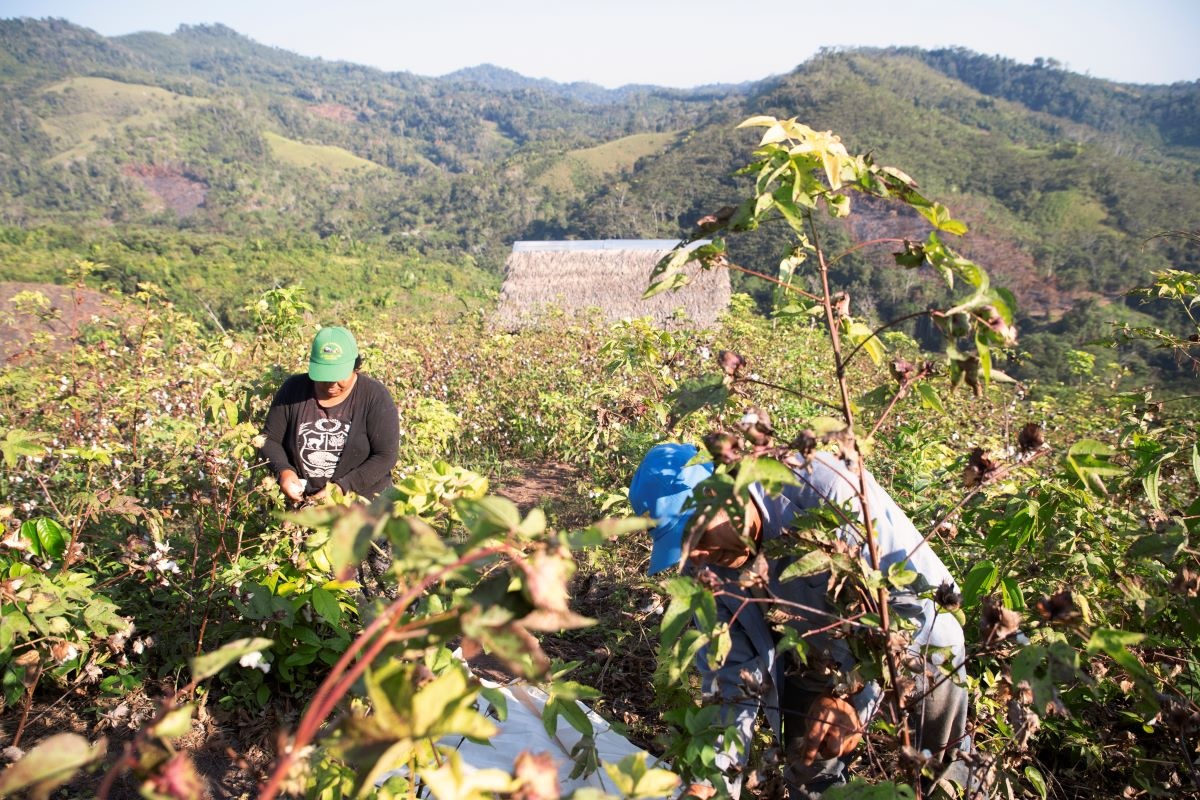
Fashion brands step into the aid gap to back regenerative cotton in Peru’s Amazon. When USAID pulled out of a sustainable cotton project in Peru’s Amazon, Lululemon stepped up. The athletic apparel giant is not just a buyer of premium cotton, but also provides grants support to the regenerative cotton company Cotton Nation. Lululemon’s dual role in procurement plus grant support has opened the door for other brands entering Peru’s San Martín region, where Lima-based Redesign Lab, an impact venture builder, is leading what it calls a “quiet revolution” in regenerative agriculture. Cotton Nation, incubated by Redesign Lab, works with more than 2,500 smallholder farming families in 150 communities, reviving eco-friendly cotton production in a region that was Peru’s cotton hub before the industry collapsed in the 1980s. Global brands, facing looming European transparency rules, are taking note. Among Cotton Nation’s buyers are Patagonia, Eileen Fisher and Lacoste. “Brands are looking for real traceability and real impact,” Redesign Lab’s Eddie Ajalcriña told ImpactAlpha at the company’s offices in Lima. “They want to touch the ground, meet the farmers and know the source of the fiber.”
- Corporate supply chains. “When you have a company like Lululemon that is actually involved in the supply chain, and that is going to be able at some point to buy the product, it creates long term sustainability for the project,” says Sara Maria of Conservation International, which helped foster the partnership between Cotton Nation and the athletic wear brand. “It will never fail, even if something like USAID falls apart.” Lululemon also is one of seven brands and organizations, including H&M, HSBC and the Schmidt Foundation, that have teamed up with the Apparel Impact Institute on a $250 million Fashion Climate Fund. The seven firms have committed $10 million each; the institute is actively raising the rest. The blended finance fund aims to unlock up to $2 billion to decarbonize fashion supply chains. The Fashion Climate Fund, says the institute’s Lewis Perkins, is modeled on Closed Loop Partners, a plastic waste reduction initiative anchored by major consumer goods companies like Procter & Gamble, Walmart and Unilever.
- Indigenous fashion. Sustainable and ethical fashion will be on display amid the flashy catwalks at New York Fashion Week, kicking off today (see, “Ethical and inclusive are in style at New York Fashion Week”). The highlight: a three-day event dedicated to Indigenous fashion. Organized by Relative Arts, an Indigenous-owned community space, the first-ever Indigenous New York Fashion Week will feature nearly two-dozen Indigenous designers from North and South America. Mobilize makes “streetwear with a Cree flair.” Jeremy Donavan Arviso is the Navajo designer behind Original Landlords. Vina Brown of Copper Canoe Woman makes jewelry drawing from coastal Indigenous culture.
- Climate + fashion. Sustainable fashion will also be prominent at Climate Week NYC, which begins Monday, Sept. 22. The Apparel Impact Institute, Textile Exchange, The Fashion Pact and other groups will try to mobilize the fashion and textile industries for climate action. Re/Make, which last year threw a sold-out “upcycled” fashion show, is teaming up with B Lab on a Wear Your Values weekend to spotlight how fashion can shift from extractive practices to a force for climate and social justice
- Keep reading, “Fashion brands step into the aid gap to back regenerative cotton in Peru’s Amazon,” by Erik Stein. The Cordes Foundation sponsors ImpactAlpha’s Sustainable Fashion coverage.
Dealflow: Climate Resilience
Waterpoint Lane backs Heritable Agriculture to make food and tree crops more resilient. Brad Zamft learned about breakthrough technologies as a project lead at X, the Moonshot Factory, Google’s innovation lab. He launched Heritable this year to use AI and gene editing to speed the breeding of trees, fruit, vegetables, and other food crops to help them become more resilient to pathogens and climate change, and to lower costs and boost yields for growers. “At X, I witnessed first hand how bold ideas, combined with visionary investment, can create game-changing outcomes,” said Zamft. Heritable, he added, marries “cutting-edge science with scalable impact potential.” A strategic investment from Miami-based Waterpoint Lane will help Heritable build its team of biologists, engineers, geneticists and plant breeders. The company is looking for a project data scientist.
- Agrifood tech. Waterpoint Lane made the investment via its $6 million food and agriculture sustainability fund, which writes early-stage checks of around $250,000 (see, “Sustainable food and ag investors line up to Make America Healthy Again”). “Our strategy centers on identifying visionary founders and breakthrough platforms with the capacity to scale and lead entire sectors,” said Waterpoint’s Meifan Shi. “We seek companies with differentiated technology, strong leadership, and a fundamental ability to drive systemic change in all aspects of the food systems.”
Digitt raises $10 million to expand fair credit access for Mexico’s middle class. Mexico City-based Digitt is aiming to make a dent on Mexico’s double- and triple-digit credit card interest rates for the country’s middle class. The startup raised $10 million in Series A financing, led by Yolo Investments. The round also included IGNIA Partners and Capria Ventures, along with individual investors. Over the past three years, the company has grown its loan book more than 10-fold while maintaining default rates in the low single digits. Seattle-based Capria Ventures, which invests in early-stage companies and fund managers across emerging markets, backed Digitt as part of its strategy to scale tech-driven solutions for underserved consumers. Capria’s Daniel Ballesteros Nader wrote that Digitt could become “the Amex for Latam’s middle class – a financial brand that earns trust and loyalty through better experiences, not just better rates.” More.
Dealflow overflow. Investment news crossing our desks:
- Nitricity, a San Francisco-based company that makes organic fertilizer from recycled almond shells, raised $50 million in a Series B round led by World Fund and Khosla Ventures. Energy Impact Partners and Susquehanna Sustainable Investments are among participating investors. The company’s first-of-a-kind production plant in Delhi, Calif. was funded by Elemental Impact and Trellis Climate. (Nitricity)
- Copenhagen-based Teton.AI clinched $20 million in Series A financing from Plural, Bertelsmann and others to help US hospitals and caregivers monitor aging seniors with AI and computer vision tools. (Global Banking and Finance Review)
- Germany’s Proxima Fusion scored an additional €15 million ($17.5 million) for its Series A round from CDP Venture Capital, the European Innovation Council Fund and other backers, as it races to commercialize its stellarator fusion system. (Silicon Canals)
Overheard at Latimpacto’s Impact Minds
Latin America’s impact investors target equitable ownership, informal workers and water security. Rather than importing Silicon Valley’s playbook, impact investors in Latin America are building capital models that fit local realities. New models include alternative ownership structures, financing tools for the region’s vast informal economy, and community-led approaches to water. The dynamism was on display last week at Latimpacto’s Impact Minds convening in Colombia, which convened more than 600 investors and entrepreneurs. From Medellín, ImpactAlpha’s Erik Stein says the city’s own reinvention – from violence and inequality to innovation and community-led growth – was an appropriate backdrop for conversations about financial models built to last.
- Ownership structures. Impact investors across Latin America are experimenting with new ownership structures to protect companies with social purpose from being sold off or flipped for short-term gain. Santiago-based nonprofit Purpose LatAm has identified 50 companies testing alternative ownership models. Chile-based Banca Ética, for example, placed its voting rights into a nonprofit foundation, even as it raised $13.6 million from 600 investors in 20 countries. In Brazil, Grupo Gaia is using a philanthropic endowment fund to hold equity, a workaround that preserves mission without losing tax benefits. “If financial incentives remain focused on short-term returns, then any impact-oriented framework will eventually be compromised,” said Purpose LatAm’s Nelson Rodríguez Harry.
- Addressing economic informality. Seven out of 10 people in Latin America work in the informal economy. “If we only develop solutions targeting the top 10% to 15% of formally registered firms, we’re missing the vast majority of the actual economy,” said Juan Carlos Iturri of Fundación IES. Mexico City-based Viwala is working with Latimpacto to map the fisheries value chain, from individual fishers to processing facilities to restaurant chefs, to identify investment opportunities. Viwala, which provides flexible loans to hundreds of small enterprises in Latin America, is tailoring financing products to meet the specific needs of the region’s small businesses. Said Viwala’s Karla Gallardo: “This is how we bridge the gap – by showing investors real, concrete opportunities [where] communities are ready to scale, and matching communities with the right type of capital.”
- Catalytic Capital 2.0. Latimpacto’s Carolina Suárez Visbal will join ImpactAlpha’s David Bank to kick off the Catalytic Capital track at SOCAP 25 in San Francisco, Oct. 27-29. The track is sponsored by the Catalytic Capital Consortium, or C3. Also joining the discussion will be Ceniarth’s Greg Neichin and Urmi Sengupta of the MacArthur Foundation. C3 backed LatImpacto to create pathways for social investors and philanthropists in the region to understand and mobilize catalytic capital, including the development of local case studies and the translation of C3’s other case studies into Spanish and Portuguese. Latimpacto is also a founding partner of ImpactAlpha Latin America, our monthly newsletter on impact investing news from the region.
- Keep reading, “Latin America’s impact investors pilot new models for ownership, informality and water,” by Erik Stein.
Agents of Impact: Follow the Talent
The University of Chicago’s Institute for Climate and Sustainable Growth welcomes Kristina Costa, previously with Brookings Institution, as managing director of policy and strategic engagement… Zeal Capital Partners adds AlignPact’s Tom Blaisdell as senior advisor… Quadria Capital taps Alykhan Nathoo as operating advisor and member of its investment committee… Franklin Templeton is hiring a stewardship and sustainability analyst in London… Also in London, Mastercard is looking for a sustainability solutions manager.
Capital One seeks a project manager of community impact and investment market engagement in Chicago… Yale University is on the hunt for a director for its Planetary Solutions Impact Accelerator… The New Jersey Economic Development Authority is recruiting a senior venture product officer… SDS Capital Group has an opening for a New Markets Tax Credits asset manager in Los Angeles… Climate Imperative Foundation is searching for a director for its US electricity initiative.
NYC Climate Week events: 17 Asset Management will host, “Soil to shareholder value: Unlocking investment opportunities in regenerative agriculture,” Thursday, Sept. 25… Also that day, Open Society Foundations will host, “Unlocking climate finance in emerging markets: Overcoming key bottlenecks for scale and speed”… Blue Forest has a list of events focused on conservation finance and forest resilience.
👉 View (or post) impact investing jobs on ImpactAlpha’s Career Hub.
Thank you for your impact!
– Sept. 11, 2025