
Lima, Peru – After USAID pulled out of a sustainable cotton project in Peru’s Amazon, many initiatives of its kind would have folded. Regenerative cotton company Cotton Nation instead landed a more durable partner: Lululemon.
The athletic apparel giant stepped in not just as a buyer of premium cotton but also provides grant support, signaling the growing role of corporations in building out sustainable supply chains.
Lululemon’s dual role — procurement plus grant support — has opened the door for other brands entering Peru’s San Martín region, where Lima-based Redesign Lab, an impact venture builder, is leading what it calls a “quiet revolution” in regenerative agriculture.
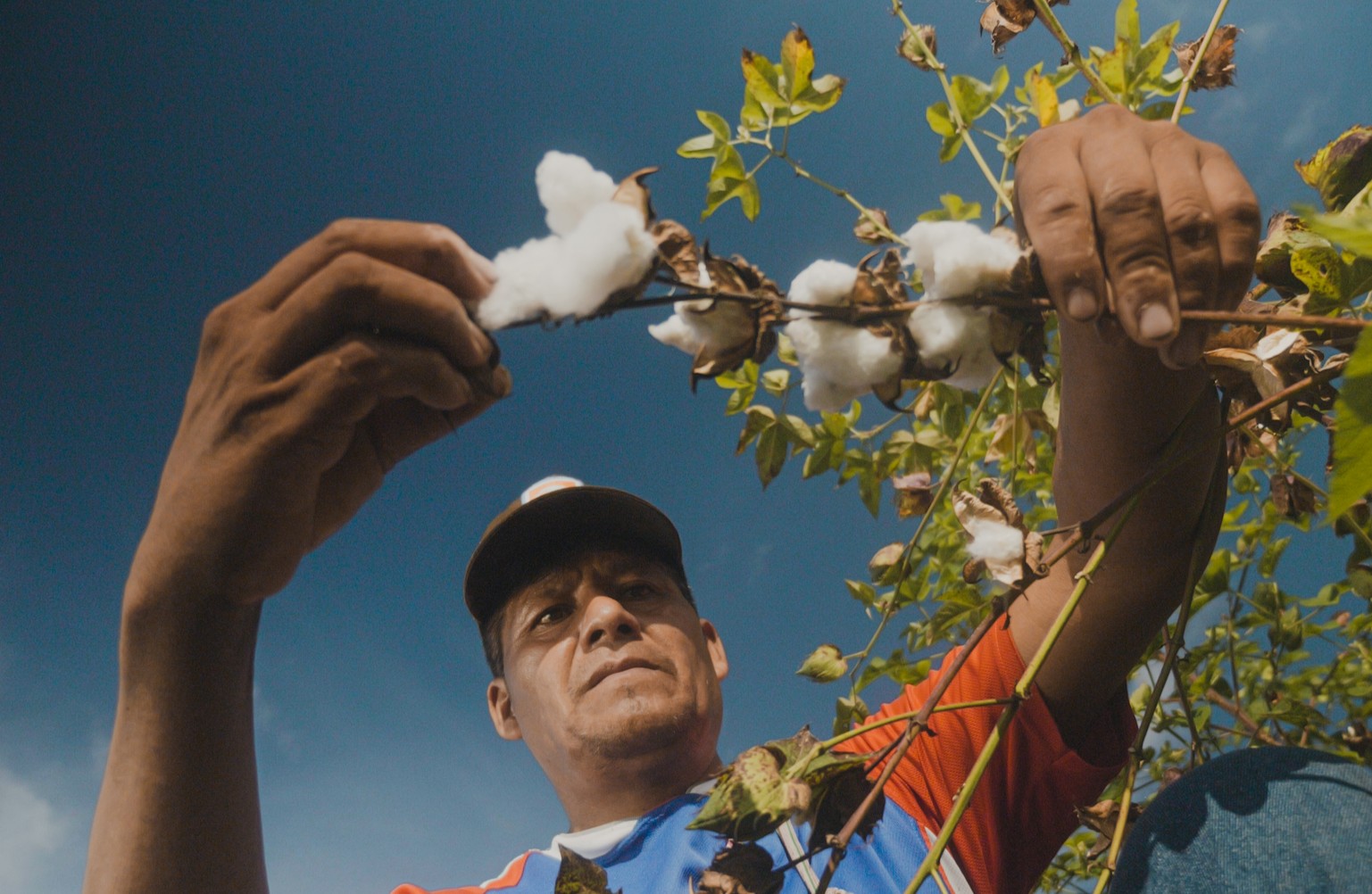
Cotton Nation, one of Redesign Lab’s portfolio companies, now works with more than 2,500 smallholder families in 150 communities, reviving cotton production in a region that was once Peru’s hub before the industry collapsed in the 1980s. Global brands, facing looming European transparency rules, are taking note.
“Brands are looking for real traceability and real impact,” Redesign Lab’s Eddie Ajalcriña told ImpactAlpha at their offices in the heart of Lima’s historic center. “They want to touch the ground, meet the farmers and know the source of the fiber.”
Redesign Lab, which incubated Cotton Nation, has an equity stake and provides technical and strategic support for the company’s growth. Ajalcriña represents both companies in their strategic growth and implementation efforts.
Aid to markets
Cotton Nation’s relationship with Lululemon began in 2023 through the Amazon Business Alliance, a USAID and Canada backed program led by Conservation International. When the Trump administration took a hatchet to USAID funding, the project didn’t collapse — it instead matured into a market-based relationship with Lululmeon stepping in.
“We kept working with Lululemon because they believed in us,” said Ajalcriña.
The yogawear brand now pairs sourcing with development finance, paying premium prices for cotton while providing grants to support Cotton Nation’s capacity-building costs. That dual approach addresses a persistent problem in sustainable agriculture: scaling regenerative practices in places where aid is unreliable.
The goal is to create a self-sustaining operation where Cotton Nation remains profitable without grant funding. Cotton Nation sells the organic and regenerative-certified cotton at a premium to major fashion brands like Lululemon, Lacoste and Patagonia, taking a small cut while still paying fair trade prices to farmers and promoting regenerative cotton farming in the region.
“Our cotton is not only high quality,” Ajalcriña said. “We guarantee offtake at a premium price and we assume the cost of certification, which is very expensive for a small farmer.”
Conservation International, which formed the original Amazon Business Alliance that connected Lululemon and Cotton Nation, remained a key partner after USAID’s fallout – helping to manage the partnership between the two.
After an initial pilot phase, Conservation International was convinced the model would work.
“The first-year pilot went so well — generating results in both the land and the people — that we at CI decided it was worth continuing the worl\k,” Conservation International’s Sara Maria told ImpactAlpha.
“What makes Cotton Nation stand out is that their business model sustains itself. Even if CI or Lululemon were to step back, the farmers would continue to receive premiums and support because the company has built regeneration directly into its commercial model,” explained Maria.
This combination of Cotton Nation’s farmer-first and self sustaining model has attracted interest from other global brands.
Lacoste turned to Cotton Nation after failing to find suppliers in Europe or South Asia that could meet its “elegant cotton” standards. Hugo Boss, targeting 50% regenerative cotton by 2030, adopted Cotton Nation’s Regenagri standard across its supply chain last year, ensuring traceability and compliance on soil health, biodiversity, and deforestation impacts. Other buyers include Patagonia and Eileen Fisher.
Reversing extraction
San Martín presents a case study in how environmental challenges can become business opportunities. The region — Peru’s third most deforested — faces ongoing issues with forest fires, drug trafficking, and poverty rates that have historically made it a site of extraction rather than value creation.
Cotton Nation’s approach reverses this pattern by moving production from Peru’s depleted coastal farms to the Amazon, where natural rainfall eliminates the need for irrigation that creates water conflicts in desert conditions.
“On the coast you are competing for water in a desert,” Ajalcriña explains. “The health of the soil is poor after so many years of agriculture without recovering the soil.” The company provides integrated support including seeds, fertilizers, technical assistance, and access to proprietary monitoring platforms — all at zero cost to farmers.
Cotton Nation signs agreements with farmers guaranteeing a premium price for 100% of their cotton, providing market certainty for the growers. The company also covers expensive international certifications that would be out of reach for many small farmers.
“We commit with them to buy 100% of the production with a premium price,” Ajalcriña said. “it’s a very, very expensive process for a small farmer. So we assume all this cost to promote the introduction and the position of cotton in the region.”
The benefits extend beyond organic cotton, healthy soil and improved livelihoods. Farmers gain regenerative skills applicable to cacao and coffee crops, while Cotton Nation’s commitment to reforest one hectare for every hectare planted with cotton directly addresses deforestation pressures.
Scaling the model
Cotton Nation has already raised $1 million in grants and $800,000 in green debt. It is now seeking $2 million to $5 million in flexible debt for processing facilities, and up to $30 million in equity to fund vertical integration. The company is targeting impact enterprise grants and exploring blended finance with impact funds, family offices, and multilaterals. “At this moment we are the only ones doing this in the Amazon,” said Ajalcriña. “It is very challenging, but we have cracked the code.”
Another one of Redesign Lab’s companies, NeoFibers, is pursuing a similar path with Amazonian biomaterials such as chambira, aguaje and kapok. These fast-growing native fibers, which are biodegradable, regenerative, and long valued in Indigenous craftsmanship, are now being adapted for modern textiles. After debuting at London’s Future Fabrics Expo, NeoFibers drew interest from more than 15 brands with $225,000 in potential orders. Expansion to the US and Europe is planned for 2025.
Neofibers is supported by the Inter-American Development Bank, Wyss Academy for Nature, the Future Fabrics Expo among others.
“Fashion can be a value proposition to regenerate the planet,” Ajalcriña said.
For investors, the bigger question is whether this template—where corporations act as offtakers and sometimes development financiers as well — can scale beyond textiles into other sectors where traditional aid and finance has failed to create lasting change in Peru’s complicated Amazonian ecosystem.
Lululemon is one of seven brands and organizations, including H&M, HSBC and the Schmidt Foundation, that have teamed with the US-based Apparel Impact Institute to launch a $250 million Fashion Climate Fund. The seven firms have each committed $10 million; the institute is actively raising the rest. The blended finance fund aims to unlock up to $2 billion to decarbonize fashion supply chains, helping overseas suppliers finance carbon assessments and pay for costly upgrades such as replacing fossil fuel-powered boilers with heat pumps.
The fund, says AII’s Lewis Perkins, is modeled on the Closed Loop Partners, a plastic waste reduction initiative anchored by major consumer goods producers such as Proctor & Gamble, Walmart and Unilever.
In other sectors, big tech firms looking to reduce their carbon footprints have stepped up as offtakers willing to pay a premium to help accelerate the commercialization of key climate tech. Frontier Climate, a group founded by Stripe, Alphabet, Shopify, Meta and McKinsey, has committed to make $1 billion in advance purchases of permanent carbon removal, via methods such as direct air capture or enhanced mineralization. “When you have a company like Lululemon that is actually involved in the supply chain, and that is going to be able at some point to buy the product that the farmers are producing with these regenerative practices and restoration practices, it changes completely,” says Maria of Conservation International. “It creates long term sustainability for the project, and it will never fail, even if something like USAID falls apart.”