
Greetings Agents of Impact!
In today’s Brief:
- Optimizing adaptation funding
- Investing in AI for impact
- Fair wages and healthy food in India
- The next frontier for impact investors
Featured: Climate Finance
New tool for adaptation finance directs concessional capital where it’s needed most. The countries most exposed to climate change are often those least able to afford the cost of adapting to it. A new tool developed by Columbia University aims to help concessional finance providers, including development finance institutions, climate philanthropies and impact-first investors, identify what kind of adaptation finance is most impactful and where. The Climate Finance Vulnerability Index, funded by the Rockefeller Foundation, ranks 191 countries based on both climate risk and financial vulnerability. The most vulnerable: Guinea-Bissau, Eritrea, Angola, Zambia and Palestine. The index goes beyond standard metrics, like GDP or sovereign credit ratings, to analyze a country’s exposure to floods, droughts and heat alongside its financial health, including debt sustainability, access to finance and financial integration. A governance lens helps investors assess adaptation finance delivery mechanisms. For example, if a country has weak institutions or high corruption, funders may want to work through a multilateral or trusted intermediary. “We wanted to build something that shows not just who’s vulnerable, but who’s vulnerable and can’t pay to fix it,” says Jeff Schlegelmilch, who led the research initiative at Columbia’s National Center for Disaster Preparedness. “We want each dollar to have the most impact.”
- Risk and opportunity. Researchers designed the index to help inform how limited but critical concessional finance dollars are used. The starting point, says Schlegelmilch, was “If you’re in a position to provide concessional financing for climate adaptation, what is the information you need to do that?” The index can help funders decide not just where to direct capital, but what kind of capital is needed. Some countries may need funding for physical infrastructure. For others, funding to ease debt burdens or strengthen institutions may be more impactful. Belize and Ecuador, two countries in the index’s high-risk, low-finance quadrant, have participated in debt-for-nature swaps, for example – an emerging financial structure that allows countries to refinance high-cost sovereign debt and redirect interest payment savings to nature restoration and conservation. The index’s inclusion of non-traditional climate finance risk metrics is meant to complement other tools and highlight aspects that get overlooked, says Schlegelmilch. “There are unrecognized risks and unrecognized opportunities.”
- Move fast and adapt things. The index was released this week against a backdrop of shrinking international development budgets and paltry adaptation finance flows. Climate Policy Initiative’s latest global climate finance tally puts adaptation funding at just $65 billion – far short of the $222 billion in annual funding needed for emerging markets by 2030. Last year’s COP29 climate summit in Azerbaijan – dubbed “the finance COP” – ended with international commitments of just $300 billion for the world’s most climate vulnerable countries, far below the $1.3 trillion sought. “We cannot outrun disasters by paying for it on the response and recovery side alone,” warns Schlegelmilch. “It’s more expensive at first to build a resilient system, but it’s much cheaper than constantly responding to disasters.”
- Keep reading, “New tool for adaptation finance directs concessional capital where it’s needed most,” by Erik Stein.
Dealflow: AI for impact
Norrsken Foundation commits €300 million to European startups using AI for impact. The Stockholm-based foundation has set aside nearly $350 million for European AI startups working to solve global climate, health, food and education challenges. The capital comes from the three of Norrsken’s five funds: Norrsken VC, Norrsken Accelerator and Norrsken Launcher. (Norrken’s other two funds, Norrsken22 and Norrsken Africa Seed Fund, are focused on African tech startups). “Artificial intelligence is the most powerful tool humanity has ever created,” the foundation’s partners wrote in an open letter. “AI is not just another productivity boost; it’s a real chance to fix what truly matters.” Norrsken VC, through its €320 million impact venture fund that closed last May, has backed half a dozen early stage AI startups in Europe. Munich-based Predium makes ESG management software for real estate and finance firms. Quadrivia, in the UK, has built an AI-powered clinical assistant to support overworked medical professionals. And Sweden’s Flower helps optimize energy usage and enhance grid resilience.
- Impact philanthropy. Niklas Adalberth, one of the founders of Swedish “buy now, pay later” company Klarna, launched Norrsken Foundation in 2016 to invest in global entrepreneurs using technology as a force for good. Adalberth sold most of his shares in the fintech unicorn and seeded the Norrsken foundation with $125 million, almost half of his personal wealth. In the US, the Kapor Foundation, San Francisco Foundation and Omidyar Network have committed $25 million for the responsible use of AI in education, workforce development, innovation and infrastructure.
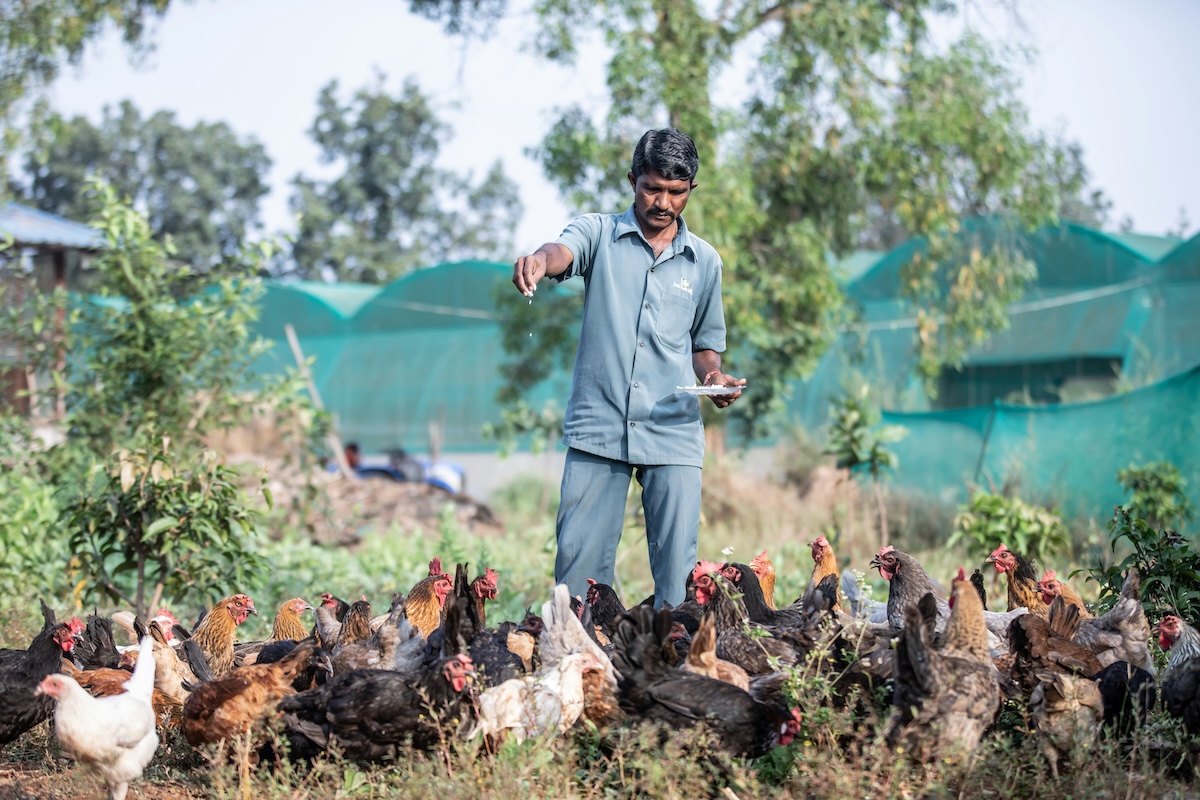
Upaya backs Country Chicken to create stable income for rural India’s poultry farmers. Seattle-based Upaya Social Ventures invests in small businesses and social enterprises in India creating dignified jobs. Its latest investment is in Country Chicken, a Hyderabad-based business that sources eggs and meat from smallholder and backyard farmers in rural India. The enterprise works with more than a thousand farmers, paying them a fair wage for their products and providing them with livestock management training. “Partnering with Upaya is instrumental in scaling our vision while staying rooted in impact,” said Sikesh Goud, who founded Country Chicken four years ago.
- Dignified work. With adulterated foods on the rise in India, Country Chicken aims to increase the availability of meat and eggs that are raised naturally and free from steroids, antibiotics and other additives. Its mobile app allows customers to order online from a network of “clean, hygienic and customer-friendly” retail stores. “Country Chicken is transforming both what we eat and how it’s brought to our tables,” said Upaya’s AB Chakravarth. “Their model uplifts rural farmers, modernizes a critical sector, and champions better norms for what we eat and how rural communities earn.” Upaya has made more than 40 investments. Its portfolio companies have created over 50,000 dignified jobs in India since 2011.
- Gift this post.
Dealflow overflow. Investment news crossing our desks:
- Oakland-based Sierra Club Foundation will move $10.5 million to women-led Nia Impact Capital and Xponance, a Black-owned investment firm, after dropping BlackRock as its asset manager. The switch was made after BlackRock refused “to address the systemic financial implications of the climate crisis in its investment and stewardship decisions,” the foundation shared.
- Spain’s Ecoalf, which develops fabric from recycled materials like fishing nets and used tires, secured €7 million ($8.1 million) from Impact Bridge’s private debt fund for Spanish and Portuguese social enterprises. (Capital Riesgo)
- Aedifion raised €17 million ($20 million) in Series B funding for its AI-powered software that helps building managers reduce their carbon footprint. (Aedifion)
- Echandia, a Swedish maker of battery systems for electric maritime vessels, raised $34 million from S2G Investments, Alantra’s energy transition fund, Klima, and others. (GeekWire)
- Lafayette Square provided debt financing for Boston-based Genuine Foods, a food service company providing fresh food for schools, healthcare facilities and senior living communities in 16 states. (Lafayette Square)
- The EU-funded Agriculture Financing Initiative provided a €2.2 million ($2.5 million) loan to Complete Farmer, a digital marketplace for agricultural commodities and inputs, to set up rural fulfilment centres in northern Ghana. (Tech Labari)
Impact Voices: Building Markets
Capital market shaping: The next frontier for impact investors. In impact investing’s early days, scattered innovators and investors challenging assumptions started to recognize they are on a similar path. A field emerged with common language, efficient collaboration and established practices for delivering and measuring results. That’s the story of impact investing 15 to 20 years ago. And it may be the story of the market-shaping field emerging today in response to stubborn obstacles, both old and new. “There’s growing excitement about the role investors can play not just in deploying capital, but in redesigning the systems that determine where capital flows in the first place,” says Antony Bugg-Levine, an impact investing consultant and former CEO of Nonprofit Finance Fund. Bugg-Levine points to Calvert Impact’s strategy to address challenged markets, and Climate United’s efforts to shape and accelerate markets for clean technologies. Rather than ferrying funds deal by deal, market shapers are designing systems to reshape the topography of capital markets to enable capital to flow unimpeded where it is most needed – or digging trenches, to use a metaphor first floated by Calvert’s Jenn Pryce in ImpactAlpha (see, “Calvert Impact’s market-shaping strategy for the future of impact”). (Disclosure: Bugg-Levine advises Calvert Impact).
- Leading models. Successful market-shaping models are being implemented across the globe. Aceli Africa studied 9,000 loans to understand why traditional guarantees weren’t moving capital to rural agricultural enterprises. That insight led to a new model blending risk-sharing with impact-linked subsidies, unleashing over $335 million in loans and setting the stage for policy reform. The Equitable Facilities Fund connected high-performing public charter schools to investment-grade bond markets, and Builders Vision partnered on a $70 million blue bond for the Bahamas, the first such guarantee from a family office. These examples are not isolated interventions, Bugg-Levine emphasizes, but evidence of new trenches that could permanently redirect institutional capital toward systemic solutions.
- Path forward. Capital market shaping requires patience, regulatory collaboration, cross-sector fluency, and a deep understanding of structural barriers, says Bugg-Levine. “We know the playbook,” he writes, noting the lessons of past field-building in public health, housing and microfinance. Not everyone has the wherewithal for this kind of work, but for those that do, “it’s time that we recognize capital market shaping as a distinct field worthy of attention,” he says. “With the momentum behind the impact investing movement, we can shape capital markets to finally release the money needed to finance social and environmental resilience and progress at the scale commensurate with the challenges.”
- Keep reading, “Capital market shaping: The next frontier for impact investors,” by Antony Bugg-Levine.
Agents of Impact: Follow the Talent
Andrew Kassoy, co-founder of the B Corp movement and sustainable business certification, has died after more than two years with advanced prostate cancer. “The B Corp movement is more important than it’s ever been,” Kassoy said in a powerful conversation with B Lab cofounders Bart Houlahan and Jay Coen Gilbert, recorded while he was in hospice. To counter negative forces in the world, Andrew called on the B Corp movement to double down on care and courage. “My greatest aspiration is that we not just continue to do that, but step it up. We take it on ourselves in a bigger way, each one of us, than we ever have before.” Andrew was 55 years old. He is survived by his wife, Margot Brandenburg, and his four children. Friends and fellow travelers shared their reflections on LinkedIn (here and here).
- “As it says in the video, what more can we aspire to than being a beautiful ancestor… something Andrew certainly has shown us all how to do.” – Sasha Dichter, 60 Decibels… “Andrew lived an incredibly impactful life that clearly has touched the lives of so many people around the world.” – Delilah Rothenberg, Predistribution Initiative… “A tremendous loss but beautiful, righteous ancestry.” – Ben Thornley, Tideline… “He is greatly missed by our global community of change makers.” – Jed Emerson, Blended Value Group… “Great sadness for a great loss, and true gratitude for a remarkable legacy.” – Clara Miller… “This leaves me with even more inspiration and urgency about what we all need to do.” – Cathy Clark, Duke University… Andrew “died peacefully in his bed, listening to the birds mixing with his favorite music, holding hands with his beloved wife, Margot.” – Jay Coen Gilbert, B Lab and Imperative 21.
Robbie Allen joins Autism Impact Fund as part-time operating partner… Nina Panda, previously with 3M, joins 3R Sustainability as a sustainability strategy associate director… Caoimhe MacRunnels was promoted from senior associate to principal at Reach Capital… Three Cairns Group welcomes Sarah Charlop-Powers, previously with Natural Areas Conservancy, as a climate program officer.
The ImPact is looking for a new CEO… New Forests is looking for a project management officer… The European Bank for Reconstruction and Development has an opening for a nature and climate finance principal manager… T. Rowe Price is recruiting a responsible investment analyst in London… Old Mutual Alternative Investments is hiring a sustainability manager in Cape Town… New York-based Third Wave Fund is accepting grant applications from youth-led nonprofits tackling gender justice in the US.
The University of Cape Town’s Bertha Centre will host an executive education course on “Impact Investing in Africa” from July 28 – Aug. 1, in person in Nairobi… Convergence, in partnership with Global Affairs Canada, is launching a blended finance training program for global fund managers, Tuesday, July 15… Transform Finance will host a webinar on alternative ownership models in Europe, Latin America and Africa, today at 10am ET/3pm London. The nonprofit will also publish its latest briefing, “The trillion-dollar opportunity hiding in plain sight: Why investors are paying attention to employee ownership.”
👉 View (or post) impact investing jobs on ImpactAlpha’s Career Hub.
Thank you for your impact!
– June 26, 2025