Kelly Michel and Daniel Izzo were pretty lonely impact investors in 2009 when they helped launch Vox Capital, one of Brazil’s first impact funds.
The pair have since watched Brazil’s impact ecosystem grow into a $280 billion market with dozens of impact fund managers, as well as public, development and commercial banks, family offices and institutional investors. The country’s impact map today covers investments in everything from financial services to small businesses to forest restoration to carbon sequestration.
“In the future, investing without thinking about impact is going to be as crazy as smoking in a restaurant,” predicts Izzo, who co-founded the fund with Antonio Ermírio de Moraes Neto of investment firm Votorantim. Vox manages more than $250 million in assets and six funds that span venture capital, private credit, real assets and public equities.
Back when Vox started, it was impact investing that was the crazy idea for many investors, recalls Michel, an American who lived in Brazil in the early aughts. The list of impact fund managers raising and deploying capital around the same time included SP Ventures, MOV Investimentos and just a few others.
Michel helped pull together capital for Vox’s first fund from “networks of very wealthy people who wanted to do good, but who also wanted to do it differently from their parents,” she says. “Their willingness to take early risks made a real difference. Vox couldn’t have launched its first fund without them.”
Market building
Michel was herself one of those early risk takers and is viewed in the market as an ecosystem catalyst. She anchored Vox through Potencia Ventures, an endowment she set up in 2002 to nurture impact ecosystem building. Potencia (or potência in Portuguese), conveys power, strength or capacity.
“I began to see that backing entrepreneurs whose businesses addressed social issues and inequality could facilitate change on a greater scale,” Michel recalls. “Using business to solve social issues seemed practical: You could reinvest profits in the business, and you could improve your offering based on market feedback.”
The organization has been an early investor in more than 50 impact funds all over Latin America and the US, including Amplifica Capital, Village Capital, Elevar Equity and iThink VC. It has also made more than 30 direct investments in impact companies.
In addition to Vox, Potencia’s other early project in Brazil was Artemisia, an accelerator that has supported nearly 1,000 social enterprises in the country, such as Geekie, an adaptive learning platform that has reached millions of students, and Hand Talk, a sign language translation app that won the United Nations’ best social app award in 2013.
“Kelly was one of the first people to bring awareness to impact investing in Brazil, being one of the people who gave money for first initiatives like Vox and Artemisia,” says Vitoria Junqueria of Aliança pelo Impacto, Brazil’s national advisory board for impact investing.
A number of Brazilian impact fund managers and entrepreneurs trace their roots to the two organizations.
“Artemisia and Vox have functioned as training grounds for impact-driven human capital,” Michel says. “When they move on to new roles at other organizations, they spread part of the culture further afield.”
Impact frontier
Many of those seeds were planted in the decade or so years after Vox, Potencia’s first fund investment. By now the fund managers Potencia supported in their first and second funds are out raising their third, fourth and fifth funds.
Vox, for example, now has seven of its own funds, including four venture capital funds. Its venture portfolio includes two early-stage funds and two growth funds, and companies like Celcoin, a fintech venture serving Brazil’s underbanked population, and Wellhub, a corporate wellness platform that has expanded across Latin America and Europe. Vox also managed four venture funds on behalf of other organizations, including a $40 million portfolio for Instituto Socioambiental, a nonprofit focused on social and environmental impact.
In 2022, Vox expanded beyond venture capital, launching a fixed-income strategy focused on Brazilian companies aligned with the Sustainable Development Goals. It later launched a credit fund for nature-based solutions, and last year, raised $50 million to finance sustainable land use in Brazil’s Amazon and Cerrado biomes.
Potencia was also an early backer of both Quona Capital, a roughly $800 million emerging markets fintech platform currently raising its fourth fund, and NXTP Ventures, one of Latin America’s oldest B2B venture firms, which closed its third fund at $98 million in 2023.
As Brazil and the broader Latin American impact ecosystem matured, Potencia realized its fund investments “didn’t have the same sort of additionality that we’d had when we were investing a meaningful amount in a very small fund, as opposed to a meaningful amount in a much larger fund,” says Patrick Maloney, who joined Potencia in 2017 and leads its investment strategy.
Workforce development
More than two decades into its work, Potencia is looking for new ways to nurture the edge of the impact field. Education and workforce development has become a key focus; it’s a sector Potencia sees as one of the most high-impact but undercapitalized in impact space.
“Education is a very low priority sector” among impact investors,” says Ana María Aristizábal, who joined Potencia last year to lead its education and workforce strategy. “Very little funding has gone to higher education and K-12 initiatives, where you can have the highest impact.”
Potencia has invested in education-focused fund managers investing in Latin America and the US, including Reach Capital, Rethink Education, a seed-stage investor focused on expanding access to education for underserved populations,Transcend, a pre-seed fund investing in early-stage founders reshaping the future of learning and work and Roble Ventures, which invests in future-of-work technologies.
It also has a direct investment strategy that includes Simón, a Mexico-based startup that trains corporations’ frontline workers through short, mobile-first lessons. The company’s enterprise clients such as Nestlé, Microsoft and Arca Contintental Mexico. Letrus is a writing and reading platform serving public school systems and students. It completed a randomized controlled trial in 2019 that enabled it to secure several municipal contracts in Brazil. Its latest investment is in Skillmaker, an AI-powered workforce training platform that helps automotive technicians learn skills faster and improve job performance.
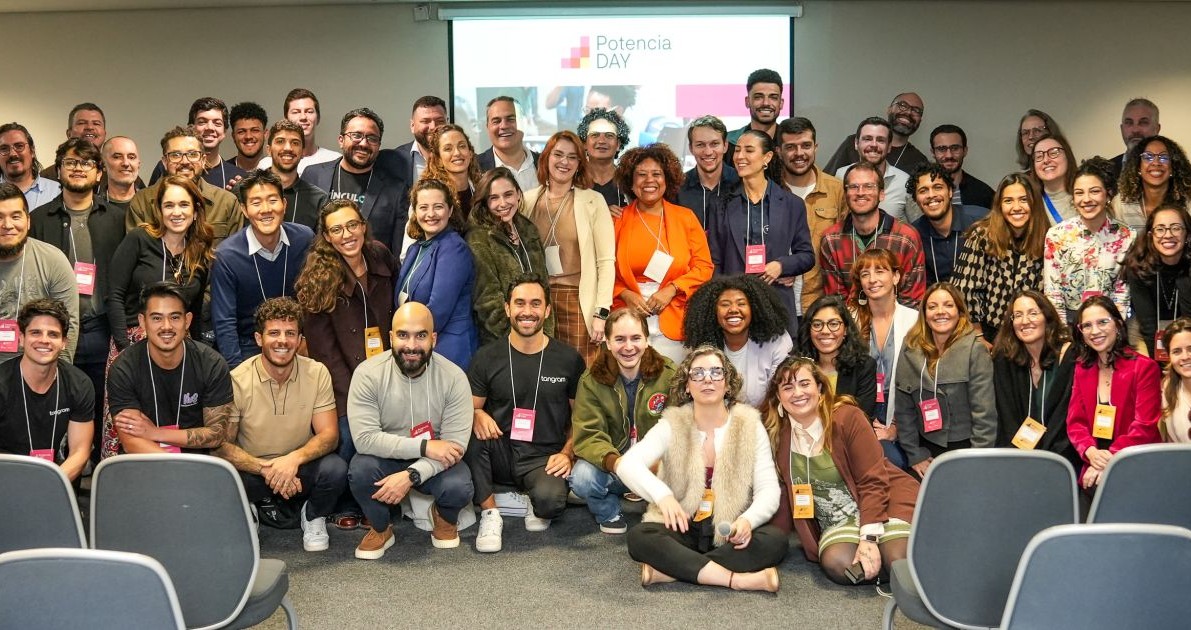
To build its investment pipeline, Potencia launched Potencia UP in Brazil in 2023. In its first year, 170 companies applied. The firm selected 20, ran them through a yearlong program and invested in two. Last year, 200 companies participated through a digital track. This year, the program is expanding to Spanish-speaking Latin America.
Potencia’s direct investment approach has prompted the organization to think about the types of impact capital social enterprises need. Its investment in Simón was set up as a revenue-share agreement with the option to convert into equity if the company closes a qualified financing within three years.
“Many founders in the edtech space are exploring alternatives to venture capital due to the capital scarcity and the constraints that this type of capital imposes,” Aristizábal says. “The cycle of founders not being able to raise capital from equity investors actually puts their business at a disadvantage and at risk.”
The acceleration of Potencia’s workforce and education strategy is partly in response to both the risks and opportunities artificial intelligence poses to livelihoods and career opportunities. One perk of AI is that needed and credible education products are being developed quickly.
“There is a huge window of opportunity coming,” Aristizábal says. “If the right founders can seize it, and intentional investors bring the right tools to support them”