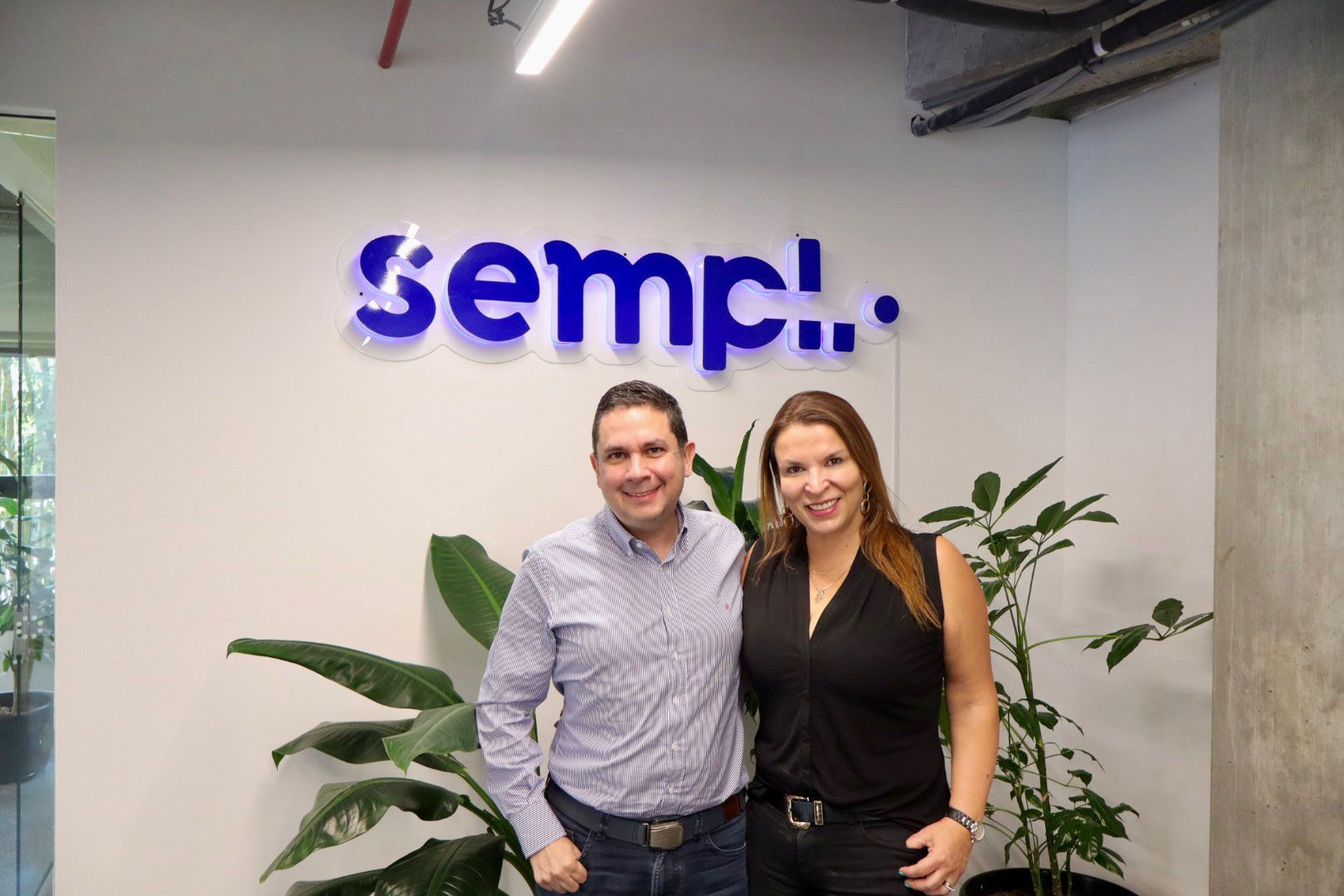

Early-stage venture capital in Latin America remains a tough sell, particularly for women-led funds. Bogotá-based EWA Capital has made the case: its second fund, EWA II, closed at $24.4 million, above its $20 million target, with backing from nearly 50 investors.
One of just a handful of women-led fund managers in the region, EWA backs startups in fintech, enterprise software, health, education and clean energy. At least 40% of the fund will go to companies with a gender-smart footprint — those with women founders, C-suite executives, board members, or majority women customers. The remaining portion of its portfolio targets companies committed to strong gender goals, aiming to combine profitability with impact.
“We do not feel like it’s necessarily a trade-off between returns and impact,” EWA’s Patricia Saenz told ImpactAlpha. “I think you can do both things perfectly here in Latin America.”
A 360-degree approach
EWA’s gender lens approach extends beyond its portfolio to its fundraising strategy. The firm has adopted what Saenz calls a “360-degree approach,” working to cultivate a new generation of female investors across Latin America.
“People always say, ‘Men make the decisions, and that’s why there’s a capital gap,'” Saenz explained. “I started asking myself—is it really just bias, or do we simply need more women across the whole ecosystem, as founders and as investors?”
The strategy worked: 41% of investors in EWA II are women, many of them high-net-worth individuals or women-led family offices investing in private funds for the first time. “Many of them had the money, but they were scared. They didn’t understand. They hadn’t built a portfolio before,” Saenz said. “So it was about education and showing them another asset class beyond bonds, real estate or stocks.”
To lower barriers, EWA set a $50,000 minimum commitment and leaned on investors’ existing interest in gender equality. “The main point was the gender lens,” Saenz said. “They really believed in addressing the gender gap. So that was an opportunity for them to walk the talk.”
EWA II also drew backing from development finance institutions COFIDE and Bancóldex, the International Finance Corporation (IFC), the Visa Foundation, the Women Entrepreneurs Finance Initiative, and Mexico’s government-backed Fondo de Fondos. Private impact investors Sonen Capital and Switzerland’s Mountain Partners also participated in the round.
Mission-alignment
EWA’s portfolio illustrates the strategy. Sempli, a Colombian fintech firm, has digitized small business underwriting and extended credit to more than 4,000 such businesses excluded from traditional banks. As a 2X Global Challenge participant, Sempli has made women-led businesses a priority: 41% of its clients are women, compared to a national average of 28%.
“With Sempli, they already had all the procedures in place and were clear from the start that they wanted to target female owners,” said EWA’s Patricia Saenz. “Our role has been more on the commercial side than in their internal development.”
Sempli’s own fundraising underscored the importance of values alignment with its investors. “Fundraising is not only about receiving money. It’s about picking the right investors,” Sempli’s Esteban Velasco told ImpactAlpha. “We said no to some, and it was the right decision.” EWA co-invested alongside IDB Lab, Oikocredit, CAF, Incofin and Comfam..
For portfolio companies that didn’t yet have formal gender policies, EWA made clear that such commitments would be expected.
Those conversations often start with the basics. “In startups, even something as simple as maternity and paternity leave usually doesn’t exist,” she noted. By encouraging companies to put policies in place, EWA aims to normalize gender equity from the early stages.
The emphasis is not just about representation, but about providing education and the tools for females to growth. “It’s wonderful to have a seat at the table,” said Saenz. “But it’s equally important to give people the tools to develop their careers. Staying at a certain level should be a choice, not an obligation.”
Advice to female-founded GPs
Raising a women-led venture fund in Latin America has not been easy. Saenz, who launched EWA in 2019, cautions against a one-size-fits-all approach.
At the time, there were less than 10 female fund managers in Latin America,” she says. “Instead of seeing that as a weakness, I said: this is our differentiation—let’s do things differently.”
“Being a female-founded GP is hard—and even harder in Latin America,” she said. Her advice: authenticity. “Don’t just say ‘we invest only in women.’ Venture capital is already difficult in Latin America. Find your own way to close the gap.”
The challenge is not unique to Latin America. Globally, female fund managers remain over mentored and underfunded. Tokunboh Ishmael, co-founder of Lagos-based Alitheia Capital, has pointed out that the capital available to women-led funds is nowhere near matching the scale of opportunity. Limited partners, she argues, remain too focused on nudging mainstream funds to adopt gender strategies rather than backing the new managers already building gender-smart portfolios.
That leads to superficial approaches and, at times, outright pinkwashing. “It ranges from complete pinkwashing to genuine interest,” Ishmael told ImpactAlpha, “but you need to have that range for any kind of action to happen.”
EWA’s oversubscribed fundraise suggests that the real opportunity lies in backing the women-led managers themselves — and in proving, as Saenz puts it, that returns and impact can go hand-in-hand in Latin America.