
Venture capital firms are placing increasingly large bets on pre-revenue startups. Infrastructure and private equity buyout funds are looking to take control of mature assets they can wring for cash flow.
S2G Investments is charting a “third way.” To maximize both impact and returns, the firm is seeking to write large checks to profitable companies with growing revenues that need capital to ramp up their volume.
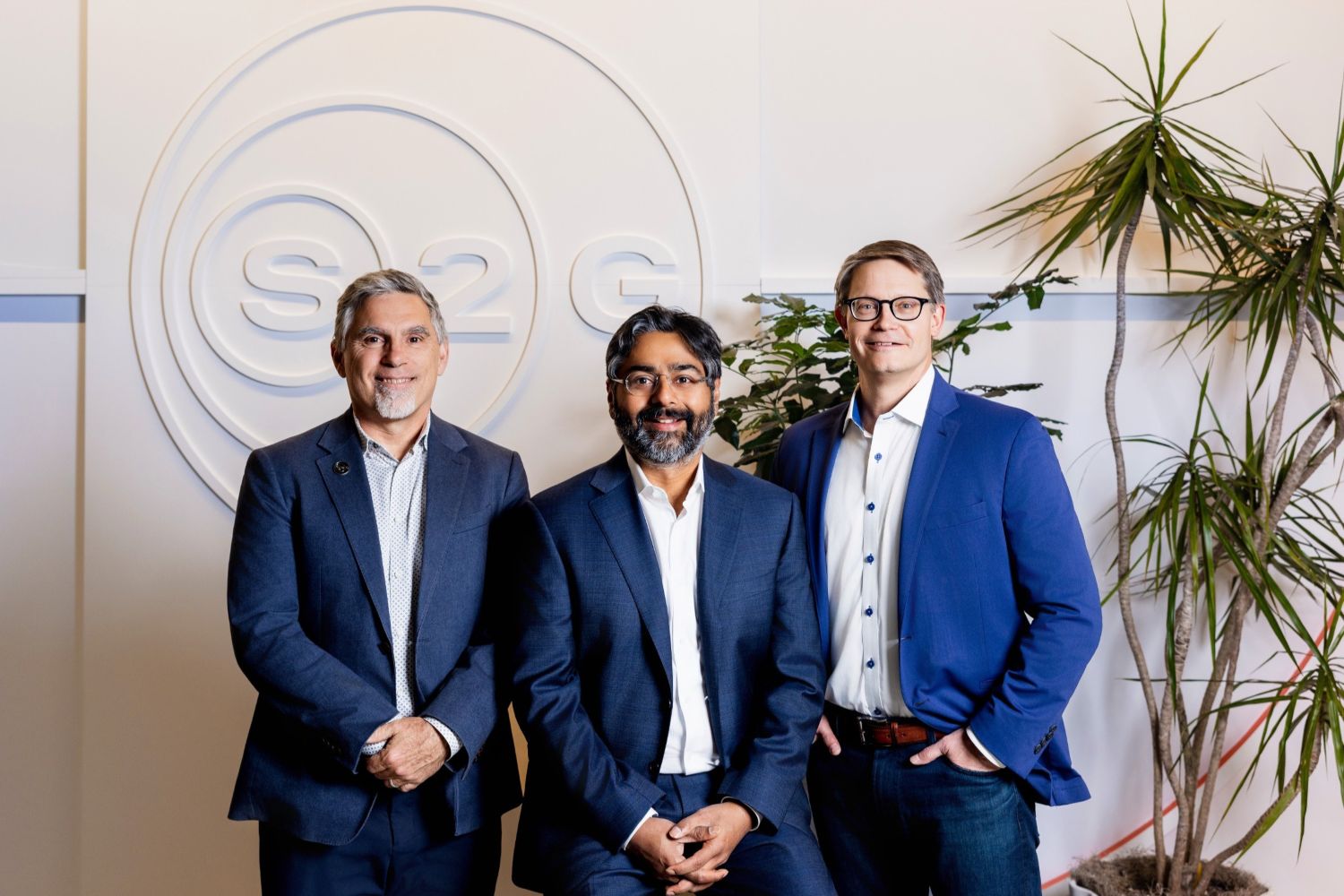
With its $1 billion Solutions Fund I, closed last month, S2G has the wherewithal to write those checks. The Chicago-based firm, founded by Walmart heir Lukas Walton with $100 million in 2014, now has $2.8 billion in assets under management.
The firm targets businesses in food and agriculture, energy and oceans that have strong revenue, paying customers and proven business models. Such firms still need capital to expand manufacturing, grow operations or pursue acquisitions. S2G – the moniker stands for “seed to growth” – typically writes checks of roughly $25 million to $100 million, taking minority investments with governance rights.
“These companies often already have the impact,” S2G’s Sanjeev Krishnan tells ImpactAlpha.. “They already have the customers. They already have the revenue. What they need is capital to scale.”
That was the case with ANA Inc., a Nevada-based manufacturer of hybrid backup generators that can reduce diesel consumption by as much as 70% at industrial sites and data centers. The company was generating more than $100 million in annual revenue but had never raised outside capital and had no interest in selling to a buyout firm. What it needed was capital to expand manufacturing capacity fast enough to meet demand.
“Most investors would have passed. ‘Too mature for venture.’ ‘Too independent for private equity,’” Krishnan told ImpactAlpha. “There’s room for a third way of operating companies that have revenue and EBITDA and just need capital to scale.”
Last year, S2G wrote a $50 million check, ANA’s first institutional investment, to take a minority stake. The business has since tripled in size.
Today, S2G announced a new investment in SWARM Engineering, leading the company’s $10 million series A to grow its AI platform that helps agrifood and manufacturing companies make operational and supply-chain decisions.
Other recent investments include Oxzo, a Chilean aquaculture company with patented oxygenation systems, and Apeiron Labs, an ocean intelligence platform that helps shipping and ocean operators turn marine data into routing and operational decisions.
The broader thesis running through the fund is that climate investing may be entering a different phase. Rather than betting primarily on breakthrough technologies or venture-scale disruption, S2G is looking for established businesses positioned to adapt the physical economy to a more resource-constrained and volatile world.
“We have to move from silo impact to system impact,” Krishnan says.
Illusion of crowds
Walton launched S2G in 2014 as a sustainable food and agriculture investor, backing companies across the supply chain. The firm later expanded into energy and oceans, built a portfolio of more than 120 companies, and spent years operating as the investment arm of Builders Vision, Walton’s family office that combines philanthropy and investment. For years, Walton served as S2G’s sole limited partner.
In 2024, S2G spun out as an independent registered investment adviser and began raising from outside investors for the first time. The $1 billion Solutions Fund I attracted commitments from pension funds, funds of funds, and family offices across North America, Europe, Asia, and Australia. S2G did not disclose its roster of LPs.
The firm has released new research to argue that the problem runs deeper than a missing stage of capital. “The Illusion of Crowds,” written by S2G’s Francis O’Sullivan and Gokul Raghavan, examines more than $88 billion raised by nearly 280 climate-focused venture, growth, private equity, and infrastructure strategies between 2021 and 2025.
The report found that roughly three-quarters of the largest “growth-stage” rounds actually funded companies generating less than $50 million in revenues, or no revenues at all. “Capital marketed as growth has often functioned as large-scale venture,” the report concluded.
Impact investing’s public profile might suggest a broad and well-capitalized market. The underlying data tells a different story, the authors argue. They found that capital is flowing through a narrow set of channels, with the same investors backing the same companies and the same rounds. The result is an investment ecosystem that appears diverse on paper but is often concentrated around the same companies, technologies and investor networks.
“The [market] aggregation mechanism is intact, but the three conditions that make aggregation wise — diversity of opinion, independence of judgment, and decentralization — appear meaningfully weaker than the market’s headline figures would suggest,” the paper states.
The new paper expands on a thesis the firm articulated in 2023 that became the foundation for Solutions Fund I.
In “The Missing Middle,” S2G argued that energy-transition private markets had become bifurcated: abundant early-stage capital at one end, substantial infrastructure capital at the other, and a structural gap in the growth-stage middle where clean energy companies with real revenue and real customers struggled to find checks sized to match their needs.
At the same time, much of the funding labeled as “growth capital” flows to companies that are pre-revenue or early in commercialization, not to profitable operating companies ready to expand their operations. That leaves less capital available for businesses able to truly deliver impact at scale.
S2G argues the market has become crowded at both ends of the climate capital stack. Venture firms continue placing increasingly large bets on pre-revenue startups, while infrastructure and buyout funds concentrate on mature assets and control deals. The result, the firm says, is a financing gap for industrial and operational businesses that already work commercially but are poorly suited to traditional venture or private equity structures.
“It’s a niche that I think is being ignored,” Krishnan says. “It’s much more labor-intensive origination and takes deep sector networks and expertise to underwrite.”
Many of the companies S2G targets would never describe themselves as climate businesses. Some are focused on industrial efficiency, maritime operations, aquaculture infrastructure or backup power systems. Others are family-owned companies that have operated profitably for years without institutional investors.
Physical commodities
S2G believes the physical economy is moving back to the center of global markets as artificial intelligence, geopolitical fragmentation and climate pressures drive demand for energy, commodities and industrial infrastructure.
“The revenge of the physical commodity economy,” Krishnan called it.
That thesis extends beyond energy and industrials. S2G’s Kate Danaher says maritime modernization, aquaculture and ocean intelligence have become increasingly commercial investment themes as shipping companies, seafood producers and governments search for more efficient and resilient systems.
“The oceans economy is one of the most important and undercapitalized transition opportunities of the next decade,” Danaher told ImpactAlpha.
S2G’s ocean investments include maritime battery systems, fish farming technologies and ocean sensing platforms that help shipping companies optimize routes and fuel use. Danaher says the firm increasingly sees oceans less as a niche sustainability theme and more as a core industrial and geopolitical market tied to food security, defense and supply chains.
S2G launched fundraising for the vehicle in mid-2024, amid questions around the future of global climate policy and the domestic Inflation Reduction Act, not to mention rising interest rates and broader market turbulence.
“We were probably fundraising at the worst time,” Krishnan says. “If you’re going out today, you’re in a much more advantaged position.”