


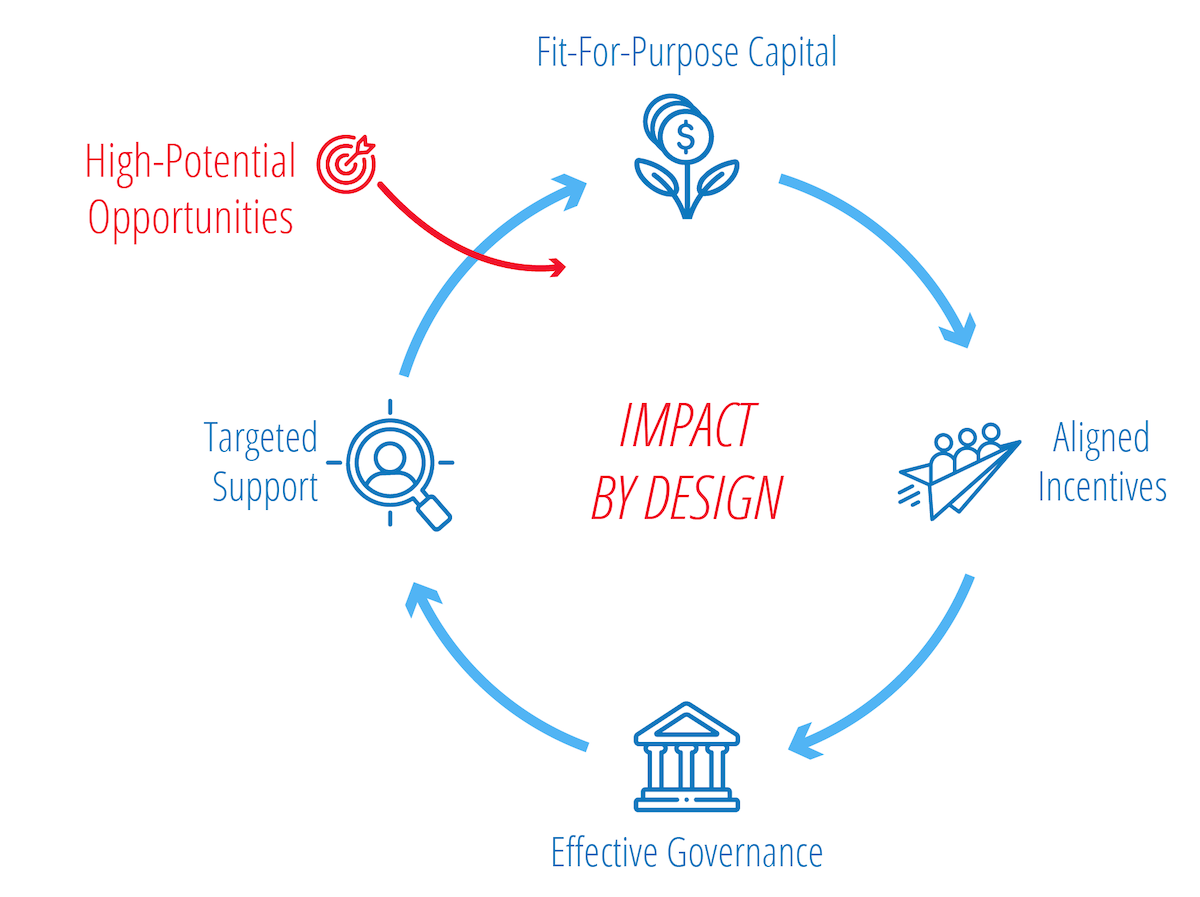
The most recent period of market volatility, fueled by war in the Middle East, underscores a financial system designed around fear. Impact investor Trimtab Impact suggests an alternative approach: “joyful capital.”
Early results from the impact holding company’s “impact first” portfolio offer a glimpse of how wealth and capital would be put to use, and profit, “if we valued all life equally.”
That includes a fund manager in Africa financing projects to electrify villages and add hospital beds, one in the US protecting forestland that’s at risk of severe wildfires, and a third supporting small businesses in conflict-affected northern Syria (view Trimtab’s full portfolio on ImpactAlpha Edge).
“We are on track financially (low single digits) and maintain a significant capacity for frontier-level risk even as the portfolio’s impact depth has only performed to the upside,” writes founder Caleb Ballou in Trimtab’s first portfolio “additionality” report.
But the most important lesson from its portfolio’s performance this year, he says, “is that our adaptable and opportunistic strategy ideally fits today’s fragmented, shifting and nascent catalytic markets where collaboration and flexibility are among the most valuable assets.”
Impact without incentives
Trimtab Impact began three years ago as a collaboration between The ImPact and Liesel Pritzker’s Blue Haven Initiative to move catalytic family office money into deep impact-first strategies, many of them helmed by first-time fund managers. To prove that it is serious about its mission, Trimtab’s shareholding structure as a public benefit corporation is controlled by a perpetual purpose trust that ensures it stays the course on impact.
Family offices responded by committing $60 million; the firm has invested $19 million so far.
“We are working on behalf of investors who don’t just want ‘exposure’ to high-impact investments. They only want their capital to be used to generate impact that would not otherwise occur,” Trimtab’s Trace Welch tells ImpactAlpha. Trimtab is a founding partner of Impact LP, ImpactAlpha’s platform for asset owners for whom LP stands for “Leadership Potential.”
Target financial returns are in the low single-digits. There are no tax benefits; investors’ capital is entirely at risk. An annual liquidity pool lets them recoup a portion of their capital.
In return, Trimtab promises to get capital willing to forego traditional incentive structures to overlooked, deeply impactful projects and communities. Its portfolio of 10 impact investment vehicles include UK-based Acre Impact Capital, Blue Forest in Oregon, Common Trust in San Francisco, and UK-based Amazonia Impact Ventures.
“We do not use traditional interpretations of the risk-return paradigm as a boundary for what and who is investable,” explains Welch.
Instead, Trimtab screens for “additionality” potential. Do vulnerable people or places get outcomes they wouldn’t get otherwise? Does a fund’s model change the market? Does Trimtab’s capital specifically matter to whether that change or those outcomes are possible?
The screens should guide Trimtab to conflict zones, Indigenous communities, “unbankable” infrastructure and other places mainstream money won’t go.
“Some deals might be major in direct impact, some in systemic, but we can’t have a zero at any of the three levels, otherwise, we say the form of capital that we deploy is probably not the right fit,” says Welch.
Additionality in action
In its more than 50-page deep dive on its portfolio, Trimtab spotlights first-time fund manager Acre Impact Capital, an equity investor for relatively small infrastructure projects in Africa that are neglected by most private equity firms. Trimtab committed $4 million to the firm’s first fund, which fits into its “accelerating neglected markets” theme. It says the firm ranks highly for “systems additionality” because it has a large capital-ready pipeline and has engaged new investors interested in co-investing. Its “on-ground additionality,” through investments like Project Helios, which is extending electricity to off-the-grid villages, is “slightly better than expected”.
Blue Forest invests in forest restoration projects to reduce wildfire risk in the western US. Trimtab committed $1 million to its Forest Resilience Bonds Catalyst Facility to issue bonds in communities facing high wildfire risks. The conservation finance firm scored “better than expected” for its on-ground additionality for its bonds’ impact on jobs created, forests protected and carbon emissions avoided.
Siraj Financial Services, a microfinance firm operating in northern Syria, scored highly for its on-ground additionality and “better than expected” on systems additionality, largely because it operates in a conflict-affected, politically unstable country that few lenders serve.
Mombak, which supports reforestation work in Amazon rainforest, secured $2.5 million from Trimtab for its first fund. The company leases and purchases deforested land, restores it by planting native trees, and sells credits based on the carbon removal from its portfolio. Trimtab reports that it scored “better than expected” for both on-ground and systems additionality.
Mombak is close to hitting its land acquisition target, having secured more than ten farms to date. The company’s approach, prioritizing long-degraded pasture, ensuring lasting forest protection, and maintaining relationships with surrounding landowners, helps contain leakage as a broader systemic risk. Mombak is also Google’s largest supplier of carbon removal credits, with long-term offtake contracts that have been signed at premium prices relative to the broader market.
“Mombak is executing extremely well, and is on track to deliver its thesis,” the report states.
After raising $120 million for its first fund, Mombak is in the market with a $150 million target for its second fund. It has early commitments from several family offices. Trimtab says it is unsure if or how it affected Mombak’s success.
On the whole, says Welch, “real, meaningful things are happening as a result of these investments. We are incredibly proud to be partners with and observers of the incredible work being done by the managers we support.”
Wrote Ballou, “We are struck by our peers’ confidence and conviction, and by the clearly increasing interest in impact-first and innovative finance.”
He added, “Sector collaboration has never felt more robust and urgent—and the urgency is not without optimism.”