
Greetings Agents of Impact!
In today’s Brief:
- Pivots on the path to high-quality carbon credits
- Access to development therapy for kids
- Designing community-driven nature projects
- Elevating workers voices with AI
Featured: Climate Finance
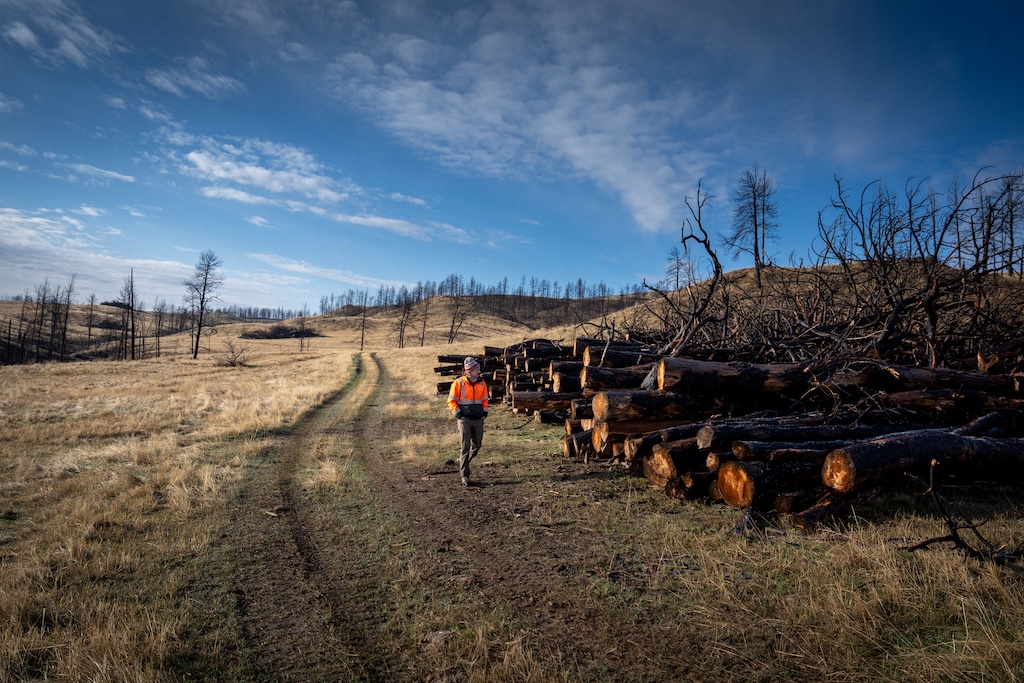
From planting trees to burying them, Mast Reforestation follows the market for carbon credits. Millions of tons of burnt, dead lodgepole pines, Douglas firs and other trees dot the wildfire-scarred hills of Montana. Mast Reforestation wants to bury the debris and to get paid for doing it. The Seattle-based forestry company in January announced the first sale of its carbon credits from biomass burial. Such “carbon removal” credits fetch relatively high prices in the voluntary carbon markets – even after steep volume discounts – from Mast’s corporate buyers, which include the Royal Bank of Canada, CNaught and Muir AI. Tree burial is the latest pivot for Mast, which a decade ago started as DroneSeed and operated remote-controlled drones that released seed-and-nutrient “pucks” intended to jumpstart new forests in burn zones. Much of the promised carbon savings from that approach failed to materialize. Now, the sale of 4,277 credits from the burial of more than 10 million pounds of dead trees is a signal that Mast, with generous VC backing, may have found a sweet spot in the volatile carbon markets. Mast raised $25 million in Series B financing a year ago, after its $36 million Series A round in 2021, with both rounds led by Chamath Palihapitiya’s Social Capital. “What we identified with biomass burial is what is turning heads today within the carbon markets,” Mast’s Grant Canary tells ImpactAlpha. “This work has specific and unique features that are exciting to buyers, and it has co-benefits that are exciting to buyers.”
- Hype cycle. The company’s twists and turns tell the tale of the voluntary carbon markets, in which credits are sold to corporations seeking to make good on their net-zero commitments. As in the classic hype cycle of many new technologies, carbon credits reached a “peak of inflated expectations” around 2022 as a tool for financing a low-carbon economy. Revelations about rampant miscalculations of climate impacts, and in some cases outright fraud, sent the market into the “trough of disillusionment”. By burying fire-killed trees, Mast hopes to climb the “slope of enlightenment” and complete the hype cycle. The biomass burial method sequesters carbon without relying on the future growth of new trees. Mast says it will monitor for emissions from the underground chamber that stores the trees for at least a century, and has established a “permanence trust” to finance the effort. Mast will continue to practice reforestation at burial project sites, but as a non-financial co-benefit for landowners. “We got from excavation to issuance in nine months,” Canary says. “For 4,277 credits, that is pretty remarkable.”
- Biomass burial. Corporate commitments from the likes of Microsoft, Stripe and Shopify are generating sustained demand for high quality – and higher priced – carbon removal credits. New firms are cropping up to tap into that premium part of the market, through methods like biochar pyrolysis and enhanced rock weathering. “There’s a big demand on the part of buyers that know they’re going to need credits going forward,” says Jennifer Jenkins of Rubicon Carbon, a broker of credits that is not involved with Mast. “They’re locking in that supply today. They’re making agreements with developers.” Other US companies trying to scale biomass carbon removal and storage projects include Breakthrough Energy-backed Graphyte, Utah-based Woodcache PBC, and Carbon Lockdown, founded by biomass burial innovator Ning Zeng. “When I first heard about the idea of biomass burial, my initial reaction was, ‘That’s the stupidest thing I’ve ever heard of,’” the Nature Conservancy’s Joe Fargione tells ImpactAlpha. “Then I looked into it further and it turns out it’s actually a good idea.”
- Keep reading, “From planting trees to burying them, Mast Reforestation follows the market for carbon credits,” by Isaac Silk.
Dealflow: Healthy Youth
Coral Care snags $13 million to expand in-home pediatric developmental therapy. As a mother of two young girls, Jen Wirt experienced firsthand the challenges of getting timely care from pediatric specialists for children with developmental delays. Early access to speech-language pathologists, occupational therapists and physical therapists plays a critical role in shaping school readiness, lifetime healthcare costs and long-term behavioral health outcomes. Wirt founded Coral Care three years ago to address provider shortages, long waitlists, high costs and other systemic barriers. “Coral Care represents the modern approach to care delivery – one that is affordable, localized and customized to meet patient need,” said Olivia Baribeau of Haymaker Ventures, which led Coral’s Series A round. GreyMatter Capital, Reach Capital, Mother Ventures, AlleyCorp and others also invested. The funding will fuel Coral Care’s expansion to Dallas, Houston, Chicago, Pittsburgh and Philadelphia, and help it extend services to Medicaid-covered families (catch up on all of ImpactAlpha’s coverage of Healthy Youth, delivered in partnership with HopeLab).
- In-person care. Coral partners with a network of 400 licensed pediatric specialty-care providers to provide home care to families. While many providers are shifting to telehealth because it’s cheaper and faster to scale, Wirt says a screen often falls short for toddlers who won’t sit still or children struggling with self-regulation. Most of the children Coral serves have autism or ADHD diagnoses. “In-home care is a harder model to build [since] it requires local density and payer infrastructure and real operations supporting each individual market,” she told ImpactAlpha. “For this population with these specialties, we fully believe that it produces better engagement, more durable progress, and creates a better path toward achieving outcomes.”
- Keep reading.
Development finance institutions back Hummingbirds to design community-driven nature projects. Financially viable models for investing in nature vary widely in approach and quality. French startup Hummingbirds partners with local businesses, organizations and communities in vulnerable and/or biodiverse areas to tap carbon market revenues. In Côte d’Ivoire, for example, the company is partnering with a local nature lodge, nature conservation organization and the national forest development company to restore degraded land and develop sustainable timber and agroforestry operations on more than 86,000 acres. Hummingbirds has more than 20 projects in the works covering more than 1.7 million acres and impacting more than 400,000 peoples’ livelihoods in nearly a dozen countries. The company secured €50 million ($59 million) from Swedfund, Proparco and British International Investment, partially guaranteed by the EU’s EFSD+ Carbon Sink program, which was launched in 2024 to encourage European development finance institutions to invest in forestry, marine and regenerative agriculture projects in emerging markets.
Resurrect Bio lands $8.1 million to resurrect crops’ natural immunity. Plant pathogens and pests are increasingly resistant to common pesticides and herbicides. Resurrect Bio uses gene editing to repair plants’ natural defenses. Its products are designed for mass-produced crops like soy, corn and wheat. It’s also developing options for cotton and cruciferous vegetables, like broccoli, cauliflower and kale. The London-based company’s Series A equity round was led by Corteva Catalyst, the investment arm of Corteva Agriscience, which spun out of DowDuPont several years after the two agrichemicals giants merged. Dutch impact investor Pymwymic, the UK Innovation and Science Seed Fund, SynBioVen and AgFunder also participated. Resurrect Bio will use the capital to develop its AI-enabled screening tool, FloraFold, which identifies disease-resistant genes in plants.
Dealflow overflow. Investment news crossing our desks:
- Africa-focused private equity firm Adenia Partners and French development bank Proparco are exiting their stake in OCS Groupe, a facility cleaning and maintenance services firm that operates in Senegal and Morocco. Adenia says it has helped the company add 500 new jobs and improve its environmental, social and governance practices since it invested in 2021. (Adenia Partners)
- Acumen and Orios Venture Partners led a $2.5 million equity round for ScrapUncle, a Delhi-based startup that offers “on demand” electronic and scrap waste recycling services. Upaya Social Ventures, Venture Catalysts, We Founder Circle and others also participated. (Acumen)
- Chicago-based Community Investment Corp. secured a $10 million loan from JPMorganChase to capitalize local affordable housing developers. (CIC)
Impact Voices: Shaping the Algorithm
Good jobs, worker voices and ownership in the age of AI. The MIT future of work expert David Autor recently warned that artificial intelligence could create a grim future where skills and jobs are devalued. “Everybody is competing over a few remaining resources that aren’t controlled by some warlord somewhere,” he says. But he adds, quoting a friend, “The future is not a forecasting exercise – it’s a design exercise. You’re building it.” Pacific Community Ventures is among the investors designing a future in which AI is wielded to uplift community voices and build economic mobility (for other examples see, “(Human) agents of impact are shaping the algorithm for ‘good AI’”). Through its acquisition of Radiant Data, a mission-driven AI startup, the nonprofit community development financial institution is incorporating ethical AI into its impact underwriting and measurement, and equipping underserved small businesses and their workers with tailored resources to shape the economic future. “Our hope is to unlock the potential of our economy by investing in high quality job creation, dignity, ownership and climate resilience in the age of AI,” writes PCV’s Bulbul Gupta in a guest post on ImpactAlpha.
- Elevating worker voices. Using Radiant’s voice-enabled AI tool, PCV gathered anonymous feedback on job satisfaction from its small business borrowers’ employees. It shared the synthesized findings with entrepreneurs, establishing a feedback loop to support productivity and retention efforts. In AI-assisted community co-learning pilots, workers communicated pain points such as unpredictable scheduling and limited career pathways as drivers of turnover. “By elevating worker voices with AI-assisted tools, we uncovered actionable insights that strengthen both business performance and job quality,” writes Gupta. With a $100 million commitment, PCV will help sustain 100,000 good and green jobs in California, the authors say. “We invite other impact investors and mission-driven lenders to join us to build data commons,” she adds, and “unleash the potential of our economy.”
- Keep reading, “Good jobs, worker voice and ownership in the age of AI,” by Pacific Community Ventures’ Bulbul Gupta.
Agents of Impact: Follow the Talent
Don’t miss these upcoming ImpactAlpha partner events:
- Mar. 16-18: MO Summit, Asheville, NC. Use code IMPACT26 for $250 off. RSVP now.
- May 19-21: ReFed Food Waste Solutions Summit, Charlotte, NC.
- June 1-5: Sustainable Finance Initiative’s Impact Week, Hong Kong. Early bird pricing is now available. Apply for tickets.
Atlanta-based VC firm for underrepresented founders 6.8.10 Partners appoints Nicole Garner Scott, formerly with Northwestern Mutual, as vice president of investor relations and strategic capital… Lindelwe Lesley Ndlovu, formerly with African Risk Capacity, becomes CEO of AfrexInsure, the insurance business of African Export-Import Bank… Greg Levin of New Leaf Climate Partners joins the board of the American Forest Foundation… Eugene Lewis, who founded the startup Every, becomes director of impact investments at Robin Hood.
Green Climate Fund promotes Darren Karjama to head of strategic engagement, outreach and partnerships… Annie McCluskey, formerly with National Geographic Society, and Everett Sanderson, formerly with City Light Capital, join Superorganism as senior associates… Karin del Ray becomes an advisor to Rumah Group and Foundation… REDF’s Impact Investing Fund seeks an investment manager in the central Appalachia region of the US.
Acumen is recruiting a New York-based chief of staff for its founder and CEO, Jacqueline Novogratz… Also in New York, Goldman Sachs’ sustainable investing group is hiring an associate, MSCI is recruiting a climate specialist vice president, Wellington Management is looking for a private climate investing associate, and PepsiCo has an opening for a sustainability investment manager… The Boston Foundation is on the hunt for an associate director of impact investments.
👉 View (or post) impact investing jobs on ImpactAlpha’s Career Hub.
Thank you for your impact!
– Feb. 23, 2026