
TGIF, Agents of Impact! We’ll be taking a Brief break to honor the birthday of Rev. Dr. Martin Luther King Jr., a holiday in the US. We’ll be back in your inbox on Tuesday, Jan. 20.
In today’s Brief:
- Roundup: Defending democracy
- Podcasts: This Week in Impact and Criterion Institute
- Spotlight: Superorganism’s biodiversity bet
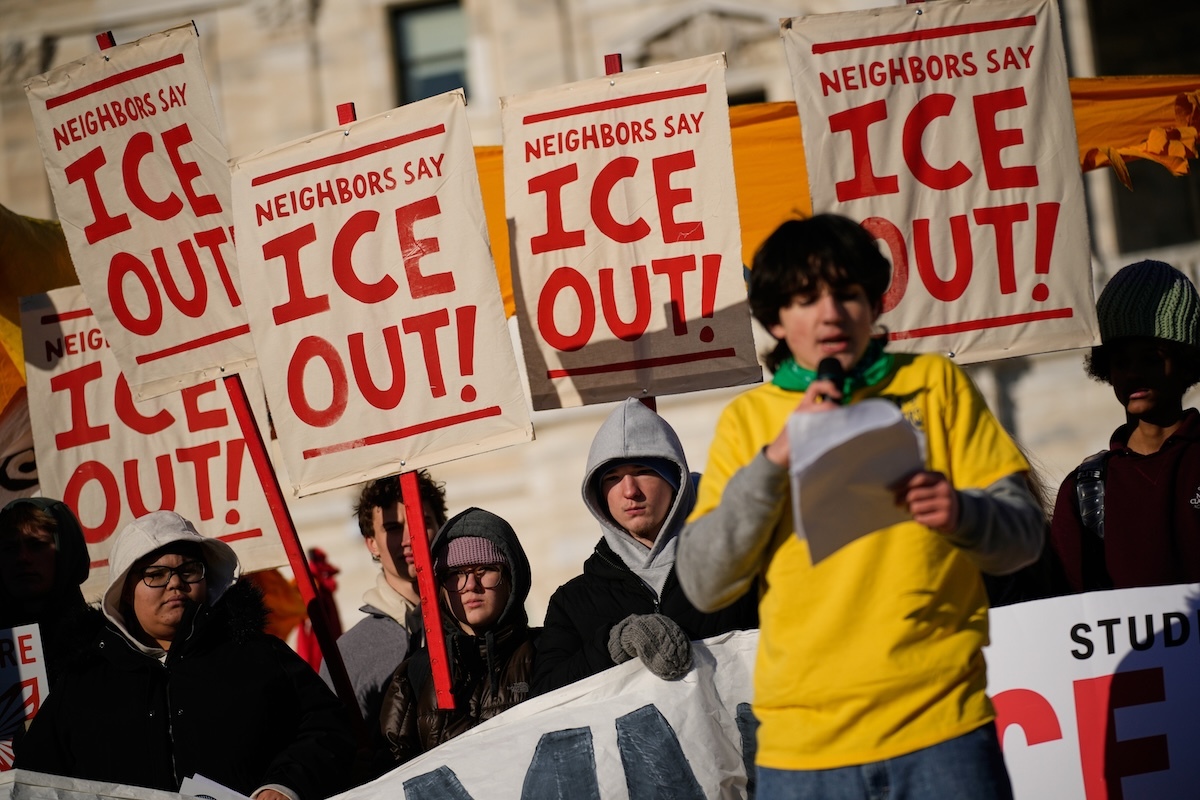
🗣 Cool kids. Perhaps the most hopeful thing I saw in my doom scrolling this week was an interview with Clover, a student at Theodore Roosevelt High School in Minneapolis, who had gotten texts from a friend, with video, of the arrival of ICE agents at her school. Clover quickly helped organize students, and adult security monitors, for a walkout and march. “I was seeing things on the news about ICE coming to other schools and people’s houses,” Clover said. “I felt horrible, but I didn’t feel, like, so much fear, until it happened to my school.” This week’s boisterous march of 150 students was as wholesome as any high school spirit day. “I’m really happy that we’re standing up for our community and our immigrant neighbors,” Clover said. So cool.
For young people, and thus eventually for all of us, it’s going to be cool to be anti-militarization. Anti-injustice. Anti-division. Anti-antidemocracy. One day, everybody will claim to have stood up to the authoritarian takeover of our communities and, perhaps, our polling places. That cool factor will resonate for these young people – as employees, as consumers, as voters – for decades to come. It’s already cool, on this Martin Luther King Jr. Day in this bisesquicentennial of the Declaration of Independence, that young people are revitalizing our shared principles of freedom from tyranny. “Closed and cruel are on their way out,” The New York Times’ Ezra Klein wrote late last year. “What comes next, I suspect, will present itself as open, friendly and assertively moral.”
Agents of Impact of all ages are building what comes next. Rutgers University’s Joseph Blasi and others are calling for an ownership stake for workers and communities in the profits and productivity gains of the accelerating AI transformation, as Roodgally Senatus and Amy Cortese explored in their interview with the dean of academic research on employee ownership. The MacArthur Foundation reported that its $128.5 million in recent fund investments helped catalyze $3.1 billion in additional capital, as Erik Stein reported (MacArthur’s Charles Coustan helpfully chimed in to explain how the foundation measures the impact of such investments). Keying in on last year’s foodie film, “Nonnas,” contributor Dmitriy Ioselevich reported on efforts to use movies and other popular entertainment to change minds and spur action. “We found that people were really hungry for community, so we wanted to come up with more ways for folks to engage,” Rachel Cooke of the production company 1Community said.
The headwinds are real, as seen in the dramatic falloff in fundraising for impact funds, which last year came in at less than one-quarter of 2022’s record total. But persistence and strategic clarity can still win, as Jessica Pothering and Lucy Ngige documented with ample examples of exceptions to the trend (see Erik’s profile of Native-led Velveteen Ventures and his spotlight on Superorganism, below). Save the Children’s Paul Ronalds explained the humanitarian organization’s pivot to impact investing amid cuts to foreign aid. HIP Investor’s Nick Gower demonstrated the value of resilient capital stacks in his tale of two living shoreline projects. “The world is in a dangerous place,” Ronald Cohen told ImpactAlpha contributor Danielle Rossingh in our Q&A. “We have to do everything we can to fight back against attempts to take over democracy.” – David Bank
The Week’s Podcasts
🎧 This Week in Impact. Host Brian Walsh takes up ImpactAlpha’s top stories with editor David Bank. This week’s top story: Amid an impact fundraising drought, novel strategies and private credit stand out, and yes, size matters. David shares takeaways from ImpactAlpha’sinterview with Rutgers’ Joseph Blasi, who proposes a “citizens’ share” in AI’s upside. And finally, a look at the impact of entertainment, specifically the Emmy-nominated film “Nonnas” from veteran producer Scott Budnick.
- Listen to the new episode of This Week in Impact. Get the podcast in your feed by subscribing on Apple, Spotify, or YouTube.
📯 Criterion Institute Podcast: Financing patience. Host Joy Anderson explores the parallels between funding social movements and financing market formation. She speaks with Katharina Samara-Wickrama and Medina Haeri about patient, long‑term investment; flexible core support instead of short‑term project grants; and a commitment to relationship‑building and collective strategy.
Next Week’s Call
The real returns of impact-first fund managers. Deep impact can come from unlikely bets. Fund managers able to invest in early-stage, novel solutions in tough markets with fit-for-purpose capital and necessary support can deliver big wins. On next week’s Agents of Impact Call, Open Road Impact’s Caroline Bressan, Rhia Ventures’ Erika Seth Davies, Global Partnerships’ Tara Murphy Forde, Echoing Green’s Daniel Tellalian, Acre Capital’s Hussein Sefian and other impact-first fund managers will explore the true costs – and returns – of impact-first investing, Wednesday, Jan. 21, at 10am PT / 1pm ET / 6pm London. RSVP today.True cost. Open Road Impact, along with Acumen, Kiva, the Miller Center for Global Impact and other impact-first fund managers, quantified the effect of smaller ticket sizes and enhanced hands-on support in “The true cost of impact-first investing.” The report found that such costs “reflect the price of inclusion.”
Superorganism lets investors bet on biodiversity. Kevin Webb worked in tech and venture capital before feeling called to climate studies at Columbia University. Tom Quigley worked as a conservationist in Australia, Madagascar and the Cayman Islands before entering the startup world. The two have now found a niche investing in pre-seed and seed stage tech startups addressing the urgent issue of biodiversity preservation. “We spoke with many founders and learned that biodiversity was a compelling reason why they were doing the work, but they didn’t have VCs around their cap table giving them that specific support,” Quigley told ImpactAlpha. “Nature tech” startups raised just $10 billion between 2018 and 2024.
The Week’s Spotlight
Webb and Quigley’s firm, Superorganism, which they launched in 2022, has closed its debut fund at nearly $26 million, anchored by Lukas Walton’s family office Builders Vision, and backed by AMB Holdings, Cisco Foundation, Understorey Ventures, Wedgetail and Mark Tercek, the former head of The Nature Conservancy. Biodiversity is “the next frontier of risk management and value creation,” Chris Wu of Builders Vision said. “Biodiversity underpins every strategy pursued by investors focused on planetary health.” More than half of global GDP is moderately or highly dependent on nature, yet few investors have dedicated allocations for nature-based solutions, much less nature-based venture capital. “It’s not about convincing people,” Quigley said. “It’s about finding people that are excited about what you are building.”
- Secular momentum. Superorganism has invested in 20 companies, which have collectively raised over $100 million in additional capital. Cecil curates nature and biodiversity datasets. Funga is focused on innovative soil restoration in forests. Inversa makes leather products from invasive species. The firm expects to write up to 15 more checks through the fund. Last year, more than 140 countries pledged $200 billion per year by 2030 to reverse biodiversity loss. “There’s secular momentum that we did not anticipate,” Webb said.
- Check it out, and catch up on all of this week’s dealflow reporting.
The Week’s Talent and Jobs
💼 See and share more than a dozen new impact jobs posted this week on ImpactAlpha’s Career Hub and view hundreds of more jobs in impact investing and sustainable finance. Have a job listing to post? Submit it here.
Ownership Works welcomed Marion Stattler, previously with Ford Motor Co., as a principal on the nonprofit’s client advisory team… Bridge Investment Group promoted Lindsay Clark to sustainability and responsibility director… Bridge Housing Corp. appointed Erik Lund as chief financial officer.
Bridget Michalowski, previously with Arctaris Impact Investors, joined Clean Energy Ventures as investor relations manager… Albuquerque Community Foundation welcomed Jenifer Garcia-Mendoza, formerly with El Puente de Encuentros, as community engagement and development manager… World Fund added Hannah Hedberg as an executive assistant… Filsan Farah stepped down as fund manager of Weave Community Capital Fund.
TheSmall Foundationpromoted Liz Wilson to CEO. Conor Brosnan continues as executive chair and chief investment officer… Convergence Blended Finance’s Joan Larrea joined the Bretton Woods Committee… Jonathan Rose Companies promoted Brandon Kearse to president and chief investment officer… Carolyn Au is promoted to managing partner… CVS Health Ventures promoted Payal Parikh to principal.
That’s a wrap. Have a wonderful weekend.
Jan. 16, 2026