
Saludos, Agents of Impact!
In this month’s newsletter:
- Boosting Nicaragua’s cassava farmers
- Seaweed-based packaging in Mexico
- Small businesses lead on global climate action
¡Empecemos! – Jessica Pothering
Featured: Financing Farmers
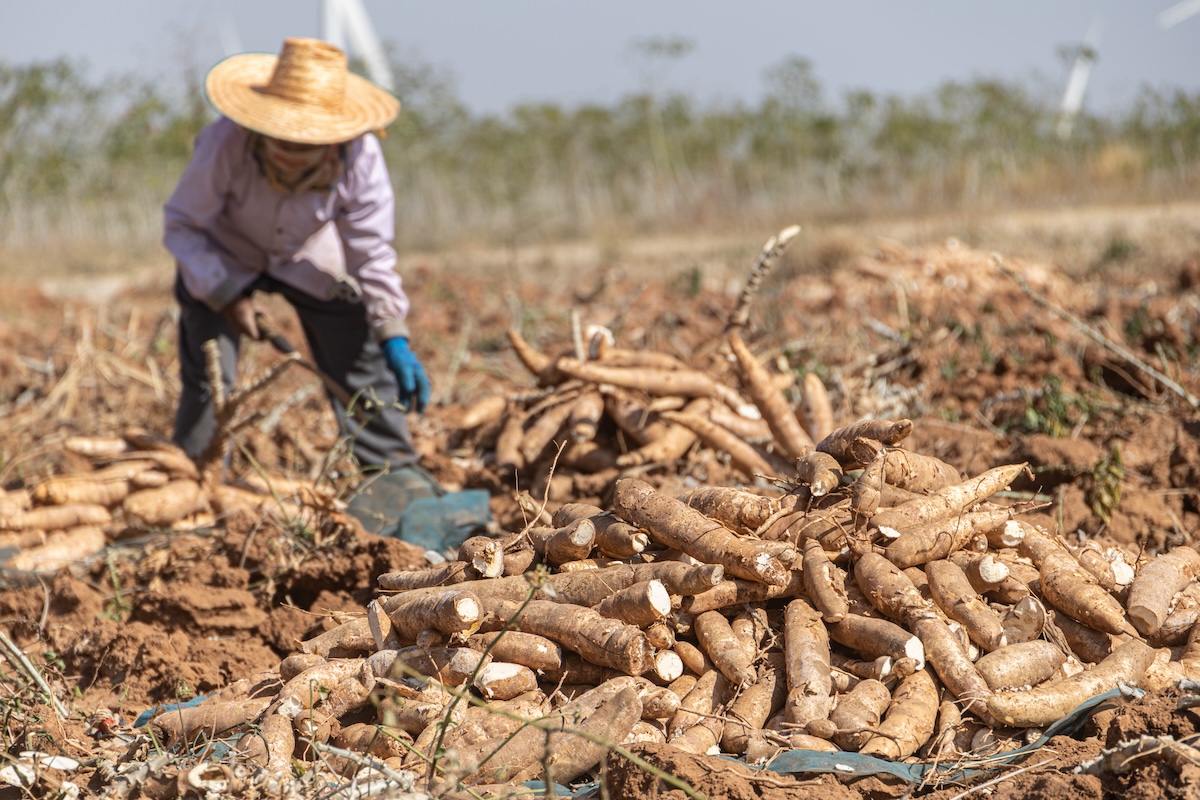
Building a supply chain and boosting farmers’ incomes in Nicaragua. Amid Covid’s disruption to global supply chains, an agriprocessing company in Nicaragua seized a high-value opportunity to build a sustainable business around a home-grown crop. Alcasa, short for Almidones de Centroamérica, has expanded to help Nicaragua’s smallholder farmers boost their incomes and weather climate shocks. Alcasa is leveraging corporate contracts, off-take agreements and low-cost financing to build a domestic production market for cassava, a starch used in everything from sauces to processed meats to industrial adhesives. Cassava demand is high: Alcasa’s corporate buyers are major food companies like Cargill and Ingredion, as well as regional players like Sigma Alimentos, all of which otherwise depend on imports from Asia. Despite a struggling economy and an increasingly isolated government, Nicaragua grows more cassava starch than any other country in Central and North America. “Cassava lets us work with small farmers because you can do it on one acre,” says Alcasa’s Raúl Amador Somarriba. “That’s what makes the impact possible.”
- Offtake contracts. Alcasa was founded in 2012 with backing from Grupo Invercasa to build Nicaragua’s first industrial-scale cassava processing facility. Cassava has an extremely short shelf-life when harvested, so processing must begin almost immediately. Alcasa cuts out middlemen and acts as a primary financier and buyer for about 350 farmers. It signs off-take contracts before planting begins and provides low-interest loans so farmers can buy the inputs they need. At harvest time, Alcasa arrives to weigh the crops; it pays farmers based on starch content. Alcasa says its support has helped double yields per acre. “You’re talking about a family that was living off $30 a month [now earning] $300, $400,” says Amador Somarriba. “That literally takes you out of the poverty line.”
- Valuable crop. Grupo Invercasa, a financial services provider, holds at least seven other companies in addition to Alcasa. The group initially worked in Nicaragua’s coffee industry, before concluding that export margins were too thin to deliver meaningful improvements in farmer livelihoods. In contrast, cassava production is so lucrative that some of Alcasa’s technical staff have left the company to become farmers. The operation supports 250 direct jobs and more than 1,100 indirect jobs. Women make up 42% of the workforce. Instead of paying dividends, Alcasa reinvests profits to expand its farmer network and processing capacity. “Whatever we get into, we have to add value,” Amador Somarriba says. “If we can’t do that, there’s no purpose. We won’t be able to transfer value to our producers.”
- Keep reading, “Building a supply chain and boosting farmers’ incomes in Nicaragua,” by Erik Stein.
Dealflow: Impact Tech
Epic Angels network invests in BioPlaster to turn seaweed into packaging. Epic Angels, a 750-member network of female angel investors, closed its first deal in Mexico: a pre-seed investment in BioPlaster Research, a Yucatán-based startup that turns sargassum, the brown seaweed piling up on Caribbean coastlines, into biodegradable packaging materials. BioPlaster has secured letters of intent from IKEA suppliers, Great Packaging, Refurbi and other buyers eager for biodegradable packaging. “We intend to revolutionize the plastics industry,” BioPlaster’s Andrea Bonilla told ImpactAlpha last year. The company sources 100,000 pounds of the brown algae each year through The Seas We Love, a Mexican nonprofit that removes sargassum from beaches around the Yucatán peninsula. The BioPlaster financing round also included Zenani Capital, GridX, Amplifica Capital and Zero by Fifty. BioPlaster will use its first outside capital to fund a new facility, expand commercial production efforts and conduct research and development.
- Female angels. Epic Angels launched four years ago in Singapore after founder Maaike Doyer noticed the absence of women in the region’s angel investor landscape. Many wealthy women kept their savings in low-yield bank accounts while their male peers participated in venture deals. “There’s this untapped capital that is just sitting in a bank account, doing absolutely nothing,” she told ImpactAlpha. That idle cash, she says, “is what I’m really excited about to bring into the markets.” The group looks for strong early-stage businesses tackling global challenges, from fintech to circular economy solutions. It has grown to nearly 1,000 members globally and is expanding in Latin America, following Doyer’s move to the region.
- More.
Other investment news crossing our desks:
- Clean energy. Colombian startup Unergy closed a $4 million pre-Series A round to deploy mini solar farms… Brazil-based Quartzo invested 6.5 million reais ($1.2 million) in Solan, a software company that supports solar system operators with remote management.
- Conservation finance. The Inter-American Development Bank raised $100 million with the issuance of its first Amazonia Bond to support forest management, protect biodiversity and boost livelihoods around the Amazon… Global Innovation Lab backed new models in Asia, Afrifa and Latin America to close adaptation and nature finance gaps.
- Education and skills. Mexico-based edtech venture Ginia raised $1.7 million in a pre-seed round to help graduating students search for jobs and connect with employers.
- Financial inclusion. Aviva, in Mexico, secured a $50 million line of credit from CIM for microlending in underserved areas.
- Financing farmers. Vox Capital raised $50 million to help farmers restore Brazil’s degraded farmland.
- Impact tech. Chilean biotech startup Frankles secured $1 million in early-stage funding to convert agrifood waste and byproducts into compounds to make new products and ingredients… Brazil-based BHub raised $10 million from Next Billion Capital Partners, the International Finance Corp., Valor Capital, Monashees and Hedosophia to offer accounting, HR, legal, and other back-office services for small businesses.
- Investing in health. Brazilian gender-lens fund Sororitê Ventures led a funding round for Sanii, a health tech company to provide business management services for elder care businesses… Ignia, Redwood Ventures, Amplifica Capital and other investors backed MiSalud Health to provide healthcare in English and Spanish to underserved workers in Mexico and the US.
- Low-carbon transition. Brazilian asset manager eB Capital spun out its decarbonization investment group, Flying Rivers Capital, which has one billion reais ($187 million) in assets under management… Atlantikos, an online marketplace for sustainable products in Brazil, secured early capital from Acrux Capital.
The Call: Climate Opportunity
PluggedIn: Savia Ventures’ Andres Baehr on Latin America’s climate moment (video). Latin America represents an enormous untapped climate market, and investors who get in early stand to benefit, says Savia Ventures’s Andres Baehr. Baehr joined PluggedIn host Sherrell Dorsey this week to discuss how the region is becoming a proving ground for climate innovation, from bio-based materials to urban mining and distributed energy. “Founders here are experts at managing inflation, regulation and scarcity,” he said. “They’re building solutions that can scale globally because they’ve been battle-tested at home.”
Impact Voices: Climate Finance
How finance and policy can empower small businesses to lead on global climate action. Small businesses in emerging markets are highly vulnerable to climate change. They’re also leading on climate action. Across the Global South, small businesses are restoring forests, producing clean energy, advancing circular agriculture, and building resilient local economies – “yet they are left out of accessing the capital needed to scale their operations to have the most impact,” said Climate Finance Fund’s Marilyn Waite (for background see, “Global Climate Finance Forum seeks to mobilize capital for locally-led solutions in the Global South”). In a guest post on ImpactAlpha, Waite’s colleague Meghna Parameswaran recaps a discussion at last month’s COP30 climate summit in Brazil exploring ways to improve capital flows and technical assistance for small businesses and elevate their role in states’ nationally determined contributions, or NDCs, for climate action.
- Practical resources. The SME Climate Hub, for example, aims to be a “one-stop shop” for small businesses trying to reach net zero greenhouse gas emissions. The ITC Deforestation-Free Trade Gateway is a digital resource for data collection and deforestation risk analysis. “The final Belém package did not codify small businesses as distinct stakeholders in NDCs but did highlight their role in climate action,” Parameswaran writes. “Scaling solutions across the Global South depends on aligning language, mindsets and frameworks among all stakeholders to reflect small businesses as builders of credible, investable solutions.”
- Go deeper.
COP catch up. Dive into these must reads on ImpactAlpha on the climate conversation in Brazil. ImpactAlpha partnered on our COP Watch coverage with Aliança Pelo Impacto, Brazil’s São Paulo-based national advisory board for impact investing.
- “Global climate summit salvages an agreement, but without a plan to phase out fossil fuels,” by ImpactAlpha’s Amy Cortese.
- “With Tropical Forests Forever fund, Brazil tries a new approach to slowing deforestation,” by ImpactAlpha’s Erik Stein.
- “Brazil’s impact finance innovators find the world stage,” by Aliança pelo Impacto’s Ricardo Ramos.
- “How Mútua is using AI to map impact opportunities in Brazil,” by ImpactAlpha contributor Gilberto Lima.
- “Let’s stop counting promises and start funding proof,” by Acumen Resilient Agriculture Fund’s Tamer El-Raghy.
Follow the Talent
Step up
Kiva is recruiting a social enterprise investment manager in Bogota… Also in Bogota, the Global Green Growth Institute is looking for a consultant on climate risk and sustainable finance regulation… Root Capital is hiring a climate advisory expert in Costa Rica… New Story seeks an investment analyst in Mexico City… Watershed has an opening for a sustainability data advisor… ThirdWay Partners is on the hunt for an associate.
Meet Up
Don’t miss these upcoming impact investing events:
- Jan. 28: Stanford Graduate School of Business LATAM Summit (Palo Alto, Calif.)
- Feb 11: Clean Firm Power LATAM Summit (Mexico City)
- Feb. 24-26:Latin American Impact Investment Forum (Merida, Mexico)