
Heatwaves, wildfires, floods, record cold snaps, hurricanes, and drought. Most of us have experienced at least one of these climate-fueled extreme weather events over the last five years. In 2024 alone, there were 219 extreme weather events globally, including 27 in the U.S., leading to 568 deaths and losses exceeding $1 billion.
The verdict has been in for some time now – we aren’t acting quickly or equitably enough to slow down, let alone reverse, the negative impacts of climate change. The communities most affected by the adverse impacts of climate change are often those that are low-income and historically marginalized communities of color; yet, they are rarely the focus of large-scale investments. Philanthropy is uniquely positioned to help address both climate finance and equity gaps through the inherent flexibility of its capital. Yet funding decisions are typically made through top-down processes, rather than by the people and communities who are recipients of these funds. Now is the time to change that. It’s time to shift decision-making power and capital into the hands of communities.
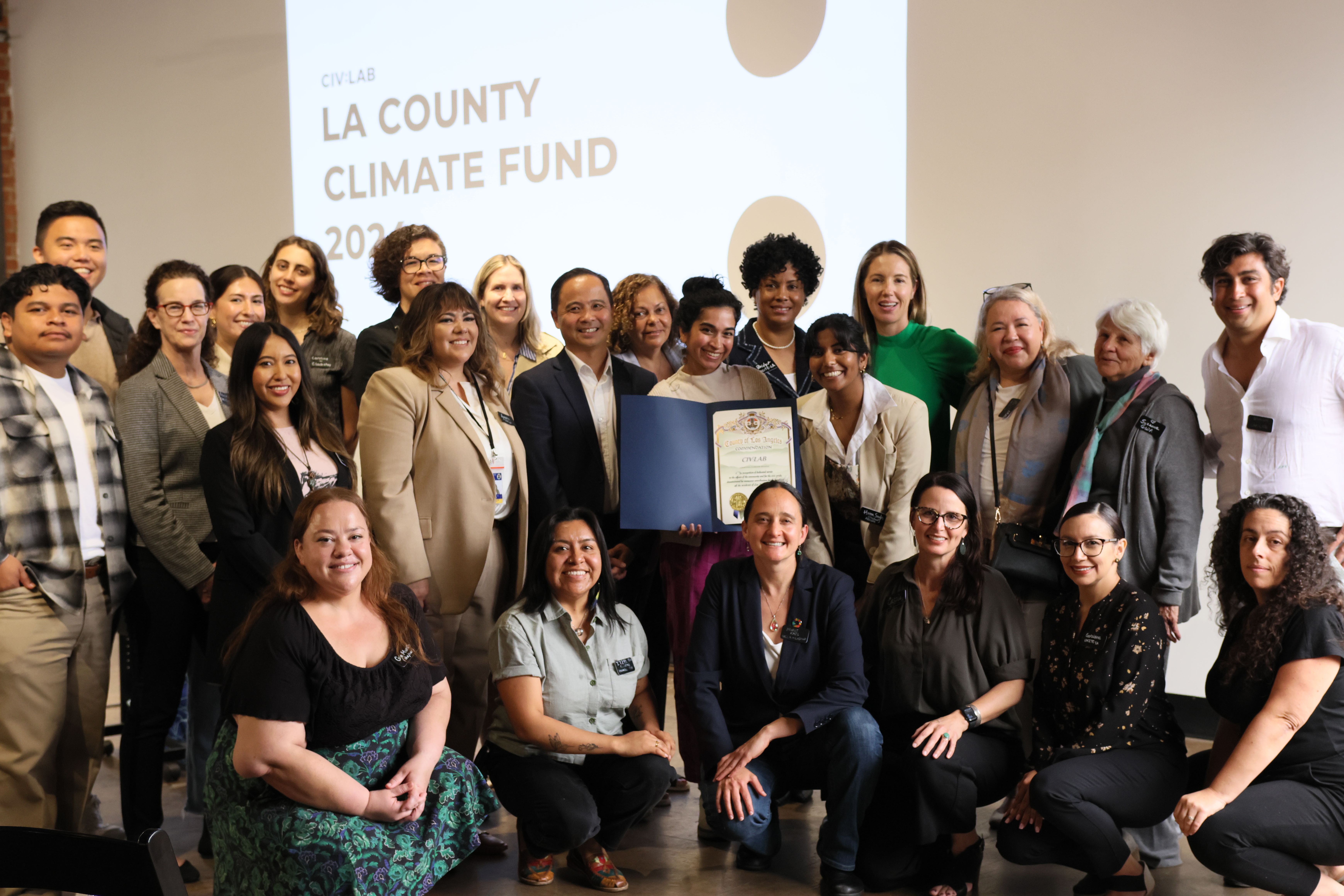
CIV:LAB is a nonprofit organization that believes collaboration is essential to social and economic change. We are committed to advancing climate action grounded in equitable, participatory processes. We have piloted place-based grantmaking Climate Funds in New York City, Michigan and Los Angeles County, distributing $1.5 million in unrestricted grants to 24 organizations working across climate education, workforce development and technology.
Our findings highlight the importance of pairing global climate finance with participatory funding that addresses climate change at the local level and nurtures solutions grown from community wisdom and experience. Here are a few lessons:
Meaningful climate action happens at the local level
Less than 10% of global climate finance targeted local-level solutions between 2003 and 2016, and only 17% of adaptation finance aimed to build local resilience between 2017 and 2021.
CIV:LAB is working to close that gap. We piloted a place-based grantmaking vehicle in New York City and Michigan in 2022, and expanded it to LA County in 2024. In two years of grantmaking across these locations, CIV:LAB funded a diverse range of projects and organizations focused on community-driven climate mitigation and adaptation.
This approach presented a rare opportunity for local organizations that are usually shut out of bigger funding opportunities. In Michigan – where we have adopted a statewide approach – the Climate Fund is distinct in offering funding for under-resourced areas like Flint and Dearborn. Similarly, community input influenced our decision to fund LA County, given the range in socioeconomic and geographic contexts that influence each of its 88 incorporated cities and more than 100 unincorporated areas.
Broadly, CIV:LAB grantees engage in local activities that prepare communities to respond to both the climate crisis as well as the new economy and technologies that it has ushered in.
Centering the community in programs like hyperlocal air quality monitoring in Dearborn and across LA County (e.g. JustAir, SmartAirLA), community climate education and advocacy in frontline neighborhoods (e.g. South Bronx Unite, UNITE-LA) or green workforce development programs prioritizing individuals from underserved communities (e.g. RETI Center, Greener Way Associates, We Want Green Too) has a trickle-up effect on future municipal policies and provides demonstrable solutions that can be adapted to other locales.
These programs – grounded in community empowerment and literacy – are runways for larger-scale climate outcomes such as climate policy advocacy, a growing climate workforce, and improved governance through community involvement.
Shifting power
A stark reality of the climate funding landscape is the distance between funders and the climate realities on the ground. Yet, the success of a climate initiative or technology – beyond its empirical viability – hinges on the broader socioeconomic context in which it will function. Will the community be receptive to the solution or technology? What are potential harms it could cause, however unintentional? Are there barriers to participation or usage?
We believe that community wisdom and expertise must be centered in decision-making processes in order to fund impactful solutions. For this reason, we convene place-specific Advisory Committees composed of climate community, industry leaders and experts to make final funding decisions. Committee members represent climate advocacy and environmental justice organizations, climate technology firms, city governments, philanthropies, venture capital funds, and academic institutions. Our Advisory Committees have prioritized organizations whose leadership represented the communities they served and who had partnerships in the communities that would ensure successful implementation.
Trust – and unrestricted funding
Unrestricted funding for salaries and overheads is critical, but far from the norm in philanthropy, making up only 20% of grant funding from foundations before 2020. We give out unrestricted grants through the Climate Fund, offering grantee organizations the ability to fund things such as salaries, office space, healthcare access, wraparound services, meals, and travel stipends. Unrestricted grants also provide the flexibility for grantees to experiment, pivot, and cultivate partnerships.
We anticipated many benefits of unrestricted funding when we created the Climate Fund. What we didn’t foresee was its role in helping some organizations strategically expand their activities or business models in response to changing climate and economic landscapes. A lot can change between submitting a proposal for funding and submitting an annual grant report, and it’s essential that as funders we recognize and make space for that in our own funding models.
Questions that drive us forward
We continue to learn from our first year of administering the Climate Fund, both in terms of the value of the model as well as the challenges that come with it. For example, a funding model that exists outside the status quo yields data that doesn’t conform to normative KPIs. We knew that the breadth of action of our funding areas, along with the unrestricted nature of the grants, meant an equally broad set of impact reporting results. Thus, the dilemma as regrantors: do we implement more standardized reporting processes that yield homogenous data, or do we try to introduce a different style of impact storytelling to our funders? (We tried the latter in our impact report.) Moreover, it’s clear that true impact isn’t achieved within just one year of funding. Multi-year grants are important in terms of seeing actual progress and evolution of climate solutions.
We are thinking about how the Climate Fund model can evolve for the next phase of grantmaking. We’re reexamining every stage from an equity lens, starting with the RFP (as many small organizations can’t afford a grant writer) and extending to our internal deliberation process. We are reflecting on our own role as an intermediary funder, asking questions like:
- What responsibilities must we take on in the stead of organizations closer to the ground?
- When is it important for us to step back and trust people on the ground to do their jobs?
- What processes must we change to make it easier for organizations doing the work to do so quickly and efficiently?
- Where can we provide technical support and supplement operational capacity that smaller organizations don’t have?
As a funder, change starts with how we distribute money and it lives on in the calculus of trust and power that exists between us and our grantee organizations. That change is happening, and with continued commitment to community-led solutions, we can build the momentum needed to address the climate crisis.
Vijayta Narang is program director and fund manager at CIV:LAB.